
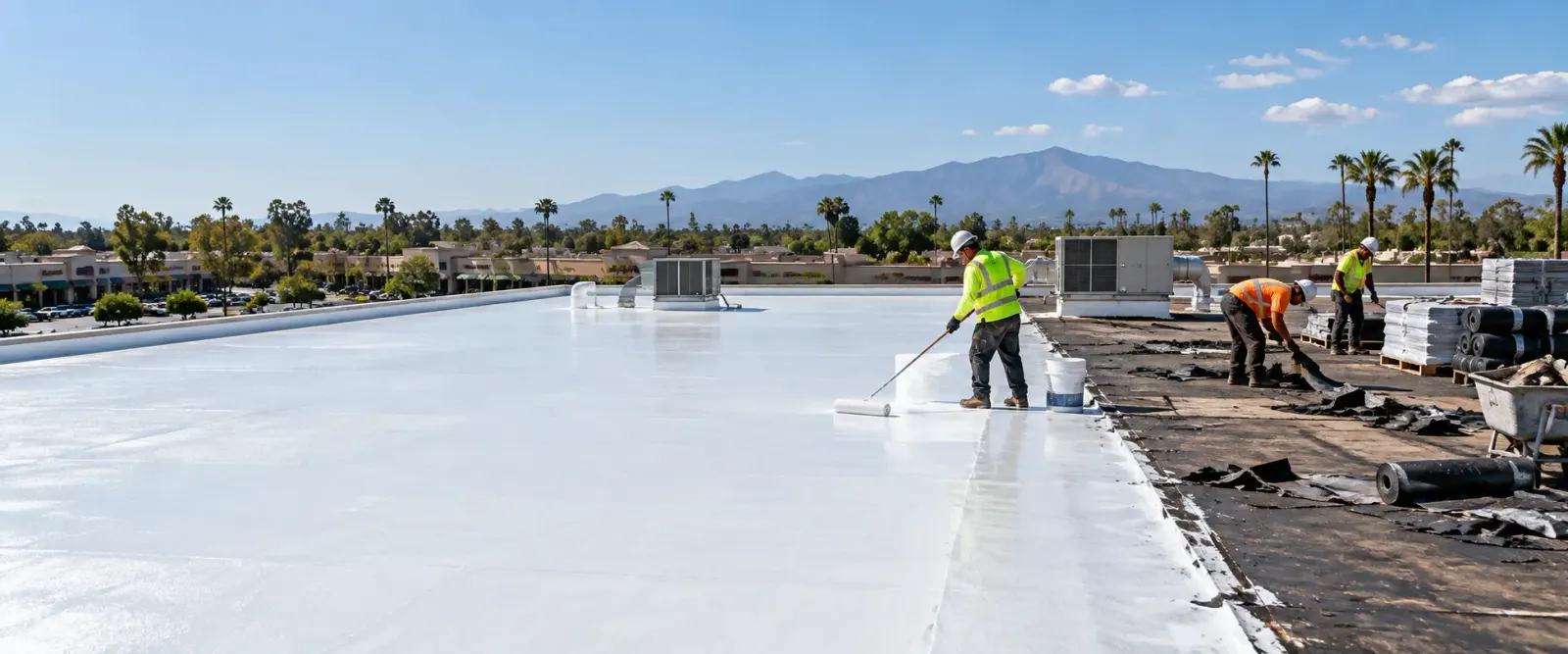
1. What a coating actually does
A coating is a new surface on an existing roof, not a new roof. It renews the weather surface, seals seams and detail work, and reflects heat. What it does not do is replace saturated insulation, fix a deck problem, correct drainage that never worked, or reset the roof's service life to that of a new system.
The test is what sits beneath. Where the membrane is sound, the insulation dry and the drains working, a coating buys years of service at a fraction of the disruption. Where any of those three is untrue, the coating locks the problem in and tenant ceilings keep staining.
2. Title 24 turns recoating into a code event
This is the part that surprises owners: California's energy code treats recoating the same way it treats a replacement once the work is large enough. Under Title 24, Part 6, section 141.0(b)2Bi, re-roofing that covers replacements, recovering or recoating on a nonresidential low-slope roof is caught where more than 50 percent of the roof area, or more than 2,000 square feet of roof, whichever is less, is being altered.
Where it is caught, the roofing product has to meet section 140.3(a)1A: a minimum three-year aged solar reflectance of 0.63, a minimum thermal emittance of 0.75 and a minimum Solar Reflectance Index of 75, in all climate zones, as set out in the CRRC's chart of the Energy Commission's 2022 Title 24, Part 6 cool roof requirements.
Three exceptions are worth knowing. An aged solar reflectance below 0.63 is allowed where the maximum roof or ceiling U-factor in Table 141.0-B is not exceeded; roof area under building integrated photovoltaic or solar thermal panels is excluded; and so are roof constructions weighing at least 25 pounds per square foot.
A 4,000 square foot strip center roof passes the 2,000 square foot trigger before it passes the 50 percent trigger. On most centers, any meaningful coating project is a code project.
3. The product has to be rated, and defaults are punishing
Compliance runs on rated products, not on a datasheet claim. Under sections 10-113(a) and 10-113(b), every roofing product installed to take compliance credit or to meet the prescriptive reflectance and emittance requirements carries a visible packaging label listing emittance and both initial and three-year aged solar reflectance, and is rated by the Cool Roof Rating Council under the CRRC-1 program.
Where a product is not certified, the code assumes the worst. The default values are an aged solar reflectance of 0.08 and thermal emittance of 0.75 for asphalt shingles, and 0.10 and 0.75 for all other roofing products. An uncertified coating therefore fails the prescriptive path on paper regardless of how it performs in the sun, which is a documentation problem rather than a product problem, and it is caught at inspection.
4. Wet insulation decides the question
Before comparing prices, find out whether the insulation is wet, and where. On a center that has been patched for years, saturation is usually local: around drains, at curbs and penetrations, along a seam that opened under wind. A survey that locates the wet area lets a coating proposal be honest, because the wet sections are cut out and replaced first, and the coating goes over a dry assembly.
What to ask for in the survey
A marked-up roof plan showing the wet areas, core samples or readings that support it, and a scope that separates the replacement of wet material from the coating itself. Two bids can only be compared when both are priced against the same survey.
When replacement is the cheaper answer
Where the survey finds saturation across a large share of the roof, coating over it buys a year or two and then pays for the tear-off anyway, with the tenant disruption arriving twice. A replacement also resets insulation performance, which is where the energy saving actually comes from on a Valley roof.
5. Strip center roofs have their own failure pattern
The roof over a multi-tenant center is not one roof, it is a shared surface with many owners of the problem. Restaurant tenants add grease-laden exhaust that degrades some membranes and coatings faster around the hood discharge. Phone and internet contractors, HVAC technicians and sign fitters all walk the roof, and the damage shows up as punctures at the traffic routes rather than at the field.
Work on an occupied center is planned around trading hours and roof access, and roof work in California sits under Cal/OSHA's roof hazards standard, Title 8 section 1730, which sets fall protection by roof slope on structures over 20 feet. That is why edge protection belongs in the bid rather than in extras.
Drains and scuppers are the other constant. Where summer debris blocks them, the first heavy storm ponds water at the low points, and ponding over a seam pushes water under the membrane into a tenant ceiling. Any scope worth signing includes the drains, the walkway routes and the flashing at equipment curbs, not just the field of the roof.
6. Timing the work in the Central Valley
The Valley gives a long dry window and then closes it hard. NOAA's 1991 to 2020 climate normals for the Modesto City-County Airport station put January at 2.57 inches of rain, February at 2.22 and March at 1.78, against 0.15 in June and almost none from July through September, when the normal high reaches 95 degrees. Of the 12.27 inch annual normal, 9.85 inches fall between November and March. That is the shape of the roofing year here: a dry season long enough to plan work into, and a short autumn window before the first storms.
The practical consequence is scheduling, not preference. Work that has to be dry to cure belongs well clear of the first storms, and drain clearing belongs before them. A center that waits until November to decide between coating and replacement usually gets neither, and gets patching instead. What either scope looks like in practice is on the commercial roofing page, and what an emergency looks like when a roof fails mid-storm is on the storm damage and board-up page.
7. Coating vs replacement: comparing two bids honestly
Put both bids against the same three things: the survey, the code path and the warranty. The survey settles how much wet material is being removed. The code path settles which products qualify and what documentation the inspector will want. The warranty settles who carries the risk and for how long, and whether it covers labour and material or material alone.
File the same three answers per building, so the next owner is not re-buying the survey. Managers running several centers can see how that is kept on the page for property managers.
Questions
If water is still flowing, stop it and start mitigation; most policies require you to prevent further damage and cover reasonable emergency mitigation. Notify the carrier the same day. The file opened on arrival is what the adjuster reviews.
It depends on the master policy type and the CC&Rs. Bare-walls policies stop at the unit boundary; all-in policies include fixtures. The moisture map showing where water travelled is what the association and the unit owner's carriers use to allocate the loss.
Only with a backup or sump endorsement, which is optional on most commercial and HOA policies. Check the declarations page. Category 3 cleanup is scoped the same way either way; the endorsement decides who pays.

