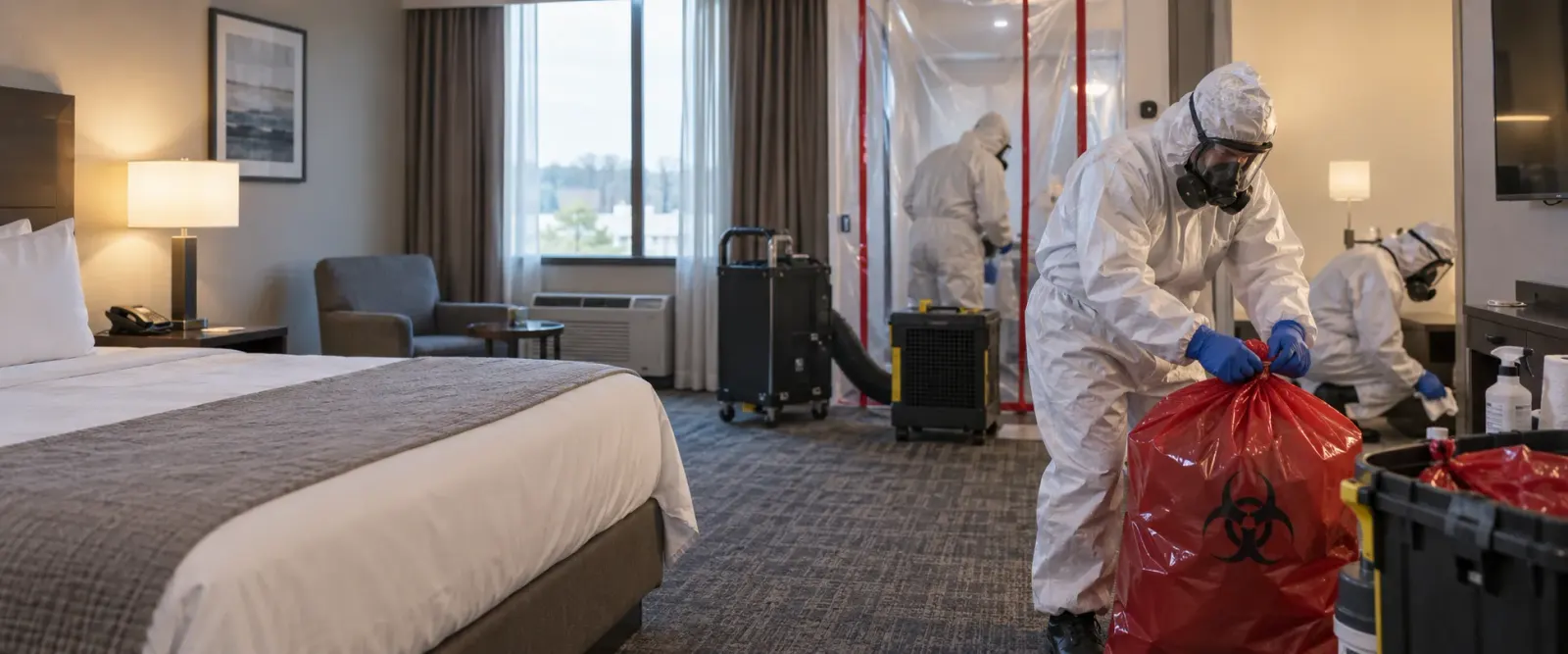
What biohazard cleanup covers, and when a property manager needs it
Biohazard cleanup is the removal of blood, body fluids and associated residues from a building, the decontamination of every surface they reached, and the lawful disposal of what comes out. The work follows ANSI/IICRC S540, the trauma and crime scene standard, whose twelve components run from inspection and preliminary determination through structural, contents and vehicle remediation to confirmation of cleaning. Timing is fixed by statute at the disposal end: Health and Safety Code section 118321.5 requires the waste to leave the scene immediately once the removal phase is finished.
A property manager needs it when a tenant dies alone and is found late, when a hoarded unit turns up sharps, rodent nests and soiled bedding, when needles are found in a vacated apartment, a public restroom or a landscaped bed, when a guest room incident happens with the rooms either side still occupied, when an injury on a warehouse slab reaches racking and machinery, or when a sewage, grease-line or septic backup puts human waste across a floor. This page covers all of them, and a crew can be requested in any of the 32 cities served.
The cleanup is carried out by a licensed and insured contractor assigned to the request, working under Cal/OSHA's bloodborne pathogens order. The same record comes out of every job: a scene log of what was contained, removed, bagged and disinfected, and S540's confirmation of cleaning.
Biohazard cleanup sub-services available across the Central Valley
Why biohazard cleanup is needed in Central Valley buildings
A death that goes unnoticed in a rental does not stay on the surface. Fluids pass through carpet and pad into the subfloor below, and Cal/OSHA's bloodborne pathogens order counts porous material as regulated waste once it is saturated or caked and could release blood or other potentially infectious materials when it is handled. Saturated material is cut out and bagged.
Cleanup starts only after the scene has been released. ANSI/IICRC S540 assumes law enforcement or a regulatory agency has released every scene before the work begins, so the first call belongs to the police, sheriff or coroner. Once release is given, the crew makes the inspection and preliminary determination the standard opens with, and scopes from that.
A hoarded unit is a sanitation problem before it is a volume problem. Health and Safety Code section 17920.3 lists rodent infestation determined by a health officer, inadequate rubbish removal and accumulations of debris and rodent harborages among the conditions that make a building substandard. Droppings and nests are wetted and wiped by the CDC method, never swept or vacuumed.
Needles turn up where they are least expected, and they cannot be binned. Vacated apartments, public restrooms, landscaped beds and HOA common areas all produce them, and in a multifamily building they are home-generated sharps. Health and Safety Code section 118286 keeps them out of the containers a property already has on site, so the clear-out roll-off is not an option.
After a sewage backup, pumping the water out is only half the job. Wet months drive surcharge backups in the Central Valley: Modesto's 1991 to 2020 normals put 2.57 inches in January, 2.22 in February and 2.21 in December against nothing at all in July. Human waste stays on every surface the water reached, and that sanitation is this trade's, while extraction and drying belong to water damage restoration.
How biohazard cleanup is delivered
Emergency requests are taken 24 hours a day and acknowledged with a reference number. The arrival window depends on the city, and the table further down this page carries the window for each of the 32. Nothing is touched before the crew is on site.
S540 assumes every scene has been released by law enforcement or a regulatory agency, so release is confirmed first. Then comes the inspection and preliminary determination: what is affected, which materials count as regulated waste, and who in a shared building is kept away.
Universal precautions apply from the door: all human blood is treated as infectious. PPE keeps it off skin, eyes and clothing, and respirators are worn under a written 5144 program.
Saturated and caked porous materials leave as regulated waste, sharps go into rigid containers, broken glass is lifted with tongs, and bags are labelled BIOHAZARDOUS WASTE.
Every surface the contamination reached is decontaminated with an appropriate disinfectant from the EPA's List S for bloodborne pathogens, held wet for the contact time on its label. Rodent areas follow the CDC method: ventilate for 30 minutes, wet the droppings, wipe them up.
Waste leaves the scene immediately once the removal phase is finished, for a permitted medical waste transfer station or treatment facility, or a dedicated freezer for not more than 14 days.
The job closes on S540's confirmation of cleaning. The scene log goes to the client area: what was released, what was contained, what was removed and labelled, and what was disinfected. Replacing flooring, subfloor and drywall passes to restoration and reconstruction under the same file.
What you receive on every scene
The file is built so the owner, manager or board can judge whether the cleanup was done properly, the purpose of CDPH's trauma scene information sheet.
Biohazard cleanup by city
Each city page sets out the buildings biohazard cleanup is called to there, the response window from Modesto and the sub-services most often requested. Modesto is the hub, and its page runs area by area across the city.
Biohazard cleanup questions from Central Valley property owners
Yes. ANSI/IICRC S540, the standard this work follows, assumes that all scenes have been released by law enforcement or regulatory agencies before cleanup begins. In practice that means the police, sheriff or coroner finishes at the property first, and the crew is scheduled around that release. Until it comes, the area is left closed and no material is moved.
Under Civil Code 1710.2, the duty turns on time. Where a death on the property happened more than three years before the offer to purchase, lease or rent, an owner or agent is not required to raise it, and the section counts a renter as a transferee. The exemption does not cover an intentional misrepresentation in answer to a direct inquiry. The statute sets the rule; nothing here is legal advice.
No. Section 118286 of the Health and Safety Code keeps home-generated sharps out of trash, recycling and green waste containers and out of any roll-off, and section 117671 brings a multifamily residence inside that definition. Needles go into a rigid, puncture-resistant, leakproof container and travel in it to a household hazardous waste facility, a sharps consolidation point or a medical waste generator's facility.
No, and the two run in sequence. Hoarding cleanup is the sanitation side: sharps among the contents, human and animal waste, rodent droppings and nests, and porous items too soiled to keep. Volume removal, sorting and hauling sit with junk removal, and that work is safe to start once the biohazards are out. A hoarded unit usually needs both.
Both, and the two halves are scoped separately. The human-waste sanitation side is this trade's sewage backup biohazard cleanup: cleaning and disinfecting every surface the backup reached, in the PPE the CDC describes for handling human waste. Extraction of the water and drying of the structure belong to sewage and Category 3 cleanup under water damage restoration. A grease-line or septic backup usually needs both.
No figure is quoted on this page. What drives cost is the size of the area affected, how far fluids reached into porous materials and structure, how much has to leave as regulated waste, and whether contents, machinery or a vehicle are part of the scene. Emergency work is scoped for approval, and planned work comes as a written line-item scope before anything starts.
Health and Safety Code section 118321.5 requires trauma scene waste to leave the scene immediately once the removal phase is complete, and to go to a permitted medical waste transfer station or treatment facility. The alternative the section allows is a dedicated freezer at the business location for not more than 14 days. A county household hazardous waste site is not one of those destinations.
Related services after a biohazard cleanup
Guides on documenting losses


Emergency biohazard cleanup response windows from Modesto
Typical time from dispatch to a crew on site, 24 hours a day, by road from the Modesto base. Fog in December and January and harvest truck traffic on Highway 99 and Highway 132 can add 15 to 30 minutes.
Windows are planning figures from the fulfilling contractor's dispatch records and are confirmed with a time when the request is acknowledged. [CLIENT to confirm]

