What commercial roofing covers, and when a property manager needs it
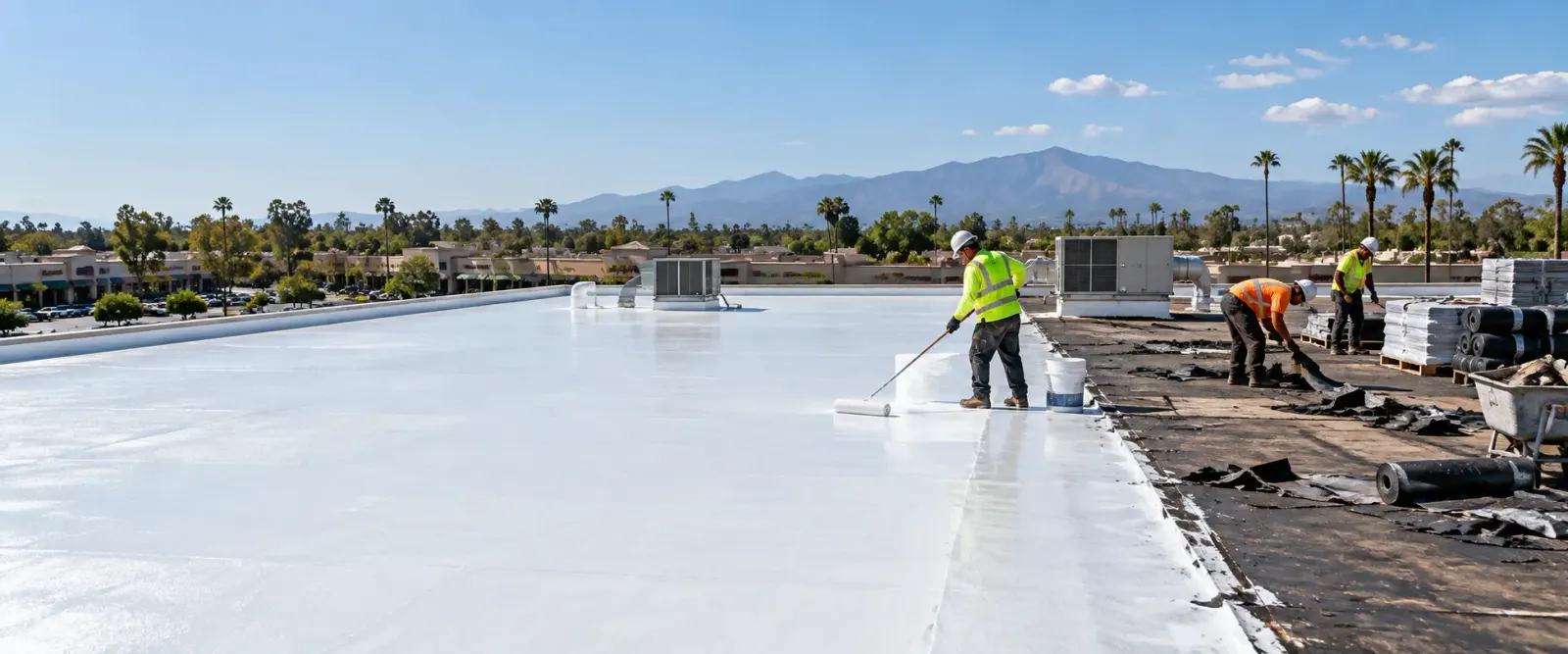
Commercial roofing on a low-slope building is the repair, recovering, recoating or replacement of the roof assembly, together with the flashings, drains and scuppers that carry water off it. Reroofing work follows Chapter 15 of the California Building Code, which sets the materials and methods, what may be covered over and what has to come off first. Timing matters because the wet season arrives as one band: an opening found in October is a detail, and the same opening in January is a tenant ceiling.
A property manager needs it when summer debris blocks a drain and the first heavy storm ponds at a low point and pushes water under a seam, when winter wind lifts single-ply seams or edge metal on a tilt-up and wets a wide stretch of insulation before anything shows inside, when restaurant exhaust has worked on the membrane around a hood curb, when a sign or HVAC trade has punctured the roof along its walking route, or when the original roofs over an HOA's common buildings reach replacement age together. All of that is scoped here, in any of the 32 cities.
The work is carried out by the licensed and insured contractor assigned to the request, identified to the customer at assignment. Every job produces the same record: the survey, a roof plan marked with what was found, a written line-item estimate and photographs at handover.
Commercial roofing sub-services available across the Central Valley
Why commercial roofing is needed in Central Valley buildings
The rain arrives in one band, and the roof meets it after seven dry months. The 1991-2020 normals for Modesto City-County Airport give 12.27 inches a year, with November at 1.07 inches rising to 2.57 in January, and under an inch a month from May to September. Seven months of debris collects on the roof, and the first storm is what finds it.
Ponding starts at a blocked outlet, not at a worn membrane. Strip centers and retail pads sit behind parapet walls that hold water in, and a parapet with no secondary drain or scupper entraps it when the primary outlet backs up. Water then stands at the low points until it finds a seam, and the tenant ceiling below stains before anyone has been on the roof.
On a large-span roof, one open seam wets a lot of insulation before anything shows inside. Winter wind lifts single-ply seams and edge metal on tilt-up warehouses, food processing plants and cold stores, and rooftop units and refrigeration curbs concentrate the flashing failures. Skylights on those roofs are a hazard of their own: anyone working within 6 feet of one is protected under Title 8 section 3212.
Downtown masonry buildings reach the point where covering over is no longer allowed. Flat roofs behind parapets have often been recovered more than once, and no further recover is permitted where two or more applications are already on the deck, so the next job is a tear-off. Parapet counterflashing and old cast-iron drain outlets are where the leaks start, and neither is reinstalled once it is rusted or deteriorated.
Past a threshold, re-roofing becomes an energy-code event. Where more than 50 percent of the roof area or more than 2,000 square feet of roof, whichever is less, is being altered, the product used has to reach a 3-year aged solar reflectance of 0.63, thermal emittance of 0.75 and SRI 75 in every climate zone. That applies to recoating and recovering as well as replacement.
How commercial roofing is delivered
A request is acknowledged with a reference number, and the site visit is arranged with the contractor assigned to it. Nothing is priced from a photograph: someone gets on the roof, because what sits under the membrane decides which of these services the building needs.
The roof plan is marked with drains, scuppers, seams, curbs, penetrations and wet areas, supported by moisture readings or core samples. That survey is what a coating estimate and a replacement estimate are both priced against. Owners look from ground level only.
Repair, recover or replacement is settled under Chapter 15: how much roof area is being altered, and how many coverings already sit on the deck. The assigned contractor pulls the permit.
The estimate comes back as line items, wet-material removal separate from the new surface, and says whether the price is fixed or subject to what is found.
Work is set around the trading hours of the tenants below and around the dry months, May to September, when normal rainfall stays under an inch. Edge protection and warning lines go up to the Title 8 roof rules, and skylights are protected first.
Drains and scuppers are cleared, flashings are rebuilt to the manufacturer's instructions, and aggregate off an existing built-up roof is not put back. No tenant is left under an open roof overnight.
The final inspection sign-off is recorded where the permit calls for one, and the product's rating label goes into the file where the energy code applies. Photographs, the warranty terms and the marked survey stay on the property file for the next inspection.
What you receive on every roof
The file is built so an owner, board or manager can see what was found on the roof, what was done about it and what the assembly needs next.
Commercial roofing by city
Each city page covers the roofs that fail in that city, the stock and districts they sit on, the permit authority for a re-roof and the sub-services most asked for. Modesto is the hub, with a section on each of its areas.
Commercial roofing questions from Central Valley property owners
The survey answers it. A coating renews the weather surface of a roof that is already sound: it seals the seams and the detail work and reflects heat. What it does not do is replace saturated insulation, correct a deck problem or fix drainage that never worked. Where the insulation is wet the two are not alternatives, and the code allows no recover over a roof deteriorated past being an adequate base.
Past a threshold, yes. The re-roofing section of the energy code reaches nonresidential low-slope work where more than 50 percent of the roof area or more than 2,000 square feet, whichever is less, is being altered, and recoating counts as an alteration alongside recovering and replacement. Above that line the product has to meet the cool-roof values. Exceptions cover a U-factor alternative, roof area under solar panels, and constructions of at least 25 pounds per square foot.
Often, but not always. A new protective coating is allowed over an existing coating, metal roof panel, built-up roof, spray polyurethane foam, metal shingles, mineral-surfaced roll roofing, modified bitumen or single-ply membrane without tearing off. It is not allowed where the existing roof is water-soaked or deteriorated past being an adequate base, where the covering is slate, clay, cement or asbestos-cement tile, or where two or more coverings already sit on the deck.
The most common recommendation is twice a year, in the fall and spring, with additional inspections after a major weather event. It is a recommendation and not a rule, and the published guidance behind it is not written specifically for low-slope commercial roofs. In Valley terms it puts one visit in March or April, after the wet months, and one in September or October, before November. Owners look from ground level only.
Usually. The work happens above the tenants rather than inside their suites, so the constraints are access, noise and anything under the work area that has to be shut down or covered. Trading hours, delivery times and quiet hours set the day's plan, and warning lines and skylight protection go in before anyone is near an edge or a rooflight. Hotels, medical suites and schools are staged around occupancy or a break schedule.
Not this page first. An opening letting water in during a storm is made safe before anything else: temporary cover belongs to storm damage and board-up, and the wet ceilings, insulation and flooring underneath belong to water damage restoration. The permanent roof work is surveyed and scoped here once the building is secure, and the two files carry the same reference.
New low-slope work is designed to a slope of not less than 1/4 unit vertical in 12 units horizontal, with coal-tar built-up roofs at 1/8 in 12. Reroofing is treated differently: where an existing low-slope roof has positive drainage and meets the structural provisions for ponding and rain loads, a replacement or recover need not be brought up to that minimum, and no new secondary drains or scuppers are required on the same condition.
Related services around the roof
Guides on flat roofs
Service area from the Modesto base
Typical time from the Modesto base to a property in each city, by road, when a site visit is booked. Fog in December and January and harvest truck traffic on Highway 99 and Highway 132 can add 15 to 30 minutes.
Windows are planning figures from the fulfilling contractor's dispatch records and are confirmed with a time when the request is acknowledged. [CLIENT to confirm]

