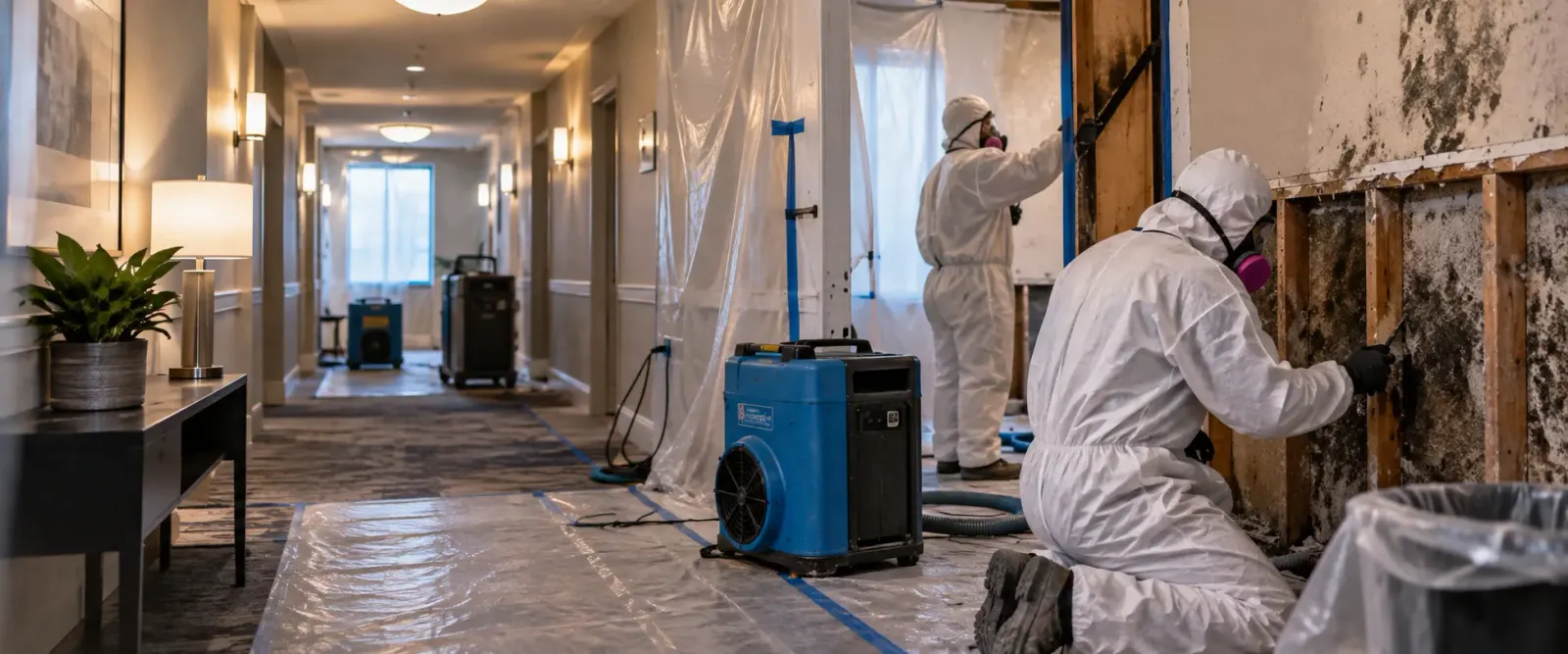
What mold remediation covers, and when a property manager needs it
Mold remediation is the correction of the water that fed the growth, the removal of material that cannot be saved, and the cleaning of what stays, performed to the ANSI/IICRC S520 standard for professional mold remediation, now in its 2024 fourth edition. Time matters because moisture decides the outcome: material left wet past the EPA response window stops being material that can be dried and becomes material that is measured, bagged inside the containment and carried out.
A property manager needs it when a tenant reports a musty smell in a pre-1970s unit, when a low-slope retail roof wets the tops of ceiling tiles above a tenant suite, when a condensate drain pan and a porous duct liner start feeding growth through an office or a school, when vinyl wallcovering traps moisture in the drywall of a hotel corridor, when condensation forms on cold surfaces in a tilt-up warehouse or cold store, or when drywall and carpet from a water loss were never dried in time. This page covers them, and a crew can be requested in any of the 32 cities.
Remediation is carried out by the licensed and insured contractor assigned to the request, identified to the customer at assignment. Every job produces the same record: the moisture source and its correction, the measured area, containment photographs, daily readings and the clearance check.
Mold sub-services available across the Central Valley
Why mold happens in Central Valley buildings
Valley rain arrives in one five-month band, so a leak that opens in November has no dry spell to recover in. The 1991-2020 normals for Modesto City-County Airport put 9.85 of the year's 12.27 inches between November and March, and EPA's water damage table asks for a response within 24 to 48 hours to prevent mold growth.
In the Valley's older rental stock, mold is reported as a smell long before it is seen. Slow supply and waste leaks under kitchen and bathroom sinks keep a wall cavity wet for weeks with nothing showing in the room. Civil Code 1941.7 provides that the duty to repair mold does not arise until the lessor has notice.
On low-slope commercial roofs the growth starts where nobody looks. A roof leak wets the tops of ceiling tiles and the roof materials above them, which the EPA guide for schools and commercial buildings lists among the places hidden mold is found. Where that ceiling space is used as return air, the growth sits in the air path and containment goes up to the deck.
Cooling season moves the moisture indoors. Condensate drain pans and porous duct liners grow mold in offices and schools with no leak at all, and EPA names portable classrooms as a problem of their own. In tilt-up warehouses and cold storage it is condensation on cold surfaces and refrigeration lines; in hotels, vinyl wallcovering holds moisture in the drywall behind it.
Moisture is the limiting factor, which is why drainage decides where growth shows up in tract housing. The California Department of Public Health states that the presence or lack of moisture generally is what allows or limits mold growth. On slab tracts the first signs are behind baseboards and garage walls; on raised foundations, damp exposed dirt in the crawl space wets joists and subfloor.
How mold remediation is delivered
Emergency requests are taken 24 hours a day, and the arrival window for each of the 32 cities is listed further down this page. The request is acknowledged with a reference number, and the time is confirmed when the crew is assigned.
Nothing is removed while the water feeding the growth is still running. EPA requires that the water or moisture problem be completely fixed first. Roofs, plumbing, drainage and condensate are traced in that order, and the finding goes in the file.
Square footage sets the method. EPA Table 2 gives three bands: under 10 square feet, 10 to 100, and over 100 or where exposure during the work could be significant.
Sheeting is sized to the band, one layer at medium and two with an airlock above 100 square feet. Respirators run under a Cal/OSHA 5144 program.
The four EPA methods do the work: wet vacuum, damp wipe, HEPA vacuum once dry, and discard. Porous material past saving is bagged inside containment. Biocides are not routine: cleaning up the contamination is the point, and dead mold is still allergenic.
Materials are read with a moisture meter before anything is closed up, the instrument EPA cites for use following water damage, and every reading goes into the daily log that travels with the file.
Clearance follows the EPA completion criteria: the moisture fixed, no visible mold or mold-damaged material, no moldy odor, a revisit showing no new growth and occupants back without complaint. S520 post-remediation verification closes the file, and rebuilding passes to restoration and reconstruction under the same record.
What the mold remediation file contains
The file is built to show that the moisture source was corrected and the EPA finish criteria were met, so an owner, board or adjuster can sign off.
Mold remediation by city
Every city page is written from that city's own research: its building stock, its water and drainage, its code enforcement office and its window from Modesto. Modesto is the hub, with a section on each of its seventeen areas.
Mold remediation questions from Central Valley property owners
Three sources put the window three ways, each in its own words. EPA's water damage table calls for a response within 24 to 48 hours to prevent mold growth. EPA's prevention guidance says to clean and dry wet or damp spots within 48 hours. The CDPH code enforcement fact sheet says materials that cannot be thoroughly dried within a day should be replaced.
EPA Table 2 puts an area under 10 square feet in the smallest band, where no containment is required and the minimum protection is an N-95 respirator, gloves and goggles. CDPH suggests soap and water for small amounts and advises avoiding bleach, ammonia and vinegar. Anything larger is measured and planned before it is disturbed.
Not in how it is removed. The CDPH statement on building dampness, mold and health says the current consensus does not justify the differentiation of some molds as toxic molds, so no species changes the plan. Square footage and the material involved decide the containment, the protective equipment and whether something is cleaned or discarded.
Visible growth usually answers that by itself. EPA's position is that in most cases sampling is unnecessary where mold growth is visible, and that no EPA or other federal threshold limits have been set for mold to measure a result against. CDPH recommends against using measurements of indoor microorganisms to judge a health hazard. Where an indoor environmental professional writes a sampling plan, sampling follows that plan.
Civil Code 1941.7 provides that the obligation to repair mold does not arise until the lessor has notice. Health and Safety Code 17920.3 lists, at paragraph (a)(13), visible mold growth as determined by a health officer or a code enforcement officer, and its lead-in reaches a listed condition only where it endangers the occupants; minor mold on surfaces that collect moisture in proper use is excluded. Since January 2022 the CDPH booklet goes to prospective tenants under section 26148.
Often, yes. Containment is there to minimize the exposure of remediators and building occupants, which is why the sheeting runs under negative pressure and the supply and return vents inside it are blocked. EPA also asks that building occupants be communicated with at all stages. Hotel and apartment work is usually staged so that rooms beside the containment stay in use.
The size of the affected area and the containment that size requires. EPA Table 2 divides the work into under 10 square feet, 10 to 100, and over 100, and each band carries its own containment and protective equipment. Hidden growth found once walls are opened enlarges the total area. Planned work comes back as a written line-item scope for approval before it starts.
Related services after mold is found
Guides on losses and claims


Emergency mold response windows from Modesto
Typical time from dispatch to a crew on site, 24 hours a day, by road from the Modesto base. Fog in December and January and harvest truck traffic on Highway 99 and Highway 132 can add 15 to 30 minutes.
Windows are planning figures from the fulfilling contractor's dispatch records and are confirmed with a time when the request is acknowledged. [CLIENT to confirm]

