Why mold happens in Keyes
About 300 Keyes homes date from before 1950, and old plumbing inside their walls can leak for a long time unseen. The Census survey for 2019 to 2023 counts 83 homes from before 1940 and 217 from the 1940s, with wide margins. Even the 7th Street fire station, which its district calls 60 years old, is described as having outdated plumbing. The EPA remediation guide names the back side of drywall, wallpaper and paneling among the places hidden mold grows, and a moldy odor may be the first sign behind an old wall.
Keyes lawns take enough water that the Community Services District sees it in its sewer flows, and the same over-watering can wet a building's base. The District says flows shipped to Turlock vary through the year with rain water and lawn over-watering draining into the storm drains. The CDPH renters booklet lists outdoor surfaces that slope and drain toward a building as a moisture source. South of Keyes Road, NRCS describes the Dinuba sandy loam at TID's reservoir site as slow to take in water, with very slow runoff.
With 623 Keyes households renting, California's rules on mold in rentals reach a large share of the town. Under Health and Safety Code 17920.3(a)(13), visible mold growth, as determined by a health officer or code enforcement officer, makes a dwelling substandard where it exists to an extent that endangers the occupants, and minor mold on surfaces that normally get wet is excluded. Civil Code 1941.7 holds the landlord's repair duty back until the landlord has notice. HSC 26148 has the landlord give a prospective tenant the CDPH booklet on dampness and mold.
In a wet Keyes winter, heavy rain can return several times in a few weeks, leaving a leaking roof or wall little time to dry. At Turlock #2, the nearest normals station, the 2022-23 storms brought 1.05 inches on 27 December, 1.25 on 31 December, 1.12 on 9 January and 0.99 on 16 January. EPA Table 1 calls for a response to wet materials within 24-48 hours to prevent mold growth. Drywall or insulation under a leak that is soaked again before it dries has passed that point and becomes Table 2 work.
South of Keyes Road, storage, truck and distribution buildings line Golden State Boulevard, and in buildings like these a roof leak can go unseen. The Interstate Truck Center, FreshPoint and Top Shelf Mega Storage are built or under construction there, and at 5024-5030 Rohde Road 39,393 sq ft of mini-storage stands in 13 buildings. In a unit that stays closed, water from a roof or wall reaches stored boxes, books and papers, which EPA Table 2 treats as porous contents to be cleaned or discarded.
The County's Initial Study for 5024-5030 Rohde Road, amended in March 2024, records mini-storage, a duplex, a four-plex and an office built without the required permits. With no permit record of how the walls and roofs were built, inspection opens them to find where water enters.
Mold remediation, as delivered in Keyes
Keyes Road is the exit, 8 road miles south of the Modesto base on Highway 99. Area measurements, containment photos and clearance notes from each visit build one file.
At the Keyes Road interchange, the town's gateway, Highway 99 carries about 122,000 vehicles a day. From there the crew turns east into the residential side or west to the rail-served industrial land. Propertyvendr confirms an arrival inside the 75 to 100 minute window and runs the file.
The water behind the growth is found and stopped first. In Keyes the likely sources are old plumbing in a pre-1950 house, sprinkler water at a slab edge, a line leaking under a mobile home, or a roof leak over storage units or a truck shop.
Growth is measured, hidden areas are opened where moisture points, and EPA Table 2 sets the size at the 10 and 100 square foot lines.
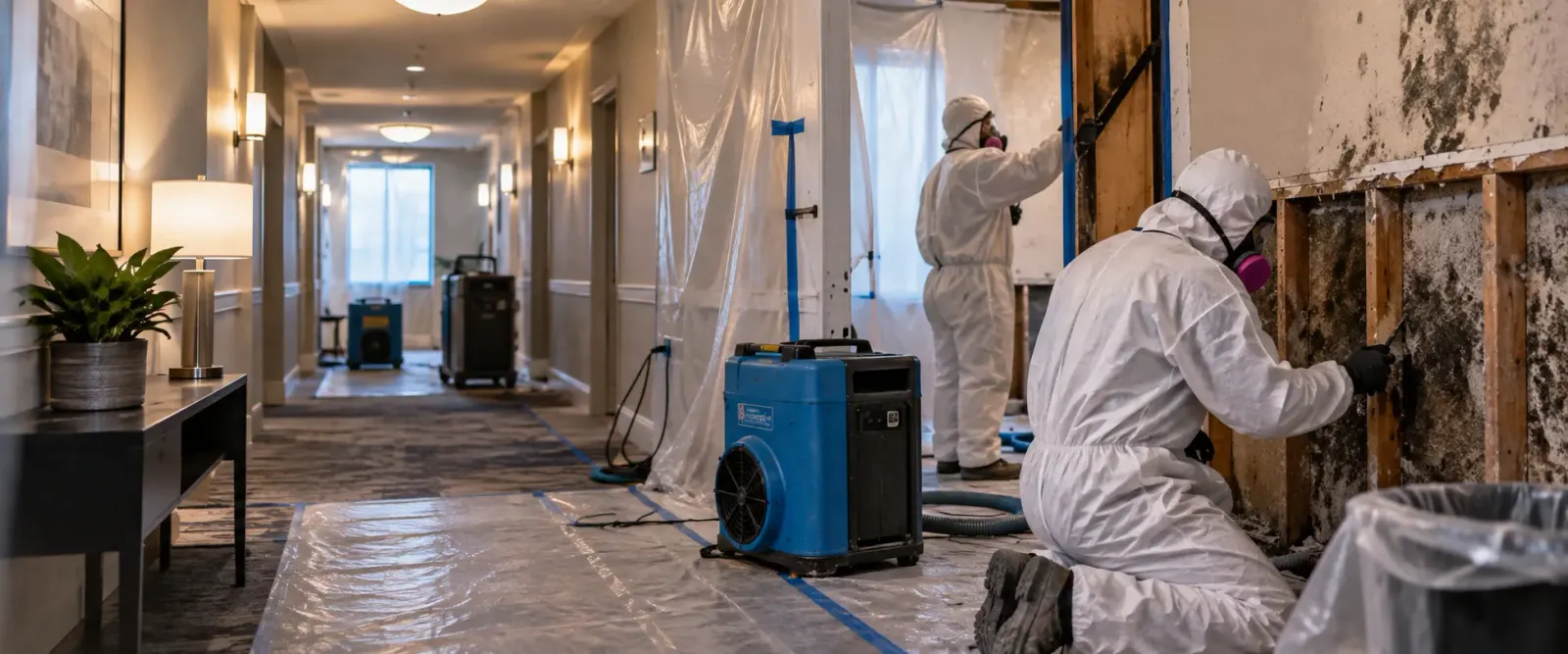
Supply and return vents close and sheeting goes up under negative pressure, doubled with an airlock for large areas. Respirators follow Cal/OSHA 5144.
Hard surfaces are wet-vacuumed or damp-wiped, porous material past saving is bagged and sealed inside containment, and dry surfaces are HEPA-vacuumed. In a Keyes storage unit, damp boxes and papers go the same way. Removal is the aim, because dead mold is still allergenic.
Meter readings on framing, subfloor and slab confirm dry before closing up, logged each day.
Clearance is recorded against the EPA criteria, with a revisit showing no new growth, and S520 verification. Any rebuild is handed to reconstruction on the same file.
Where mold happens in Keyes
Keyes splits at the SR 99 bypass: homes and tracts to the east, rail-side industry to the west, highway businesses along Golden State Boulevard.
7th Street community core
The pedestrian core of homes, shops and public buildings, with the CSD office at 5601 and the fire station at 5627, whose plumbing its district calls outdated. In older buildings a slow plumbing leak wets the wall cavity before any stain shows.
Original townsite beside the Union Pacific line
The first blocks, set at right angles to the railroad from the 1871 Keyes Switch siding. Where pre-1950 houses stand, wallpaper or paneling over a damp wall can hide growth on its back side, and it comes off inside containment.
SR 99 and Keyes Road interchange, Highway Commercial
Highway Commercial land at the gateway, where Keyes Plaza was proposed in 2023 with a 7,500 sq ft store, a 12,850 sq ft retail shell and two storm basins. If built, retail roofs over dropped ceilings would hide leaks on the tile tops.
Golden State Boulevard, Nunes Road to East Keyes Road
Planned Development 332, with a 5.23-acre truck terminal approved in 2022 that includes a 4,414 sq ft maintenance shop and a 6,500 sq ft administrative building. Office space brings air handler drain pans into the inspection.
Golden State Boulevard, East Keyes Road to Barnhart Road
The Interstate Truck Center, FreshPoint, a service station and Top Shelf Mega Storage on 65 acres of Hanford and Dinuba sandy loams in Zone X. Where lot or yard water meets a building, the wall base is where growth begins.
Rohde Road gateway and TID Upper Lateral 2½
Mini-storage in 13 buildings, a duplex, a four-plex and a house used as an office, built without the required permits, beside TID's lateral. Stored goods in a closed unit can take on mold unseen after a roof leak.
Industrial lands west of SR 99 and Foote Road
84 acres of Industrial and 40 of Planned Industrial land with heavy rail access, and the Foote Road lift station pumping wastewater to Turlock. In large industrial buildings, condensation at cold spots is a moisture source EPA names.
Norma Way, Nunes Road and Washington Road subdivisions
Newer R-1 tracts on 5,000 sq ft lots, among them Keyes 19 North and Keyes 19 South, part of the town's 2010s growth. In houses this new, mold starts at a sprinkler-soaked slab edge or a backed-up condensate line.
Anna Avenue, Grace Avenue and 10th Street
The County's multifamily zoning along Anna Avenue, its example area for rezoning, and the cross streets of the 2008 storm drain project. In a rental here, a tenant's written notice of mold starts the landlord's repair duty.
Hatch Park, Maud Avenue and Lucinda Avenue civic blocks
Hatch Park, the County library at 4420 Maud Avenue and a 6,000 sq ft community center on Lucinda Avenue the County applied to renovate in 2025. Moldy books and papers are cleaned by Table 2 methods or packed out.
Mobile home parks on the district edge
Parks running their own sewer and water, one of them north of TID's Upper Lateral 2½, with District water through a master meter. A park line leaking under a coach dampens the floor from beneath, so the coach is inspected from below.
East Keyes Road farm edge and the Ceres Main Canal
Almond land along TID's Ceres Main Canal, where TID built its regulating reservoir in 2023 on Dinuba sandy loam. Farm buildings on wells and septic here are checked where yard drainage runs toward their walls.
Mold sub-services available in Keyes
Questions from Keyes property owners and managers
The Stanislaus County Building Permits Division, 1010 10th Street, Suite 3400, Modesto. The County requires a permit for rebuilding or remodeling existing structures and issues it to the owner or to the assigned contractor. The Keyes Community Services District has no land use authority. The County enforces flood zone rules through the building permit and decides whether a soils report is needed, and walls close only after clearance.
In the pre-1950 houses it starts behind old walls, paneling and wallpaper where plumbing has leaked unseen. In the 2010s tracts off Norma Way and Washington Road it starts at slab edges wetted by sprinklers and at condensate lines. Under mobile homes it grows on the floor above a leaking park line, and in the storage and truck buildings on Golden State Boulevard it follows roof leaks onto stored goods and ceilings.
LAFCO describes those parks as running their own on-site sewer and water, with District water delivered through a master meter, so the lines inside the park belong to the park. The leak is found and repaired first. The coach is then inspected from below, the damp decking and insulation are measured under EPA Table 2, and material that cannot be cleaned is removed inside containment.
Yes, over time. The Keyes CSD notes lawn over-watering draining into its storm drains, and CDPH counts outdoor surfaces that slope and drain toward a building as a moisture source. Water held at the slab edge wicks into the wall base, and growth shows first behind baseboards and in garage walls. Resetting the heads and fixing the grade stops the source; any growth already inside is measured and removed.
No. The California Department of Public Health says current consensus does not justify treating some molds as especially toxic, so the species does not change the method. What changes it is the size of the area and the material. A dark patch behind a pre-1950 bathroom wall is measured, contained under EPA Table 2 and removed like any other growth, and clearance follows the EPA finish criteria.
CDPH treats a moldy odor as a sign of hidden growth, so look for its source before moving boxes around. Report any roof or wall leak to the facility so the water is stopped. EPA Table 2 sorts stored items by material: hard items can be cleaned, while wet books, papers and upholstered pieces may need to be discarded. Items worth keeping can be cleaned on site or packed out.
Mold remediation near Keyes

