Why mold happens in Turlock
Under Turlock's oldest houses, damp soil in the crawl space is where mold gets its start. Turlock was laid out in 1871 as a railroad town, and its oldest homes stand near the tracks, downtown and in Crane Park, many on raised foundations with galvanized supply lines. The CDPH renters' booklet names damp, exposed dirt in crawl spaces as a mold source, and CDPH's code enforcement sheet gives a ground moisture barrier as the fix. Joists and subfloor above that soil grow mold well out of sight of the rooms above.
On table-flat ground a cloudburst puts water into many Turlock buildings at once, and each one starts its own mold clock. When two thirds of an inch fell in a single morning hour, water came over the curbs on Lander Avenue and North Olive Avenue into vehicles and houses, and Municipal Services took more than 300 calls in one storm. EPA's Table 1 asks for a response within 24-48 hours to prevent mold growth. Carpet, pad and the lower edge of drywall still wet after that become material to remove.
Around Stanislaus State, tenant turnover lets a leak under a sink grow unnoticed between one lease and the next. Apartments and converted houses from the 1960s to the 1980s line Monte Vista Avenue and Geer Road. Under Health and Safety Code 17920.3, visible mold growth, as determined by a health officer or code enforcement officer, is a substandard condition where it endangers the occupants; minor mold on surfaces that normally collect moisture is excluded. The landlord's repair duty starts once the landlord has notice.
At Monte Vista Crossings, low-slope roofs hide leaks above the ceiling tiles of national tenants. Roughly 875,000 square feet of big-box and in-line retail stands along Highway 99, and the older strip centers on Geer Road add restaurant suites under shared ceilings. EPA lists the top of ceiling tiles and the roof materials above them among hidden mold sites. Where the ceiling space is used as a return air plenum, heavy growth can reach the air handler, so containment runs floor to ceiling deck and the filters may need replacing.
West of Highway 99, cold rooms and refrigeration lines make their own water. The Westside Industrial Specific Plan area holds food processing, cold storage, distribution buildings and truck yards. EPA's building guide lists condensation at cold spots in a building among the sources of moisture that let mold grow, and in cold storage that points to refrigeration lines and chilled walls. Growth on those surfaces is measured and contained like any other, once the condensation that feeds it has been dealt with.
In one 12-hour storm Turlock recorded 2.86 inches of rain, and its storm basins came near capacity for the first time in a decade. On ground this flat the water lingers at slab edges and under raised floors, and mold follows any material left wet.
Mold remediation, as delivered in Turlock
Turlock is 12 road miles from the Modesto base, down Highway 99 or Geer Road. The same crew keeps the job from the first moisture reading to clearance, and its containment photos and logs stay in one file.
The run south is Highway 99 to Monte Vista Avenue, or Geer Road. Monte Vista Crossings and Geer Road addresses fall at the quick end of the 90 to 120 minute window, the Westside and the dairies at the slow end, and fog or harvest traffic can push any call toward two hours.
Growth returns while its water source stays, so the source is traced and stopped first. In Turlock that is often damp soil in a Crane Park crawl space, a low-slope roof at Monte Vista, storm water off Lander Avenue, or condensation in Westside cold rooms.
Growth is measured in square feet and set against EPA Table 2's small, medium and large sizes. Mold found behind walls adds to the plan's total area.
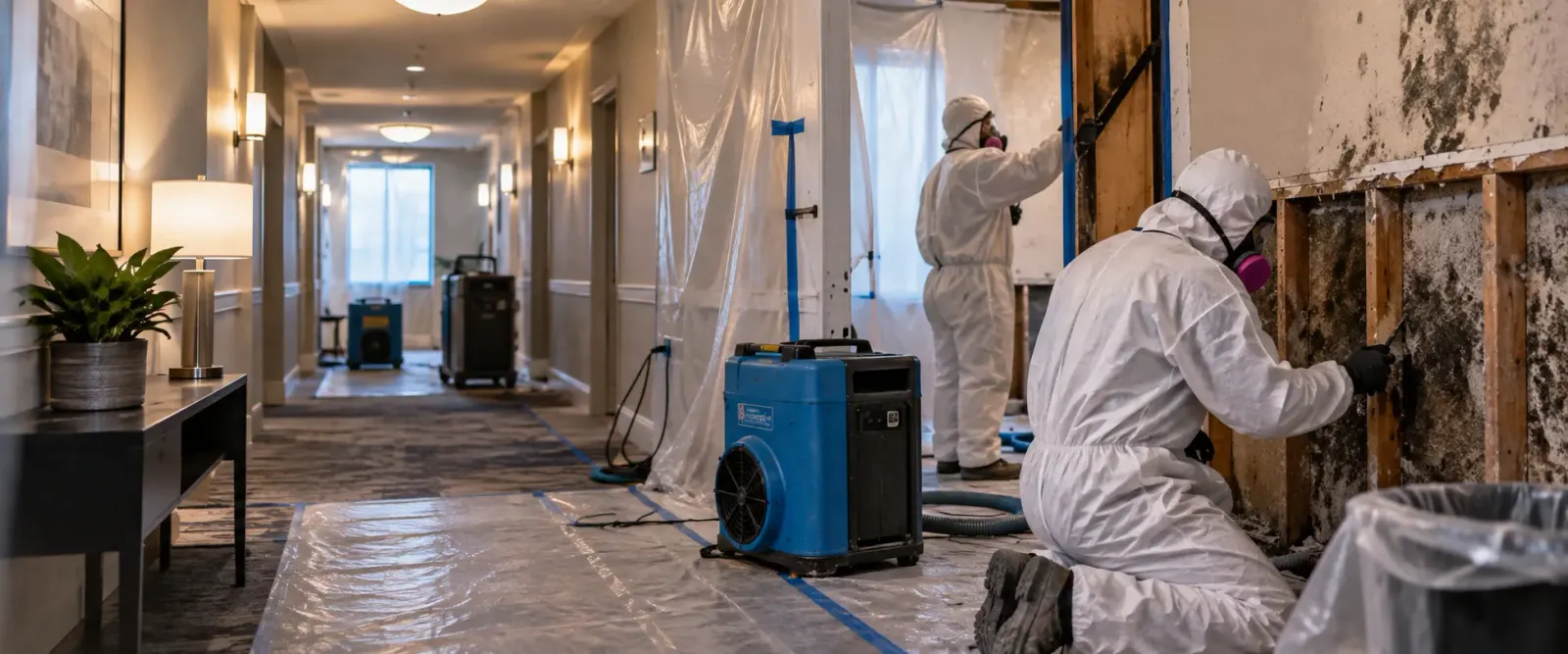
Sealed poly sheeting under negative pressure, vents blocked, an airlock on large jobs; respirators under a written Cal/OSHA 5144 program.
Surfaces are wet-vacuumed, damp-wiped or HEPA-vacuumed once dry, and porous material past saving is discarded, bagged in plastic inside containment. Crawl space joists in Crane Park houses and wallboard in campus rentals are the usual Turlock cases. EPA says mold must be cleaned up, not just killed.
Joists, subfloor and wallboard are read with a moisture meter, and nothing closes until the log shows dry.
The job clears when no visible mold, damaged material or moldy odor remains and a revisit shows no regrowth. Any rebuild passes to reconstruction.
Where mold happens in Turlock
Turlock's mold sources run from crawl spaces under railroad-era houses to campus rentals, freeway retail roofs and Westside cold rooms.
Downtown and the Main Street grid
Pre-war commercial and residential buildings between the railroad and Lander Avenue, with flat roofs, cast iron and plaster. Street water over the curb on Lander and Olive wets floors and wall bases that must dry quickly or come out.
Crane Park and the historic district
Turlock's oldest houses, on raised foundations over crawl spaces, with galvanized supply. Wet soil beneath the floor feeds growth on joists and subfloor, and a ground moisture barrier is part of the fix.
Stanislaus State and university rentals
1960s to 1980s apartments and converted houses around Monte Vista and Geer with steady turnover. Leaks under sinks and in bathrooms go unreported between tenants, and growth is found at move-in.
Monte Vista Crossings and Highway 99 corridor
About 875,000 square feet of big-box and in-line retail under low-slope roofs with national tenants. Roof leaks wet the tops of ceiling tiles, where growth spreads out of sight of the sales floor.
Geer Road retail
Older strip centers with restaurant tenants and grease lines. In-line suites that share a ceiling space can share a roof leak too, so neighboring ceilings are checked for hidden growth.
Westside Industrial Specific Plan area
Food processing, cold storage, distribution and truck yards west of Highway 99. Condensation on refrigeration lines and cold walls is the moisture source to find before containment goes up.
Northeast Turlock
1990s to 2010s HOA subdivisions on former orchard land, with stucco and irrigation laterals. Overspray and yard drainage run toward slab edges, so baseboards and garage walls show growth first.
East Turlock and Canal Drive basins
Neighborhoods around Donnelly Lake and Dianne Pond, which drain last in back-to-back storms. Standing water near buildings keeps wall bases wet longer, and those walls are read before they are closed.
South Turlock and Lander Avenue
Mixed residential and light commercial where street flooding has been recorded. Water pushed indoors over the curb leaves carpet and drywall that must be dried fast or removed.
West Turlock along Fulkerth and Tuolumne
Mid-century tracts and newer commercial under mature street trees. Where a limb opens a roof, rain reaches ceilings and wall cavities, which are opened and checked for hidden mold.
Dairies and ranchettes at the city edge
Farm homes and outbuildings on wells and septic, under large-span agricultural roofs. Outside city limits, rebuild permits after removal come from Stanislaus County, not the City of Turlock Building Division.
Keyes, Denair and Hilmar
Nearby towns 5 to 7 road miles from Turlock. Each has its own mold remediation page, built from its own housing, drainage and permit records.
Mold sub-services available in Turlock
Questions from Turlock property owners and managers
Start below the floor. CDPH names damp, exposed dirt in crawl spaces as a mold source, and in Turlock's oldest houses on raised foundations that moisture reaches the joists and subfloor first. Galvanized supply lines of that age can also drip under the house. The inspection traces the moisture, measures the growth, and the fix usually pairs removal with a ground moisture barrier, which CDPH's code enforcement sheet gives as the remedy.
Get the wet materials drying or out quickly. EPA's Table 1 calls for a response within 24-48 hours to prevent mold growth. Street water that crossed the threshold soaks carpet, pad and the bottom of drywall, and porous material that stays wet is removed rather than cleaned. If growth already shows, it is measured under EPA Table 2 and removed inside containment before anything is closed up, and salvageable furniture and boxes are packed out for cleaning.
Dairies and ranchettes outside the limits permit through Stanislaus County; inside them, the City of Turlock Building Division issues it. Removal and clearance come first, and replacing drywall, flooring or framing afterward is scoped under the reconstruction service. The contractor assigned to the request files the application with the right office.
Not automatically. Health and Safety Code 17920.3(a)(13) counts visible mold growth, as determined by a health officer or code enforcement officer, only where it endangers the occupants, and it excludes minor mold on surfaces that get wet in normal use, such as a shower. CDPH's code enforcement sheet lists a bathroom without a working fan as a separate issue. The landlord's repair duty under Civil Code 1941.7 starts on notice.
For under 10 square feet, EPA Table 2 requires no containment and suggests at least an N-95 respirator, gloves and goggles. CDPH suggests soap and water for small amounts and advises against bleach, ammonia and vinegar. Find the water first: in these tracts it is often irrigation or yard drainage running toward the slab. A larger area, or growth that returns, calls for professional removal.
Usually not. EPA says sampling is unnecessary in most cases where mold growth is visible, and that no EPA or other federal limits exist for mold. CDPH recommends against using measurements to judge the hazard. The job is sized by area under Table 2, and clearance rests on EPA's finish criteria: source fixed, no visible mold, no moldy odor and no regrowth on a revisit.
Mold remediation near Turlock

