Why mold happens in Ceres
In older Ceres homes, mold usually begins at a slow leak nobody can see. The City counts 2 percent of its houses from 1939 or earlier, 11 percent from the 1940s and 1950s and 26 percent from the 1960s and 1970s. The CDPH guide for California renters tells occupants to watch for water leaks under kitchen and bathroom sinks and a moldy odor in a sealed-up home. Behind a cabinet back or a bathroom wall, growth can spread well before that odor gives it away.
Ceres code enforcement already tags homes as substandard, and state law lets visible mold count where it endangers the people inside. The Housing Element records eight residential structures tagged for conditions from broken doors and windows to sanitation problems. Under Health and Safety Code 17920.3(a)(13), visible mold growth, as determined by a health officer or code enforcement officer, is a substandard condition to an extent that endangers the occupants, and minor mold on surfaces that normally get wet is excluded. Multifamily buildings hold 13 percent of Ceres units, where one leak can affect several households.
Winter roof leaks in Ceres can feed growth above a ceiling, where nobody looks. The Modesto airport normals give 2.57 inches of rain in January and 2.22 in February, and the New Year storms of 2022 and 2023 set a daily record of 1.57 inches there on 27 December. In a Fourth Street suite with a dropped ceiling, or a large store such as the 191,430 sq ft Walmart building proposed at Mitchell Ranch Center in 2010, the tops of ceiling tiles and the roof materials above them are hidden mold locations the EPA remediation guide names.
The Ceres storm system keeps its biggest storms in basins and local streets, so water can stand beside a building for most of a day. Under the 1995 Storm Drain Master Plan, a 100-year storm is held within the basin and local streets, and basin pumps need about 24 hours to empty a 10-year storm. Carpet, pad or drywall wetted at a threshold in that time sits inside the EPA Table 1 advice to respond within 24-48 hours to prevent mold growth. Material still wet after that is sized for removal under Table 2.
On nearly flat ground, water that lands beside a Ceres house has little reason to leave. The city sits on alluvial soils at about 80 to 100 feet, and detached houses make up 79 percent of its 13,313 units. CDPH names outdoor surfaces that slope or drain toward a building, a downspout included, as a moisture source, and irrigation overspray at a slab edge is the local version. Summer shifts the source indoors: with a July normal high of 95.0°F, air conditioning runs hard and a blocked condensate drain wets the drywall around the air handler.
The City's Housing Element (HCD revised draft, June 2024) counts 467 mobile homes in Ceres, 4 percent of all units, and sets a goal of grant-funded rehabilitation for 20 of them. A slow leak under a manufactured home wets the floor from beneath, out of view.
Mold remediation, as delivered in Ceres
From the Modesto base the crew drives 4 road miles south on Highway 99 and leaves at Whitmore Avenue or Mitchell Road. Moisture readings, containment photos and clearance notes build one file across every visit.
Whitmore Avenue and Mitchell Road are the two Highway 99 exits into Ceres, and the freeway carries more than 107,000 vehicles a day past each. December and January tule fog and harvest trucks push an arrival toward the 90-minute end. Propertyvendr confirms the time when the request is acknowledged and keeps the file.
Nothing moldy is disturbed until water damage restoration has stopped the water behind it. In Ceres the source is usually a sink or supply leak in an older house, a roof leak after winter rain, irrigation water at a slab edge or a blocked condensate line in summer.
Growth goes into EPA Table 2 by square feet: small, under 10; medium, 10 to 100; large, over 100. Hidden mold found later enlarges the plan.
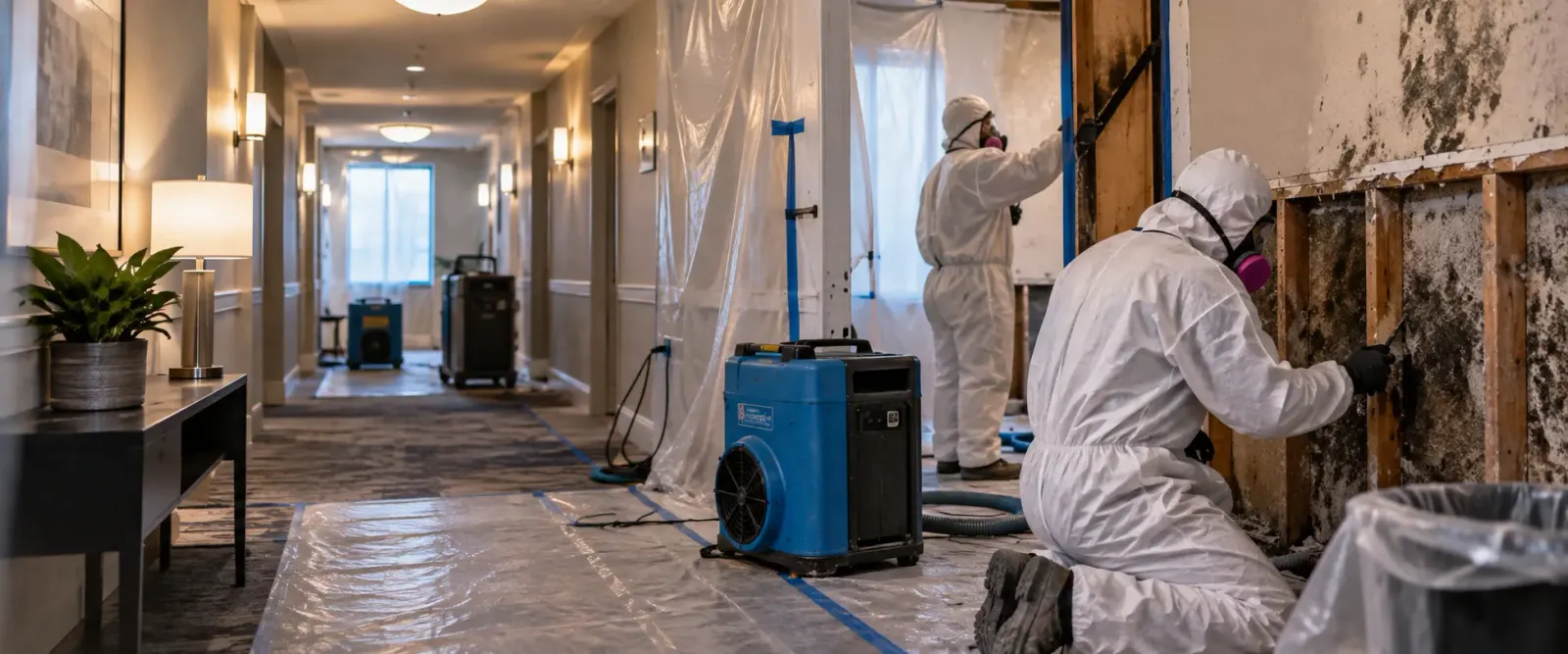
Limited containment is one layer of 6-mil sheeting under negative pressure; full containment doubles it and adds an airlock. Respirators follow Cal/OSHA 5144.
Each material gets its EPA method: wet vacuum, damp wipe, HEPA vacuum once dry, or discard. Wallboard from a Mitchell Road apartment or a Fourth Street suite is bagged inside containment before it leaves. The goal is removal, since dead mold is still allergenic.
Framing and subfloor are read with a moisture meter before any wall closes, and each day is logged.
Clearance follows the EPA finish criteria: no visible mold, no moldy odor, no new growth at a revisit, and S520 verification. Rebuild passes to reconstruction under the same file.
Where mold happens in Ceres
Mold in Ceres follows the building: century-old houses, sidewalk storefronts, attached units, flat subdivisions, farmland in conversion and manufactured homes.
Downtown and Fourth Street
Mostly single-story commercial buildings set to the sidewalk, among them the IOOF building at Fourth and Lawrence, shown on a 1910 Sanborn map. Where a suite has a dropped ceiling, a roof leak wets the tops of the tiles out of sight.
Fifth Street historic homes
The 1870 Daniel Whitmore Home, the Whitmore Mansion and houses built around 1900. Where old walls carry wallpaper, it comes off inside containment, because EPA warns that stripping it can release a massive quantity of spores.
Mitchell Road corridor
About 450 acres planned since 1995 for homes at 5 to 25 units an acre, mobile homes and condominium groups, with TID's Ceres Main Canal alongside. In attached units a bathroom leak can wet the wall cavity the next unit shares.
Mitchell Ranch Center, Mitchell and Service roads
Proposed in 2010 at 299,830 sq ft on 26.4 acres, outside the 100-year flood plain, with groundwater 24 to 26 feet down. In a store that size the likely sources sit overhead: roof leaks and air handler condensate pans.
West Landing
960 acres between Whitmore Avenue, Service Road, Ustick Road and the Union Pacific line, planned for homes, retail, offices and industry, with about 660 acres of farmland to convert. On a 0.15 percent slope, water beside a slab drains slowly.
Eastgate, Hatch Road and Boothe Road
A 370-acre planned community whose 2004 master plan set densities of 4.5 to 12 units an acre. On lots this flat, sprinkler overspray and downspout water pooling at the slab edge can start growth behind baseboards and in garage walls.
Whitmore Ranch
About 94 acres of mainly residential land south of Whitmore Avenue, bounded by Moore Road and La Rosa Elementary School. In a house with central air, a condensate line that backs up soaks the drywall around the unit.
Morrow Village
A neighborhood north of Whitmore Avenue and west of Mitchell Road that the City lists as disadvantaged. Where a home is rented, a tenant's notice of mold starts the landlord's repair duty under Civil Code 1941.7.
River Road and the Tuolumne bluffs
Small residential areas along River Road inside FEMA's 500-year zone, and land below the bluffs that can flood in severe events. Drywall and carpet soaked by floodwater and left wet past the EPA window become Table 2 material.
South and west Ceres along Highway 99
Older neighborhoods next to the freeway, and blocks from Hackett Road to Farris and Central avenues that the City ranks most in need of repair. Worn fixtures and slow drain leaks feed growth inside sink cabinets and wall cavities.
South Modesto/Ceres, Herndon Road to Richland Avenue
Homes off Herndon Road to Richland Avenue, from Nadine Avenue to River Road, also listed among the areas needing the most repair. CDPH notes that a moldy odor in a closed-up house is often the first sign.
Mobile home parks
Lazy Wheels, Ceres Mobile Estates and Ceres West Mobile Home Park, where the City plans grant-funded repair of 20 units. A supply or drain leak under the home starts growth on the underside of the floor, beyond anyone's view.
Mold sub-services available in Ceres
Questions from Ceres property owners and managers
The CDPH renters booklet advises contacting local code enforcement when a landlord does not act, and in Ceres that is the City's code enforcement, which the Housing Element records tagging substandard homes. An officer decides whether visible mold endangers the occupants under Health and Safety Code 17920.3(a)(13); minor mold on surfaces that normally get wet does not count. The landlord's repair duty under Civil Code 1941.7 begins once the landlord has notice, so give that notice in writing.
It depends on the stock. In the older neighborhoods beside Highway 99 and the houses on Fifth Street it starts under sinks and inside walls where slow leaks go unseen. In Mitchell Road apartments and condominium groups, one unit's leak reaches the shared wall. In Fourth Street suites and big retail buildings it grows on the tops of ceiling tiles after a roof leak, and on flat subdivision lots at slab edges wetted by irrigation, and store stock a suite leak reaches is packed out and cleaned off site.
Inside city limits, the City of Ceres Building Division at 2220 Magnolia Street, whose pages list Commercial, Patio and Residential Permits. Removal finishes first and clearance is recorded before new drywall, insulation or flooring goes in, so the rebuild starts on dry, clean framing. The rebuild then comes back as a written line-item scope for approval before any of it begins.
Not if the wet material is dealt with in time. Ceres basin pumps take about 24 hours to empty a 10-year storm, and EPA Table 1 calls for a response within 24-48 hours to prevent mold growth. Carpet, pad and drywall that took on street water are dried or removed within that window. Anything still wet after it is measured, contained and removed under Table 2.
The method is not set by the species. The California Department of Public Health states that current consensus does not justify treating some molds as especially toxic. A dark patch in a Morrow Village bathroom or a mobile home floor is handled like any other growth: its size in square feet sets the Table 2 containment, and the material decides whether it is cleaned or discarded.
Usually not where the growth is visible. EPA says that in most cases sampling is unnecessary when visible mold is present, and that no EPA or other federal threshold limits exist for mold. CDPH also recommends against measuring indoor mold to judge the health hazard. Samples are taken only under a written plan, and the finish is judged against the EPA criteria: no visible mold, no moldy odor and no new growth.
Mold remediation near Ceres

