Why mold happens in Empire
About four in five Empire houses were built before 1980, and hidden leaks in homes of that age are where mold takes hold. The Census survey for 2019 to 2023 counts 506 homes from before 1970 and 496 from the 1970s among 1,198, a median year of 1972, and none from 2010 on. The CDPH renters booklet names leaks under kitchen and bathroom sinks and a moldy odor in a sealed-up home as the signs to look for. A slow drip inside a cabinet or a wall can feed growth for a long time before anyone smells it.
Empire's planned storm system holds rain near the street and lets it soak in, so water can linger close to buildings after a storm. The County's 2014 filing described sidewalks and bio-retention swales that store runoff and treat it through natural soil percolation. CDPH counts outdoor surfaces that slope and drain water toward a building as a moisture source. Where a swale or a low yard sits beside a slab or crawl space, the wall base on that side is where growth starts.
About four in ten Empire households rent, and state law sets out when mold in a rental becomes a substandard condition. The Census survey counts 495 renting households, 163 mobile homes and 40 units in three- and four-unit buildings. Under Health and Safety Code 17920.3(a)(13), visible mold growth counts where it exists to an extent that endangers the occupants, as determined by a health officer or code enforcement officer, and minor mold on surfaces that normally collect moisture is excluded. Civil Code 1941.7 starts the landlord's repair duty on notice.
Empire's sewer lines are old and undersized, and a backup that is not cleaned up in time leaves wet material behind. A 2003 City of Modesto study found the collection system at 90 percent of capacity, with the main line to Modesto at a level that could result in sanitary sewer overflows, and LAFCO notes several lines are undersized and over 30 years old. Drywall, carpet or cabinet bases soaked by a backup and left past the EPA Table 1 response time of 24-48 hours become growth sized for removal under Table 2.
In Empire's shared buildings, a shelter, a library and a school district office, the remediation plan is written around the people inside. The CHSS Empire Camp shelter on South Avenue has 73 beds, the County lists a new library of about 5,000 sq ft among its completed projects, and Empire Union School District is on McClure Road. The EPA remediation guide asks for communication with building occupants at all stages and uses containment to limit their exposure. Books and papers are Table 2 contents with methods of their own.
Of Empire's 1,198 homes in the 2019-2023 Census survey, 109 date from 1939 or earlier. Where wallpaper in a house that old covers a damp wall, it comes off inside containment, since EPA warns stripping it can release a massive quantity of spores.
Mold remediation, as delivered in Empire
Yosemite Boulevard, State Route 132, carries the crew the 6 road miles from the Modesto base past Claus Road into Empire. Measured areas, moisture readings, containment photos and the clearance record join one file over every visit.
The crew comes east on Yosemite Boulevard, where SR 132 carries 14,900 vehicles a day at Santa Fe Drive and E Street, and turns off at McClure Road, I Street or the lettered streets. Arrival falls inside the 60 to 90 minute window, and Propertyvendr confirms the time.
Moisture is dealt with first. In Empire the likely sources are a backup from the near-capacity sewer, water held in a storm swale or low yard beside a wall, a drip under a sink in a pre-1980 house, or a leak beneath a mobile home.
Each patch is measured in square feet, hidden growth is sought behind finishes, and the job is sized as small, medium or large under EPA Table 2.
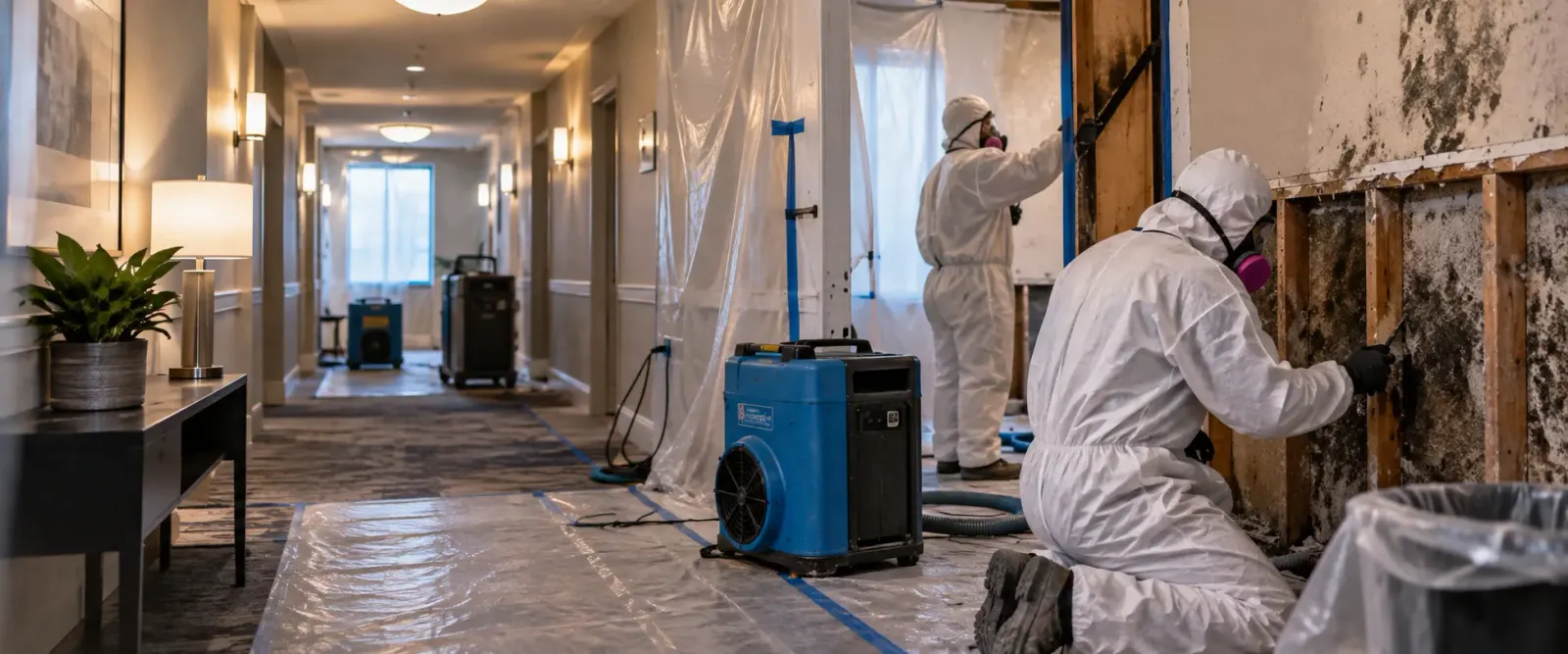
Vents are blocked and the area goes under negative pressure behind one or two layers of sheeting, with respirators under Cal/OSHA 5144.
Hard surfaces are damp-wiped or wet-vacuumed, then HEPA-vacuumed; porous material past cleaning is bagged inside containment. Under a mobile home that can mean floor decking, in an older house wallboard and cabinet bases. Biocide is not routine: dead mold is still allergenic.
Before anything closes, a moisture meter checks the framing and floor, and the result goes in the daily log.
The job ends on the EPA finish criteria, no visible mold, moldy odor or new growth at a revisit, and S520 verification; reconstruction follows.
Where mold happens in Empire
Empire's areas differ by what surrounds the building: a state highway, a rail line, an irrigation lateral, a shelter or the river.
Yosemite Boulevard (SR 132) commercial strip
Empire's main commercial frontage, with the post office at 5102 Yosemite Blvd and the fire station expected to move once SR 132 is widened. A roof leak over a shop wets ceilings and stock, and growth follows if they stay wet.
Yosemite Boulevard between A and B Streets
The 3,720 sq ft retail building at 4275 Yosemite Boulevard backs onto an 18-foot alley, and a 2023 County proposal put a valley gutter in its lot to capture storm water. Where lot runoff meets a shop wall, its base is checked for growth.
Santa Fe Avenue and the rail line
Empire's second commercial street, beside the BNSF and Modesto & Empire Traction lines. In older commercial buildings, growth after a leak hides on the back of wall panels and the tops of ceiling tiles, two places EPA names.
Southeast lettered streets (E to I Streets, 3rd Street to Sunshine Court)
Blocks between 3rd Street, Sunshine Court, E Street and I Street, where the City of Modesto filed in June 2026 to replace water mains. Inside the houses, a drip at a supply valve under a sink is where hidden mold can start.
Abbie Street rezone sites
Five parcels proposed for 25 units an acre, about 55 homes, part of a 2025 County proposal covering 14 Empire parcels. In multifamily buildings of that kind, one unit's leak can wet a wall cavity shared with the next.
I Street and the Empire Library
The Empire Library at 98 I St., and a new library of about 5,000 sq ft among the County's completed projects. Moldy books and papers are handled by EPA Table 2 methods, or packed out when they cannot be cleaned on site.
South Avenue
The CHSS Empire Camp emergency shelter at 6132 South Ave., with 73 beds. With guests on site, containment and clear notice to occupants decide how the work is staged and which rooms close.
Codoni Road at Highway 132
The corner where the 2003 study monitored the district's sewer pipe, then running at 90 percent of flow capacity. A backup into a nearby building leaves wet flooring and wall bases that grow mold unless removed within EPA's window.
MID Lateral No. 1
County rezone maps label MID Lateral No. 1 and an aqueduct beside the Abbie Street sites. Where irrigation water or yard drainage runs toward a house, CDPH counts that slope as a source of indoor moisture.
McClure Road
Empire Union School District at 116 N. McClure Rd., on the SR 132 stretch a 2021 Caltrans notice marked for curb ramps and signals. In school and office buildings, EPA looks first to air handler drain pans and porous duct liners.
Claus Road and the Modesto sphere
The whole sanitary district lies inside Modesto's sphere of influence beside Claus Road, though LAFCO records no plan to annex. The County and the City share land use responsibility here, so the permit office is confirmed before a rebuild.
Tuolumne River edge
The original Empire City stood on the south bank, across the river, until the riverboat trade declined. Town storm water was planned to cross under SR 132 to an MID outfall here, and rain-wetted walls are checked for growth once dry.
Mold sub-services available in Empire
Questions from Empire property owners and managers
Empire is unincorporated and permits through the County: the Stanislaus County Building Permits Division, 1010 10th Street, Suite 3400, Modesto, requires a permit for rebuilding or remodeling, and the owner or the assigned contractor obtains it. LAFCO says land use responsibility within the sanitary district rests with the County and the City of Modesto, and that the City has no plans to annex. The rebuild starts only after clearance.
It can if water keeps reaching the wall. The County's 2014 storm drain filing described bio-retention swales that hold runoff and let it percolate into the soil. CDPH names outdoor surfaces that slope and drain toward a building as a moisture source. Watch the wall base, baseboards and any crawl space on the swale side after storms; a musty smell or staining there is checked, measured and, where growth is found, removed under EPA Table 2.
In the houses built before 1980, which are most of the stock, it starts at slow leaks under sinks and inside walls. Under mobile homes it starts on the floor above a leaking line. In homes and shops near the old, undersized sewer lines it follows backups that were not cleaned up in time, and along Yosemite Boulevard and Santa Fe Avenue it grows on ceiling tiles and wall backs under a roof leak.
Within a couple of days. EPA Table 1 calls for a response within 24-48 hours to prevent mold growth. The City of Modesto has maintained Empire's sewer since December 2015, so the line itself is reported to the City. Inside, wet flooring, drywall and cabinet bases are dealt with at once; anything still wet after that window is measured, contained and removed as mold remediation.
Civil Code 1941.7 says the landlord's obligation to repair mold does not arise until the landlord has notice, so give notice in writing. HSC 17920.3(a)(13) treats visible mold growth as substandard where it endangers the occupants, as a health officer or code enforcement officer determines, and excludes minor mold on surfaces that normally get wet. HSC 26148 also has landlords give prospective tenants the CDPH booklet on dampness and mold.
Not as a rule. EPA says sampling is usually unnecessary when mold is visible and that no federal limits for mold exist, and CDPH advises against measuring mold to judge the health risk. Return depends on the EPA finish criteria: the moisture problem fixed, no visible mold or mold-damaged material, no moldy odor, and occupants back without complaints. Samples, when used, follow a written plan.
Mold remediation near Empire

