Why mold happens in Modesto
Modesto's rain and its fog arrive in the same months, so a winter leak rarely dries out by itself. Almost all of the city's 12.27 inches of normal rainfall comes between November and March, and tule fog settles in through December and January. Roofs, stucco and yards stay damp for weeks, with no dry spell for a wet ceiling to recover in. EPA's Table 1 calls for a response within 24-48 hours to prevent mold growth, and in a Modesto January that clock runs against the weather.
In Modesto's older rentals, mold usually begins with a slow plumbing leak that the tenant smells before anyone sees it. The average home in the city was built in 1976, and much of the pre-1970s stock still runs on galvanized steel supply lines. The College Area around Modesto Junior College holds 1940s to 1960s homes and rentals on galvanized supply and cast-iron waste, where a pinhole behind a cabinet can keep a wall wet unseen. Under Civil Code 1941.7, the landlord's repair duty for mold arises once the landlord has notice.
Flat roofs on the retail strips and downtown hide their leaks above the ceiling, where growth spreads out of view. The McHenry and Standiford corridors are strip centers, pads and big-box stores under large flat roofs, and downtown's pre-war brick buildings on 10th and 11th streets carry flat roofs over plaster. EPA lists the top of ceiling tiles and the roof materials above them among hidden mold sites. Where a ceiling space doubles as a return air plenum, heavy growth on the tiles can reach the air handler, so containment runs from floor to ceiling deck.
When Dry Creek or the Tuolumne comes up, the mold work starts in the days after the water drops. Dry Creek crosses the city with no dam and backs up when the Tuolumne runs high, and La Loma is its most flood-prone reach. In January 1997 the Tuolumne reached a record 71 feet at the Ninth Street Bridge and flooded downtown blocks and the 9th Street trailer parks, and in January 2023 Dry Creek was projected to crest at 87.9 feet. Drywall and carpet soaked by flood water and left wet are measured and removed under EPA Table 2.
In Village One and the newer tracts, yard water at the slab edge shows up as mold behind baseboards and on garage walls. Village One's 1990s and 2000s HOA subdivisions sit on compacted fill with stucco walls and underground irrigation laterals, and Beyer Park and Pelandale add tracts on former farmland with expansive soils. The CDPH booklet on dampness and mold lists ground that slopes and drains water toward a building as a cause, and a cracked stucco wall lets rain into the cavity behind it.
Relative humidity in Modesto peaks near 74 percent in January, in the middle of the December and January tule fog. EPA advises keeping indoor humidity below 60 percent, ideally 30 to 50, so a room wetted by a winter leak is dried with equipment before mold work can close.
Mold remediation, as delivered in Modesto
The crew sets out from the base inside Modesto and crosses town on Highway 99, McHenry Avenue or Oakdale Road. One file carries the moisture readings, containment photos and clearance record from first visit to handover.
Most Modesto addresses are a short run from the base, with the crew on site within 60 to 90 minutes, day or night. Calls from Village One, Beyer Park or the Highway 99 corridor below Hatch Road can take the full 90 minutes when December and January fog or harvest trucks slow the roads.
Removal waits until the water behind the growth is stopped, as EPA requires. In Modesto the usual culprits are galvanized lines in pre-1970s houses, flat roofs on the retail strips, failed irrigation laterals in Village One and Dry Creek high water in La Loma.
The affected area is measured against EPA Table 2: small under 10 square feet, medium 10 to 100, large above 100. Hidden growth found later enlarges the plan.
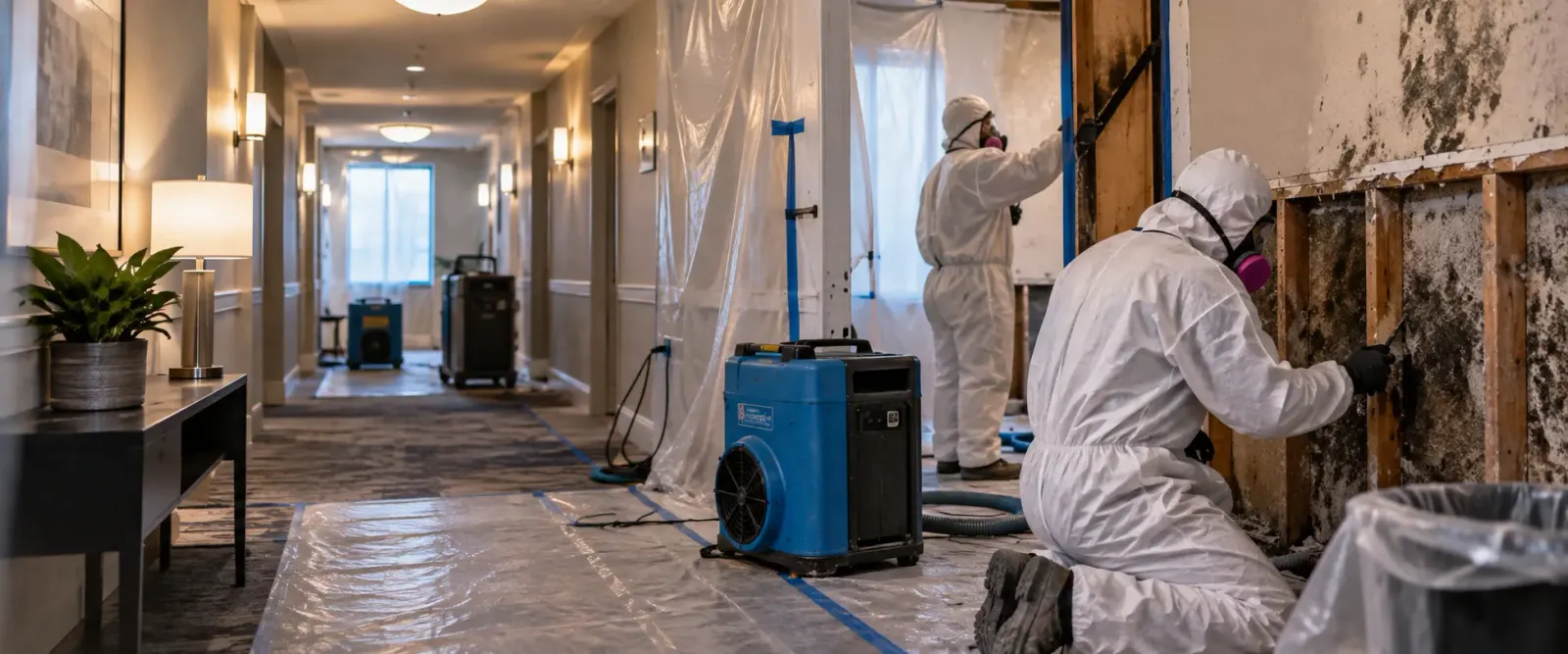
Limited containment is one layer of 6-mil fire-retardant sheeting under negative pressure; full adds a second layer and an airlock. Respirators follow Cal/OSHA 5144.
Removal follows EPA's four methods: wet vacuum, damp wipe, HEPA vacuum once dry, and discard. Moldy wallboard in College Area rentals and ceiling tile under strip-center roofs are bagged inside containment. Killing the mold is not the aim, because EPA notes dead mold is still allergenic.
Framing and wallboard are checked with a moisture meter before anything is closed up, and each reading is logged.
Clearance is judged on EPA's finish criteria: the moisture fixed, no visible mold or moldy odor, and no regrowth on a revisit. Rebuild passes to reconstruction on the same file.
Where mold happens in Modesto
Each of Modesto's seventeen areas grows mold for its own reasons: pipe age near the college, roofs on the retail strips, yard water in the tracts.
Downtown
Pre-war brick and masonry mixed-use on 10th and 11th streets, with flat roofs, cast-iron drains and plaster. Roof leaks soak the plaster and the tops of any ceiling tiles, and growth there stays hidden until it stains through.
College Area
1940s to 1960s homes and rentals near Modesto Junior College on galvanized supply and cast-iron waste. A slow leak under a sink or behind a bath wall is often first reported as a musty smell.
La Loma
Mid-century homes on the bluffs above Dry Creek, its most flood-prone reach, with mature trees and root-cut laterals. After the creek rises, drywall and carpet that stayed wet are removed under containment.
Village One
1990s to 2000s HOA subdivisions on compacted fill with stucco and underground irrigation laterals. A lateral leaking at the slab edge shows as growth behind baseboards and at the base of garage walls.
McHenry and Standiford corridors
Strip centers, pads and big-box stores under large flat roofs, many with restaurant tenants. A roof leak wets the tops of ceiling tiles first, and where the ceiling is a return plenum the growth can reach the HVAC.
Highway 99 industrial corridor
Tilt-up warehouses, food processing and truck yards from Kansas Avenue to Hatch Road. Wide floors are measured in sections, because growth across more than 100 square feet is a large job under EPA Table 2.
Airport District
Older homes and light industrial east of the airport, with drainage problems and deferred maintenance. Water pooling against walls in heavy rain and leaks left unrepaired are the moisture sources traced first.
Sherwood Forest
Large-lot 1960s and 1970s homes under old canopy, where limb strikes open roofs in winter wind. Rain through the opening reaches ceilings and wall cavities, which are opened and checked for hidden growth.
Coffee-Sylvan
Established HOAs and 1970s to 1980s tracts with aging irrigation and roofs. Overspray from one and worn roofing on the other both bring water to the building, and boards receive the containment plan with the owner.
Riverdale Park and Tuolumne corridor
Flood-adjacent low ground with a high water table and mobile home parks. After high water, flooring and wall materials that stayed wet are sized under Table 2 and removed in sealed bags.
Beyer Park and Dry Creek subdivisions
Newer tracts on former farmland with expansive soils and plumbing under the slab. A slab line that leaks shows first as damp flooring or a baseboard that will not dry.
Shackelford
Unincorporated south Modesto on septic and open drainage, with industrial and residential side by side. Rebuild permits after removal come through Stanislaus County, not the City's Building Safety Division.
Bystrom
An unincorporated pocket toward Ceres with older housing, light industrial and yard flooding. Yard water pushed against older walls is traced before cleanup, and Stanislaus County issues the permits.
Standiford and Dale Road
The northwest retail and medical corridor of 1990s to 2000s centers with large parking fields. In offices, EPA names air handler condensate pans and porous duct liners as places growth hides.
Oakdale Road and Floyd
East side 1970s to 1990s tracts and neighborhood retail with stucco walls. Cracked stucco lets rain into the wall cavity, and EPA points to the back side of drywall as a hidden growth site.
Pelandale and North Modesto
The newest big-box and HOA growth at Highway 99 and Pelandale, on former farmland with expansive soils. New slabs still take irrigation water at the edges, so baseboards and garage walls are checked.
West Modesto and Paradise Road
Older housing and industrial along Paradise and Carpenter with deferred maintenance and poor drainage. Long-running leaks here often mean hidden growth, so wall cavities are opened before the plan is final.
Ceres, Salida and Empire
Neighboring towns 4 to 7 road miles from the Modesto base. Each has a mold remediation page of its own, written from that town's buildings, drainage and records.
Mold sub-services available in Modesto
Questions from Modesto property owners and managers
EPA's Table 1 calls for a response within 24-48 hours to prevent mold growth, so the clock starts with the water, not with the first spot you see. Dry Creek has no dam and La Loma is its most flood-prone reach, so creek water often sits in a house for a while. Drywall, carpet and pad that stayed wet are measured under EPA Table 2 and removed under containment once the water source is gone.
Those unincorporated pockets permit through Stanislaus County. Inside city limits the permit comes from the City of Modesto Building Safety Division. The removal itself, containment and clearance come first, and the rebuild of drywall, flooring and finishes is scoped afterward under the reconstruction service, with the application filed by the contractor assigned to the request.
It follows the building stock. In the pre-1970s houses and College Area rentals it starts at slow leaks from galvanized supply lines and cast-iron waste. On the McHenry and Standiford strips and downtown, flat-roof leaks wet the tops of ceiling tiles. In Village One, Beyer Park and Pelandale, irrigation water at the slab edge feeds growth behind baseboards and garage walls, and in La Loma and Riverdale Park it follows high water, and belongings soaked there are packed out and cleaned.
Under Health and Safety Code 17920.3(a)(13), visible mold growth, as determined by a health officer or code enforcement officer, makes a building substandard only where it exists to an extent that endangers the occupants; minor mold on surfaces that normally get wet is excluded. Civil Code 1941.7 starts the landlord's repair duty for that condition on notice, so report it in writing. Since 1 January 2022 landlords give prospective tenants the CDPH mold booklet.
No. The California Department of Public Health's statement on dampness and mold says current consensus does not justify treating some molds as especially toxic. What sets the method is how much area is affected and what material it grows on: EPA Table 2 sizes the containment and protective equipment, and porous material such as wallboard or carpet is often discarded rather than cleaned.
Usually not. EPA says that in most cases, if visible mold growth is present, sampling is unnecessary, and that no EPA or other federal limits have been set for mold. CDPH also advises against using measurements to judge the health hazard. Sampling has a place when a professional plan calls for it, and the job is cleared against EPA's finish criteria, not a lab number alone.
Mold remediation near Modesto

