Why mold happens in Delhi
Delhi lies outside FEMA's mapped flood zones, yet water still stands in its older neighborhoods because the ground takes it in slowly. Merced County's 2026 Housing Element traces localized flooding there to poor drainage and low soil permeability, and notes that many older neighborhoods rely on older systems while newer subdivisions drain better. Twenty years earlier the Community Plan already called Delhi prone to seasonal flooding. Water held against a house for days soaks the bottom of drywall and baseboards from the outside, and that wet band is where growth appears.
Delhi's recorded storms brought wind and street flooding, and a roof opened by wind wets the ceiling space above rooms. On 4 January 2023 a 35-knot gust brought power lines down across August Avenue near Hinton Avenue; five days later Highway 99 took water near Shanks Road, and in March 2019 the CHP reported flooding at Canal Drive and South Avenue. EPA lists the tops of ceiling tiles and the roof materials above them among the places hidden mold grows, and its Table 2 guidance sizes the work by area.
Much of Delhi's housing predates the 1990s, and a slow leak in an older rental stays hidden until someone smells it. Delhi began as a 1919 State land settlement and had 2,636 residents by 1980; the County now counts about 3,000 homes and names Almond Garden Family and Magnolia Garden Apartments among its rentals. CDPH warns renters about leaks under kitchen and bathroom sinks. Under Civil Code 1941.7, a landlord's duty to repair mold under the substandard housing law begins once the landlord has notice.
Some Delhi homes are still on private wells and septic tanks, and a backup or a leaking well line becomes the moisture behind the growth. The Delhi County Water District holds a grant to extend water to the neighborhoods either side of West Letteau Avenue and near West August Avenue and North Shanks Road, with Self-Help Enterprises working on sewer. The 2005 Draft EIR kept a 167-acre Agricultural Residential area outside the district. The CDPH code enforcement sheet puts correcting the water source ahead of any cleanup.
Delhi's rain comes in winter and its heat in summer, and each season wets buildings in its own way. NOAA's nearest normals station, Turlock #2, puts 10.10 of its 12.39 annual inches between November and March, and the July normal high at 93.0°F. Winter moisture comes through roofs, walls and yards. In summer it forms inside central air systems, where EPA names condensate drain pans and porous duct liners as growth sites, in homes, Schindel Elementary and the commercial space that serves the town and Highway 99.
The 2005 Draft EIR for the Delhi Community Plan found groundwater generally 10 feet or more below the surface. So the moisture checks in a Delhi building start above ground, with rain the soil takes in slowly and leaks inside.
Mold remediation, as delivered in Delhi
Delhi is 20 road miles from the Modesto base, straight down Highway 99, which cuts the town in two. One file follows the job from the first moisture reading to the clearance record.
Highway 99 runs through Delhi, and the Bradbury Road, Shanks Road and South Avenue exits reach either side of town. The freeway flooded near Shanks Road on 9 January 2023, and county fog from November to March can stretch the drive toward 120 minutes. Propertyvendr confirms the time and runs the file.
The checks start above ground: rain standing against walls on slow-draining soil, a roof opened by wind, a leak under a sink, or a septic backup on a lot not yet on district service. Each is stopped before cleanup starts.
Visible growth and any hidden areas behind wallboard are measured in square feet, and EPA Table 2 sets small, medium or large, which fixes the containment.
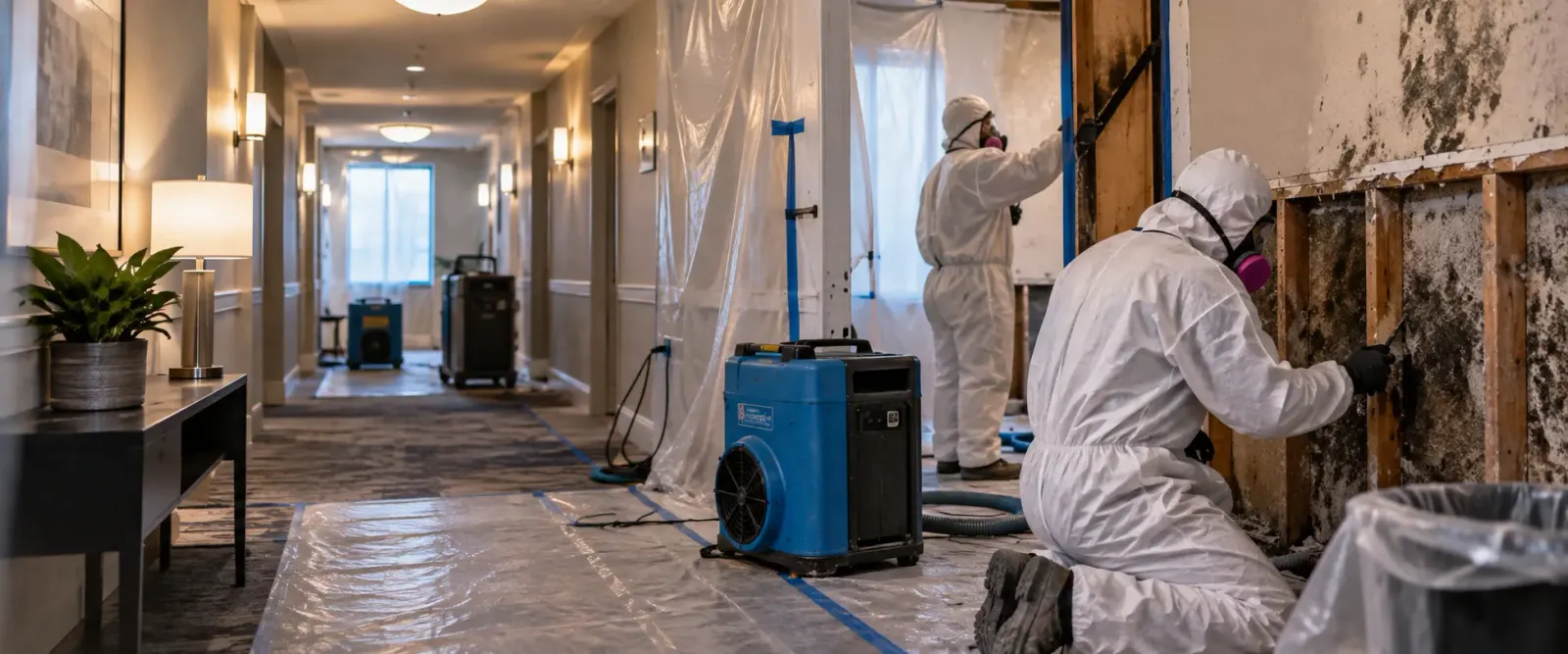
Sheeting sealed around the work under negative pressure, supply and return vents blocked, and respirators worn under a Cal/OSHA 5144 program.
Wallboard from low on the walls in older blocks and rental carpet are typical discard material, sealed in bags inside containment. Framing and slab are HEPA-vacuumed and damp-wiped; EPA says the contamination itself must be cleaned up, so biocide is not routine.
Before anything is closed up, meter readings show the materials dry, and each day's readings join the log.
Handover comes when EPA's finish tests are met: no visible growth or moldy smell, and none returning at a revisit. Reconstruction takes over the same file.
Where mold happens in Delhi
Delhi's areas split by the freeway and by age: older blocks with slow drainage, 1990s tracts, farm ditches and lots still on septic.
Downtown Delhi west of Highway 99, Stephens Street and Letteau Avenue
The Mixed Use core of established homes, shops, offices and Schindel Elementary, where a 2001 County study proposed redevelopment. After heavy rain, walls in its older blocks are read low for moisture wicking in from outside.
Downtown east of Highway 99, Vincent Road, 4th and 6th streets
Homes mixed with light industry and businesses, in the tract with the highest CalEnviroScreen score among the County's housing sites. In small shops and houses here, a leak behind a wall is traced before anything is removed.
West Letteau Avenue, north-west Delhi
One of two neighborhoods where the water district is extending service under a grant, with Self-Help Enterprises on the sewer work. Until a house is connected, its septic tank and private well line are checked as moisture sources.
West August Avenue and North Shanks Road, south-west Delhi
The second grant-funded extension area, on low ground with shallow sewer inverts; power lines came down across August Avenue in a 35-knot gust on 4 January 2023. Wind damage to a roof lets rain into ceilings.
Schendel Avenue and the 1990s west-side subdivisions
Mainly single-family tracts from the 1990s boom, some built without connections to their neighbors. Yard water running toward the foundation shows up as growth behind baseboards and in garage walls.
Bradbury Ranch Master Plan, east of Highway 99
About 273 acres of farmland with several homes, farm ditches and canals, where the 2023 draft plan drains new development to two detention basins. For the farmhouses there now, ditch and canal water is the first source checked.
Flower Street Master Plan Area
About 160 acres in the north-east quadrant, mostly residential and the only master plan area with much existing development. In its homes, readings behind walls and under sinks come before any removal.
North Delhi Gateway and the Bradbury Road interchange
Planned for commercial and business park uses for highway travellers, about 1.1 million sq ft at build-out, with houses on the north side of Bradbury Road. Buildings with central air are checked at drain pans and ducts.
Shanks-Vincent Commercial Center and the Shanks Road interchange
A 35-acre commercial plan area for about 380,000 sq ft beside the freeway, which flooded near Shanks Road on 9 January 2023. Where a building takes street water, soaked drywall and carpet are sized under EPA Table 2.
South Avenue, Canal Drive and the South Avenue Master Plan Area
Mostly low-density homes on smaller lots near the ponding wastewater plant, where the CHP reported flooding at Canal Drive and South Avenue on 6 March 2019. Water that reaches a house is dried or removed within EPA's window.
Union Pacific corridor and the El Capitan Way crossing
About 30 freight trains a day in the 2004 study, with homes within 1,000 feet of the tracks exposed to their noise. A closed-up room with a musty smell is one of the signs CDPH tells renters to report.
Agricultural Residential edges and TID Lateral #6
Estates and ranchettes of an acre or more, the Draft EIR's 167 acres kept on private wells and septic, with the lateral crossing the west and north of the Plan area. Drainage toward farm dwellings is checked first.
Mold sub-services available in Delhi
Questions from Delhi property owners and managers
Yes, if water reaches the walls and stays. The County's 2026 Housing Element blames localized flooding in older Delhi neighborhoods on poor drainage and low soil permeability, whatever the FEMA map shows. EPA's Table 1 asks for a response within 24-48 hours to prevent mold growth. Once the water drops, lower walls and baseboards are read with a meter; anything still wet or already growing is measured and handled under EPA Table 2.
The source is dealt with first. The Housing Element says some Delhi homes remain on private wells and septic while the water district extends service to those two neighborhoods, with Self-Help Enterprises on the sewer connections. A backup has to be stopped before remediation, since EPA's finish test starts with the moisture problem fixed. Soaked drywall, carpet and pad are then bagged and discarded, and framing is cleaned, dried and logged, and furniture and boxes worth keeping are packed out to be cleaned.
Merced County's Building and Safety Division, at 2222 M Street, 2nd Floor, in Merced, since Delhi is unincorporated. The County's Housing Element gives 30 working days for a first plan review and 14 to 30 for later ones, and a permit stays valid six months, extended with each inspection. The Department of Engineering and General Services checks every building permit against FEMA flood guidelines. Removal and cleaning do not wait for the rebuild permit.
The town's own records point to a few places. In the older neighborhoods with slow-draining soil, growth starts in the lowest wall sections after rain stands against the house. In the 1990s tracts, yard water running toward the foundation wets baseboards and garage walls. On lots still on septic, a backup is the source. Anywhere, a slow leak under a sink or behind a wall stays hidden until the smell gives it away.
For a small area, often yes. EPA Table 2 treats anything under 10 square feet as small: no containment is required, and the minimum protection is an N-95 respirator, gloves and goggles. CDPH suggests soap and water for small amounts and advises against bleach, ammonia and vinegar. Growth larger than that, growth that keeps coming back, or a musty smell with nothing visible calls for the assigned crew to find the source.
Often, in rooms outside the work. EPA sets up containment to minimize the exposure of remediators and building occupants, and asks that occupants be kept informed at all stages. The sealed area stays under negative pressure, so air moves into it from the rest of the house. How much of a Delhi home stays usable depends on how large the affected area is under EPA Table 2 and where it sits.
Mold remediation near Delhi

