Why mold happens in Vernalis
The Vernalis houses on record date from 1914 to 1959, and in houses that old, plumbing leaks can stay hidden for a long time. Only six of the 19 Assessor parcels that touch the community list a year built, and three of those six houses have two storeys. The CDPH renters booklet lists water leaks under kitchen and bathroom sinks among the common sources of indoor mold. In a two-storey house, a leak at an upstairs bathroom can wet the ceiling and wall cavity below well before a stain shows.
With no public water or sewer, every Vernalis home runs its own well and septic system, and either can soak a house. County GIS shows no water, sewer or storm district anywhere in the 142-acre community. When a supply line breaks, the well pump goes on feeding it until someone switches it off, and a septic backup leaves contaminated water in floors and wall bottoms. Porous material that either one soaks, and that cannot be dried quickly, becomes mold-damaged material under EPA Table 2 and is bagged and discarded.
Vernalis is in FEMA Zone X, yet a high river can still put water into the farm ground nearby. The Weather Service expects seepage into crop land outside the levees once the Vernalis gauge passes 21 ft, and severe seepage that spreads as the river rises at 26 ft. Where that water reaches a house over a crawl space, CDPH names damp, exposed dirt in crawl spaces as a cause of indoor mold, and its code enforcement fact sheet gives a ground moisture barrier as the fix.
Storm water in Vernalis runs to ditches and ponds, so a wet February leaves it close to foundations. The County's checklist shows no drainage system, curbs or gutters. At Tracy Carbona, the nearest station with normals, February averages 2.57 inches, and December to February is the wettest stretch of the year. The CDPH renters booklet lists outdoor surfaces that slope and drain toward a building, including from a downspout, as a cause of indoor dampness, and the lower walls and baseboards on the side the water comes from are where growth shows first.
The Warehouse Industrial parcels and the Route 132 corner bring larger roofs to a mostly agricultural community. The General Plan counts about 12 acres of industrial use and 0.8 acres of commercial inside the boundary, on land zoned Warehouse Industrial and Rural Service Commercial. Under a leaking roof, EPA names the tops of ceiling tiles and the roof materials above them as hidden growth sites, and in a building cooled through a 93.2°F July, condensate drain pans in the air handler. EPA Table 2 sizes what is found.
In 2023 the San Joaquin at Vernalis stayed in minor flood through a long stretch of March and fell below flood stage only at 0700 on 4 April. Any floor or outbuilding damp for that long is well past EPA's 24-48 hour window for preventing growth.
Mold remediation, as delivered in Vernalis
Route 132 carries the crew the 16 road miles from the Modesto base to its junction with SR 33 at Vernalis. Each visit starts by checking the containment and ends with readings and photos added to one file.
The crew approaches on Route 132 and turns at SR 33. San Joaquin County's hazard plan describes thick winter tule fog on roads countywide, and fog or harvest trucks can stretch arrival toward 120 minutes. County records give Vernalis addresses two ZIP codes, so a crossroads with the request helps find the property.
The water source is stopped before any mold is touched. In Vernalis it is likely a well-fed supply line, a septic backup, runoff standing in ditches and ponds by a foundation, a leak in a pre-1960 house, or river seepage under a raised floor.
Measured square footage places the job in EPA Table 2: small under 10, medium 10 to 100, large over 100. Hidden growth enlarges the plan.
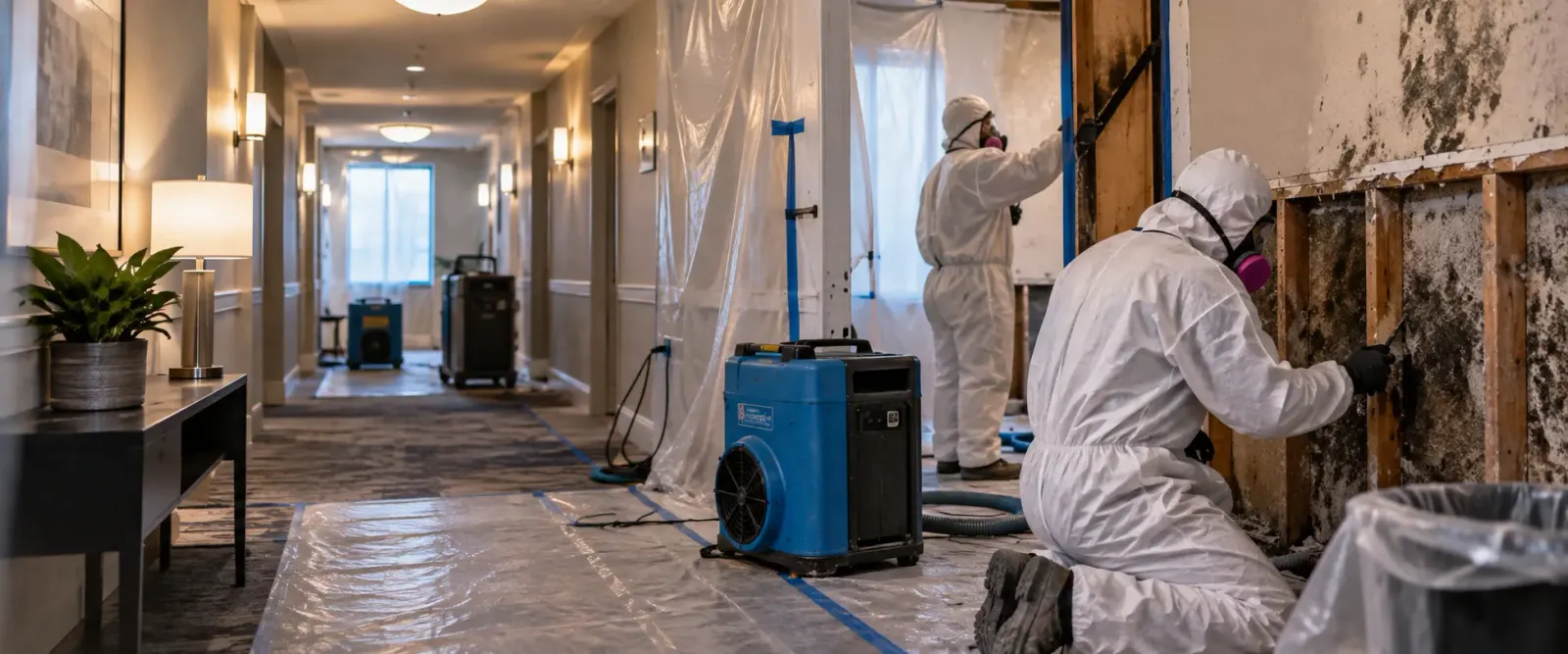
A single sheet of 6-mil fire-retardant polyethylene under negative pressure closes a medium area; a large one gets two and an airlock.
Moldy porous material is bagged inside containment and discarded under EPA Method 4; wood framing is damp wiped and HEPA vacuumed once dry. In the two-storey houses, the ceiling below an upstairs leak is opened. Dead mold still causes allergies, so growth is cleaned away.
No wall or floor is closed until a moisture meter shows it dry, and each reading is logged.
Clearance under EPA's criteria: no visible mold, no mold-damaged material, no moldy odor, and a revisit with no new growth. S520 verification follows, then any rebuild.
Where mold happens in Vernalis
Vernalis spans 142 acres across a county line; its mold follows old houses, wells and septic tanks, drainage ditches and warehouse roofs.
SR 132 and SR 33 junction, Rural Service Commercial corner
The commercial corner where Routes 132 and 33 meet, on land zoned Rural Service Commercial. A roof leak over a roadside business wets ceilings and insulation, and growth is measured once the roof is closed.
State Route 33 frontage homes
Frontage houses whose recorded years run 1914, 1923, 1941, 1948 and 1959, each on a domestic well and septic system. In these older homes, the inspection starts under sinks, around bathrooms and at the lowest walls.
S Welty Road
Parcels here range from about 5.7 to 139 acres, the biggest held in a Williamson Act contract, and one carries a house built in 1940. Barns and outbuildings on these parcels are inspected apart from the house, each with its own moisture source.
Warehouse Industrial parcels
About 12 acres of industrial use in a Warehouse Industrial zone, with no occupant named in the records read. Under a large roof, a leak can spread across ceiling tiles and stored goods before anyone finds it.
Sacramento Northern Railroad corridor and the old train stop
The rail line, Southern Pacific in the 1880s and Sacramento Northern now, whose train stop started Vernalis with a few stores and a post office. Older buildings by the tracks are checked under sinks, behind walls and at wall bases.
Stanislaus County side, the Vernalis General Store
The General Plan puts the Vernalis General Store, with the early-1900s oil pumping facility to its south, on the Stanislaus side of the line. Rebuilding on that side after mold removal is permitted at 1010 10th Street in Modesto.
Farmland ring, Vernalis clay loam and Capay clay
Farming takes up 67 percent of the community's land, on Vernalis clay loam and Capay clay inside West Stanislaus Irrigation District. Farm buildings that take field runoff at the wall base are checked for growth there.
San Joaquin River gauge reach
The gauge about 3.3 miles north-north-east, where seepage outside the levees begins at 21 ft. Where seepage reaches a floor or crawl space, the soil is covered and the framing dried before growth is removed.
Mold sub-services available in Vernalis
Questions from Vernalis property owners and managers
It can be. Damp, exposed dirt in a crawl space is one of the causes CDPH lists for indoor mold, and its code enforcement guidance gives a ground moisture barrier as the fix. By the Weather Service's reckoning, seepage outside the levees starts at 21 feet on the Vernalis gauge, though no source says how far it travels. The inspection reads the joists and subfloor, removes any growth inside containment, and records where the moisture comes in.
In the older houses on State Route 33 and S Welty Road, at hidden leaks under sinks and inside walls, and below upstairs bathrooms in the two-storey homes. After a septic backup or a well line that kept running, in the wet floors and wall bottoms. Where ditch and pond runoff stands beside a foundation, at the lowest walls. Under warehouse and commercial roofs, on the tops of ceiling tiles, where stored goods are packed out and cleaned off site.
The San Joaquin County Building Division at 1810 E. Hazelton Avenue, Stockton, which handles plan review, permits and inspections, including electrical, plumbing and mechanical work, with records kept in its Accela Citizen Portal. Vernalis falls in the County's Building Inspector Area 4A. Buildings across the line on the Stanislaus side, such as the one holding the General Store, permit through the counter at 1010 10th Street in Modesto.
Everything porous that the sewage soaked: drywall to above the wet line, insulation, carpet and pad. It is bagged inside containment and discarded, and framing and hard floors are cleaned, HEPA vacuumed and dried until meters read dry. CDPH advises replacing materials that cannot be thoroughly dried within a day, and sewage-soaked materials are removed regardless. The septic system itself is checked separately.
For a contained medium job, usually yes, in rooms away from it. EPA says containment exists to minimize the exposure of remediators and building occupants, and the sheeting should billow inward, which shows the negative pressure is holding. Large jobs under full containment may need nearby rooms cleared, and EPA asks that occupants be kept informed at all stages of the work.
Killing it is not enough. EPA says it is necessary to clean up mold contamination, not just to kill the mold, because dead mold is still allergenic, and CDPH advises against bleach, ammonia and vinegar for small cleanups. Growth on hard surfaces is cleaned off, and porous material with growth is bagged and discarded. Fixing the moisture is what keeps it from coming back.
Mold remediation near Vernalis

