Why mold happens in Westley
Westley's migrant center units stand closed through the rainy months, which gives a hidden leak months to feed mold. The Housing Authority's migrant rental units there run a 180-day season, which in 2026 goes from 18 May to 13 November, and sit shut while most of the year's rain falls. The CDPH renters booklet names a moldy odor in a sealed-up home among the signs of hidden growth. Each unit is checked for staining and odor before it reopens, and any wet area is measured under EPA Table 2.
Westley has no storm drains, so winter runoff waits at foundations until the ground takes it. The County's 2015 study found rock wells in fair condition doing the work, with no pipes or detention ponds, and no curbs or gutters in the eastern part of town. At Tracy Carbona, the nearest normals station, 10.06 inches of a 12.72-inch year fall from November to March. Where a lot drains toward the house, CDPH counts that as a moisture source, and in a house over a crawl space, damp soil beneath the floor adds to it.
Westley's sewer runs at its limit, and a backup leaves materials that are wet and contaminated at once. The plant, which the Housing Authority owns and runs, was built for 90,000 gallons a day and is considered full, and the lift station and its two pumps have had short-term fix repairs and need major work. A 2017 project planned a 3.25-mile force main to the Grayson plant, and no source says whether it has been built. Drywall, insulation and carpet a backup soaks are bagged and discarded inside containment, and hard surfaces are cleaned and dried before growth can start.
Packing sheds and agricultural warehouses line Highway 33 and the railroad, and their large roofs shelter stored crops. County history calls the town a place where Westside beans, hay and grain were warehoused and shipped. When a roof that size leaks, the wet area can be large before anyone finds it, and anything porous stored beneath becomes part of the contents work. Growth is measured under EPA Table 2, and an area over 100 square feet gets full containment with an airlock.
Westley's school and its two highway grocery stores bring mold risks that houses do not have. Grayson Charter School, a K-5 dual-language school, sits on streets with curbs, gutters and above-ground ditches, and the town's two grocers, El Mercadito and Westley Market/El Paisano, sit on Highway 33. EPA's guide for schools and commercial buildings points to condensate drain pans and porous duct liners in air handlers, and to the tops of ceiling tiles under a roof leak. Those spots are inspected wherever a building has them.
A 2016 filing called Westley's old water service laterals antiquated, and the District's State-funded project replaces 39 of them. A lateral that leaks under a yard keeps the soil beside a house damp, which wets its foundation wall from outside.
Mold remediation, as delivered in Westley
The run from the Modesto base is 16 road miles, ending on Highway 33 or on Howard Road from I-5. Each visit checks the containment, logs readings and adds photos to one file for the owner, manager or adjuster.
Through town, Highway 33 is a two-lane road with one four-way stop, at Howard Road, which runs about 3 miles west to I-5 at McCracken Road. Winter tule fog and harvest-season trucks can stretch the arrival toward 120 minutes. Propertyvendr confirms the arrival time when the request is acknowledged.
Nothing is removed until the water source is fixed. In Westley that is often a closed migrant unit's roof or plumbing, runoff held against a foundation with no storm drain to take it, a sewer backup, a leaking service lateral, or a roof over stored crops.
The mold is measured: EPA Table 2 calls under 10 square feet small, 10 to 100 medium and over 100 large. Hidden growth adds to the total.
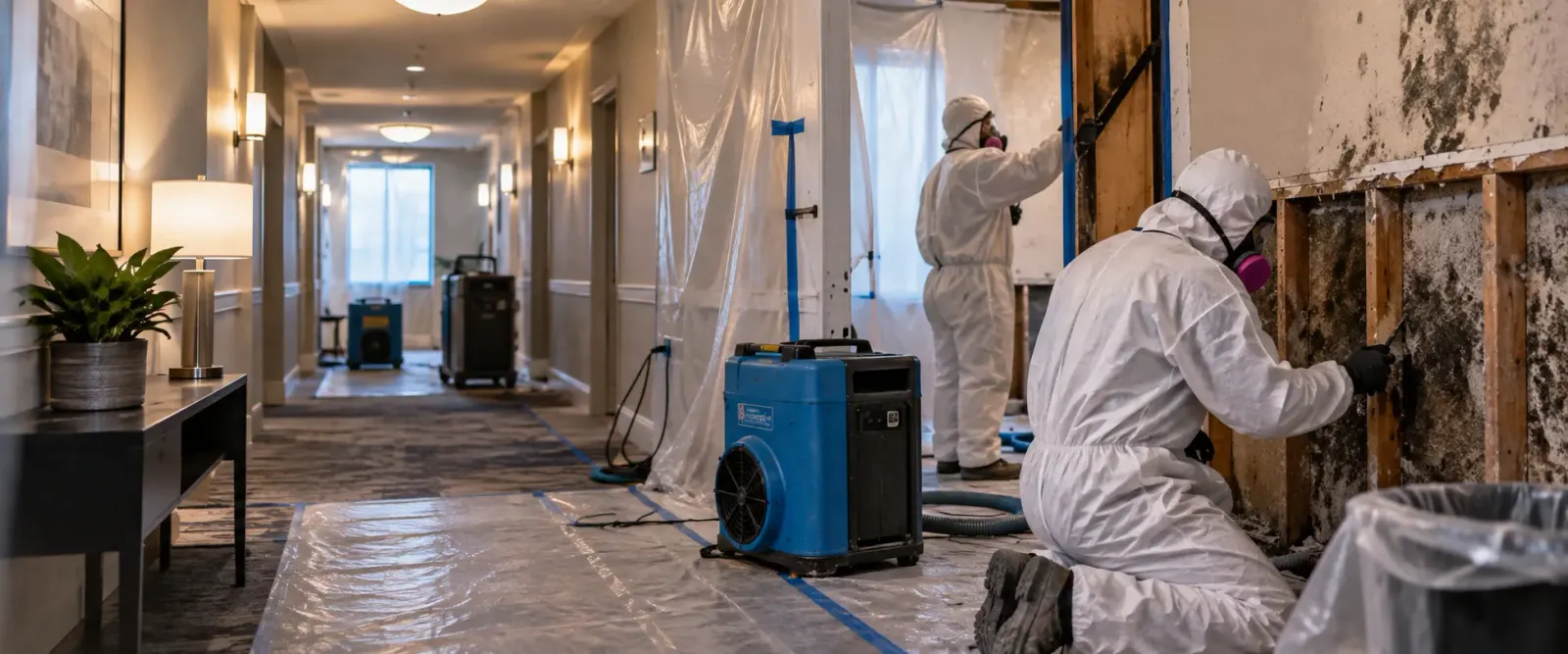
Limited containment is one layer of 6-mil fire-retardant sheeting under negative pressure; full containment doubles it and adds an airlock.
Porous materials with growth are bagged inside containment and discarded; framing is damp wiped and HEPA vacuumed once dry. In migrant units closed all winter, cabinet bases and wall bottoms under windows are opened. Removal is the goal, since dead mold still causes allergies.
Meters confirm dry materials before anything is closed up, and the log keeps every day's readings.
Clearance follows EPA: moisture fixed, no visible mold, no moldy odor, no new growth on a revisit, then S520 verification. Any rebuild continues as reconstruction.
Where mold happens in Westley
Westley is small, and its mold risks differ by block: closed seasonal units, sheds by the tracks, and homes without storm drains.
Highway 33 commercial strip, Howard Road to E Street
Both grocery stores and the town's commercial frontage, with a WSID office building of up to 6,500 sq ft planned at C Street. Under any suspended ceiling there, a roof leak grows mold on the tile tops.
Packing sheds and warehouses along Highway 33 and the railroad
Agricultural warehouses and packing sheds along the highway and the tracks on the east side of town. Stored crops and packing materials under a leaking roof are handled as contents once the roof leak is fixed.
Westley Migrant and Farm Labor Housing Complex
Housing Authority units on the west and south-west side, open from 18 May to 13 November. Units shut through the wet months are inspected for staining and odor before the season, and growth is removed before residents return.
Lettered streets, B Street to E Street
The grid of lettered streets from B to E, crossed by 2nd and 3rd, with WSID's office at 116 E Street. Homes here are checked where runoff meets the foundation, since the town has no storm drains to carry it off.
Howard Road and Livingston Circle
The southern edge and the road to I-5, a two-lane route designated a future four-lane expressway. Houses along it are inspected at the slab edge and in any crawl space after a wet winter.
Kern Street fire station and Grayson Charter School
Station 53 at 8598 Kern Street and the K-5 school, whose streets have curbs, gutters and above-ground ditches. In the school buildings, air handler drain pans and ceiling tiles under roof leaks are where growth hides.
Walt, Haidlen and Beall Avenues and Wildermuth Circle
Named on the Community Plan map as residential streets, with a StaRT stop where Griscott Way meets Walt Avenue. Each house here is inspected first where water collects around it after rain.
Westley wastewater plant and the River Road force main
The Housing Authority's plant, at capacity, and the planned 3.25-mile force main to Grayson. A building that a sewer backup reaches loses its soaked drywall and flooring, and the rest is dried before growth starts.
WSID South Lateral, the Westley Wasteway and Frank Cox Road
The canal and the tracks roughly bound the east side, with the Westley Wasteway on the County map. On this edge, as anywhere in town without storm drains, standing water after a storm is checked at foundations.
Westley Airport, northern edge
A private field on the northern edge that Valley Crop Dusters owns, used mostly by crop dusters. Hangars and outbuildings with roof leaks are sized under EPA Table 2 like any commercial space.
Westley Triangle, Interstate 5 at McCracken Road
Fifty acres at 7001 and 7003 South McCracken Road, between the freeway and the California Aqueduct, holding a 1,752 sq ft manufactured dwelling, marked FEMA Zone X on the applicant's plan sheet. In a manufactured dwelling, leaks under the floor are checked from below.
Farmland edge and the Westley rest areas on Interstate 5
Prime farmland of about 1,000 acres west and north-west of town, and the Caltrans rest areas on I-5, whose leach fields and bathroom plumbing were repaired in November 2012. Farm dwellings are checked where drainage runs toward them.
Mold sub-services available in Westley
Questions from Westley property owners and managers
It is a reason to check. The CDPH renters booklet names a moldy odor in a sealed-up home as a sign of hidden growth, and the center's units stand closed from mid-November to mid-May, through most of the rain. The inspection finds the leak or damp source, looks behind cabinet bases and wall bottoms, measures any growth under EPA Table 2, and removes it inside containment before residents move back in.
It can if it reaches the structure. Runoff goes to rock wells, and water they cannot take stays on the lot until it soaks in. CDPH lists outdoor surfaces that drain toward a building, and damp, exposed dirt in crawl spaces, among the causes of indoor dampness, and its code enforcement guidance gives a ground moisture barrier as the crawl space fix. The subfloor and framing are read for moisture before anything is decided.
Stanislaus County. Its Building Permits Division at 1010 10th Street, Suite 3400, Modesto, open weekdays from 8:30 am to 4:30 pm, requires a permit for rebuilding or remodeling existing structures as well as for new work. The Community Services District holds no land use authority in Westley. In a Special Flood Hazard Area, the County also reviews repairs as a possible substantial improvement before the work begins.
In the migrant center, in units closed through the wet months where a leak goes unseen. In homes, at foundations and crawl spaces where runoff stands, since the town has no storm drains, and in rooms a sewer backup reached. In the packing sheds and warehouses, under roof leaks over stored crops and packing materials. The school and the grocery stores add air handler drain pans and ceiling tiles.
EPA's water damage table for schools and commercial buildings asks for a response within 24-48 hours to prevent mold growth. In a Westley migrant unit that stays closed all winter, that window passes long before anyone sees the water, so the inspection at reopening assumes growth may be present and looks behind finishes as well as on them.
The California Department of Public Health says current consensus does not justify treating some molds as especially toxic. What sets the removal method is the size of the affected area and the material it grows on, under EPA Table 2, whatever the species or color. Every type is removed, the moisture behind it is fixed, and the area is cleared against EPA's finish criteria.
Mold remediation near Westley

