Why mold happens in Crows Landing
Crows Landing leaves its rain to soak in at the roadside, and water that waits at a foundation feeds mold inside. The County's 2015 report found neither pipes nor detention ponds, and curbs and gutters missing across most of town. The CDPH renters booklet lists outdoor surfaces that drain water toward a building, and damp, exposed dirt in crawl spaces, among the causes of indoor dampness. January averages 2.66 inches at Newman, the closest normals station, so winter is when lower walls and subfloors need checking.
Every home and business in Crows Landing is on a private septic system, so a backup puts contaminated water straight into floors and walls. LAFCO's review found nothing nearby that could give the town public wastewater service. Drywall, carpet and pad that a backup soaks are bagged and discarded inside containment, and framing and slab are cleaned and dried behind them. The CDPH code enforcement sheet advises replacing materials that cannot be thoroughly dried within a day, so porous material a backup reaches is not left in place to dry.
A County survey found 41% of Crows Landing's housing needing rehabilitation, and deferred repairs let leaks run. Census estimates for 2020-2024, with very wide margins, place about 52 homes in 1939 or earlier and 76 more in the 1940s and 1950s, along with some 31 mobile homes and 22 duplex units. In houses that old, slow leaks under sinks and behind walls stay hidden until an odor is noticed. In a mobile home, a plumbing leak under the floor is traced from below before the growth it feeds is measured.
Bonita Elementary is the town's only school, and schools are where EPA's mold guidance is aimed. The K-5 school on Bonita Avenue had 156 students in 2014, with the 1-acre Bonita Park and Pool across the street. EPA's guide for schools and commercial buildings points to condensate drain pans and porous duct liners in air handlers, to the tops of ceiling tiles under roof leaks, and to moisture problems in portable classrooms and other temporary structures. In a school, containment keeps the work away from classrooms in use.
Summer in Crows Landing moves moisture indoors through cooling, and farm storage adds large roofs. Newman's normals give a 100.0°F July high and almost no rain from June to September, so air handlers carry the season and their drain pans become the moisture source. The walnut storage site on Crows Landing Road holds four steel buildings, 80,300 sq ft in all, and packing sheds line Highway 33 and the tracks. A leak over stored crop or packing materials is handled as contents, sized under EPA Table 2 with the structure.
Stanislaus County runs a Class III landfill for non-hazardous municipal solid waste at 4000 Fink Road, open Monday to Saturday. Mold-damaged drywall, carpet and insulation from a Crows Landing job, sealed in plastic bags inside containment, go there for disposal.
Mold remediation, as delivered in Crows Landing
The town sits on Highway 33 between Patterson and Newman, 20 road miles from the Modesto base, with I-5 3 miles west at the Fink Road interchange. Containment is checked on every visit, and readings and photos join one file.
Highway 33 through town is two lanes with a four-way stop at Fink Road and Crows Landing Road, and I-5 is 3 miles west. December and January tule fog and harvest traffic can push arrival toward 140 minutes, the far end of the window. The time is confirmed when the request is acknowledged.
Remediation begins with the moisture source. In Crows Landing it is usually runoff standing against a foundation with no storm drain to carry it, a septic backup, a leak in a pre-1960 house or mobile home, or a roof over farm storage.
The growth is measured and placed in EPA Table 2's small, medium or large band; hidden mold found later is added to the plan.
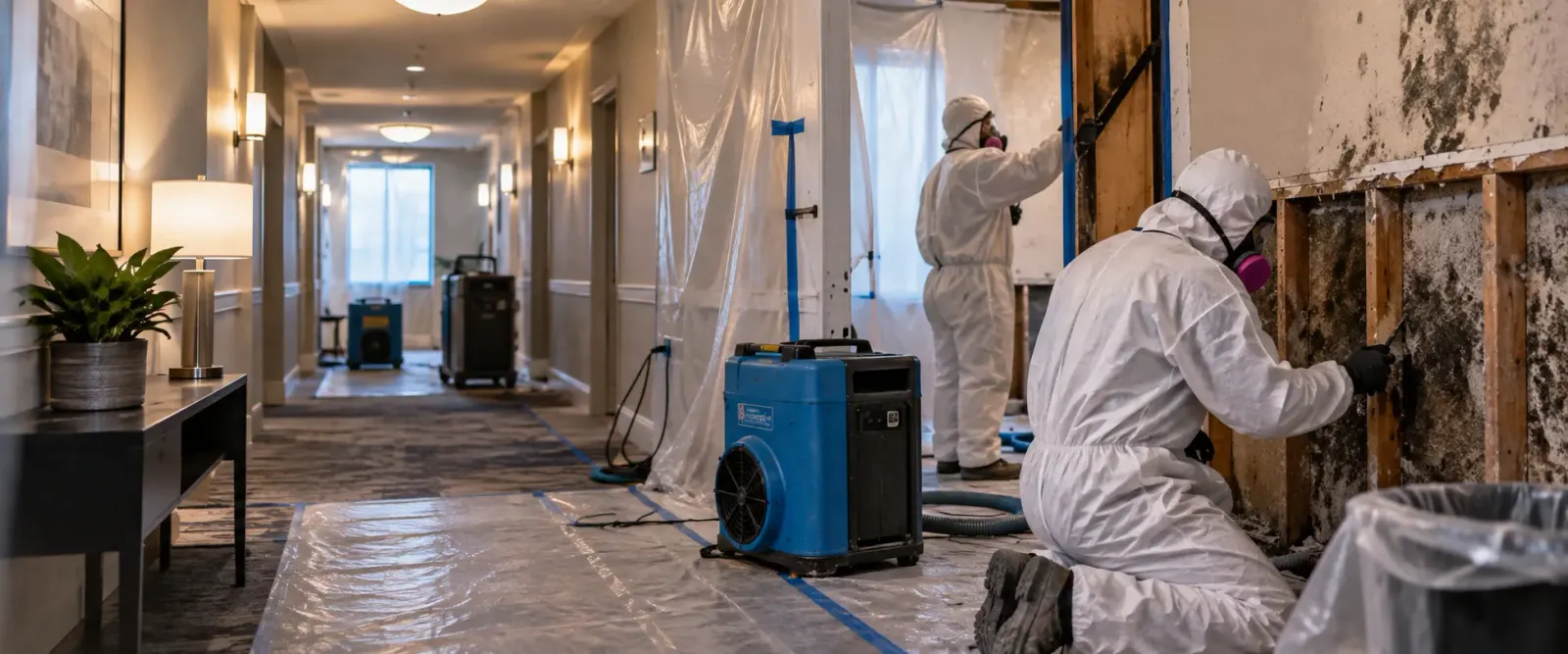
Negative pressure holds single 6-mil sheeting around a medium area; a large area gets double layers and a decontamination airlock.
Porous materials with growth are bagged inside containment and hauled under EPA Method 4 to the County's Fink Road Landfill; hard surfaces are damp wiped and HEPA vacuumed once dry. Removal is the aim, since dead mold is still allergenic.
The meter has to show each material dry before it is covered, and every reading is logged.
EPA's finish criteria settle clearance: no visible mold, no moldy odor, a revisit without regrowth, occupants back without complaint. S520 verification, then reconstruction.
Where mold happens in Crows Landing
Crows Landing's areas are few but differ: septic highway lots, older houses without storm drains, a school, farm storage and flood ground.
Highway 33 and the 5th Street commercial strip
The commercial frontage west of the highway and along 5th Street, with lots like 21931 State Highway 33 on District water and a private septic system. A septic backup into a small shop wets its lower walls first.
Packing sheds and warehouses along Highway 33 and the Union Pacific
Agricultural warehouses and packing sheds by the tracks, on blocks whose zoning runs from General Commercial through Limited Industrial. A roof leak over stored produce or packing materials is handled as contents and structure together.
G Street and the civic block
The fire station at 22012 G Street, rated Poor and needing replacement or major renovation, where the water district meets monthly. In an older civic building with a suspended ceiling, a roof leak puts growth on the tile tops.
West 5th Street, I Street and Fink Road (south-west edge)
Houses around the 1893 church on three sides; the church parcel sits in FEMA Zone X on Vernalis and Zacharias clay loams, facing farmland over Fink Road. With no curbs or gutters, runoff at each foundation is where the inspection begins.
Bonita Avenue: Bonita Elementary and Bonita Park and Pool (north-west edge)
The K-5 school, 156 students strong in 2014, faces the 1-acre Bonita Park, whose pool was shut for repairs in 2015. School air handlers and ceilings under roof leaks are checked, with containment kept clear of classrooms.
4th Street well sites
Well No. 4 on 4th Street, proposed for replacement in 2024 with a new pump motor and controls. Nearby homes sit on the District's old galvanized mains, and a leak inside a house is found by moisture reading.
East side: E Street, Armstrong Road, East 5th Street and the Main Canal
E Street and Armstrong Road bound the town on the north-east, near the CCID Main Canal and the walnut storage buildings off Crows Landing Road. Houses on this edge are checked where yard water drains toward them.
Highway 33 and Fink Road / Crows Landing Road junction
The main crossroads and its four-way stop, where the highway carries 4,600 to 6,000 vehicles a day on either side. Buildings facing it have no storm drains either, so their foundations are read after heavy rain.
Crows Landing Industrial Business Park, former Naval Auxiliary Landing Field (Fink and Bell Roads)
The former naval landing field north-west of town, where a 2018 plan sets 1,528 acres for a 370-acre public-use airport and some 14 million sq ft of buildings across 30 years. New buildings there will bring commercial roofs and central air.
Fink Road Landfill (4000 Fink Road)
The County's Class III landfill, open Monday to Saturday, with its estimated closure moved to 2050 by the 2020 permit. Bagged mold debris from local jobs goes here for disposal.
San Joaquin River and the Crows Landing Road bridge (the original landing)
The original landing, where the 670-foot bridge was to be replaced and in 2021 Reclamation District 2092 approved degrading floodplain berms across about 251 acres. Buildings reached by river water are opened and dried before growth sets in.
Orestimba Creek at Kilburn Road
About 2.4 miles east in FEMA Zone AE, with the 1890s ranch employee house at 21942 Kilburn Road. A house that age is checked under sinks, inside walls and at floor level after creek water.
Mold sub-services available in Crows Landing
Questions from Crows Landing property owners and managers
It is one CDPH names. Damp, exposed dirt in crawl spaces and outdoor surfaces that drain toward a building both appear in its renters booklet, and its code enforcement guidance gives a ground moisture barrier as the crawl space fix. The inspection reads joists and subfloor, removes growth inside containment, and records where the runoff reaches the house, since drainage in town is only roadside percolation.
In the pre-1960 houses, at hidden leaks under sinks and behind walls. In homes and shops, wherever roadside runoff stands against the foundation or reaches a crawl space, and after a septic backup. In mobile homes, under the floor. At Bonita Elementary and other buildings with central air, in condensate drain pans, and under any roof leak, on the tops of ceiling tiles.
Stanislaus County's Building Permits Division, 1010 10th Street, Suite 3400, Modesto, open weekdays 8:30 am to 4:30 pm. Its One-Stop Shop routes construction permits to Planning, Environmental Resources, Public Works and the Fire Warden's Office, and it handles floodplain administration, including elevation certificates. A rebuild or remodel needs a permit just as new work does, and the owner or the assigned contractor takes it out.
Porous material the sewage soaked, including drywall to above the wet line, insulation, carpet and pad, is bagged inside containment and discarded. Two days is already at the end of EPA's 24-48 hour window, so the remaining framing and subfloor are read for moisture, cleaned, HEPA vacuumed and dried. Bagged debris goes to the County's Fink Road Landfill, a Class III site for non-hazardous waste.
If it covers less than 10 square feet, EPA Table 2 needs no containment, only an N-95 respirator at minimum, gloves and goggles. CDPH suggests soap and water for small amounts, and advises against bleach, ammonia and vinegar. Stop the moisture first, or it comes back. Growth larger than that, inside a wall or crawl space, or after a septic backup is work for a crew.
Often not. EPA says containment is there to minimize the exposure of remediators and building occupants, and the sheeting should billow inward while negative pressure holds. A medium area sealed off that way usually leaves the rest of the house usable. A large job under full containment may need nearby rooms cleared, and EPA asks that occupants be told what is happening at all stages.
Mold remediation near Crows Landing

