Why mold happens in Newman
Roughly 500 Newman homes needed some repair at a February 2024 inspection, and worn roofs and plumbing are how water reaches their walls. That count covered about 15% of the housing stock, with needs running from roofing and plumbing replacement to paint and siding; the Central Residential District, bounded by Yolo, T, Inyo and P Streets, is one of four areas where those homes concentrate. A roof leak wets insulation and the top of a wall cavity, a plumbing leak its base, and the CDPH renters booklet lists a moldy odor among the signs.
Orestimba Creek floods Newman as shallow sheetflow, and walls it soaks from the floor up grow mold where no one can see. The General Plan EIR expects it from October to April, generally under two feet deep, and dates damaging floods to 1958, 1985, 1995 and 1998; the 1995 flood left more than two feet of silt-laden water inside structures. EPA lists the back side of drywall and paneling among hidden growth sites, and its water damage table gives 24-48 hours to prevent mold growth once materials are wet.
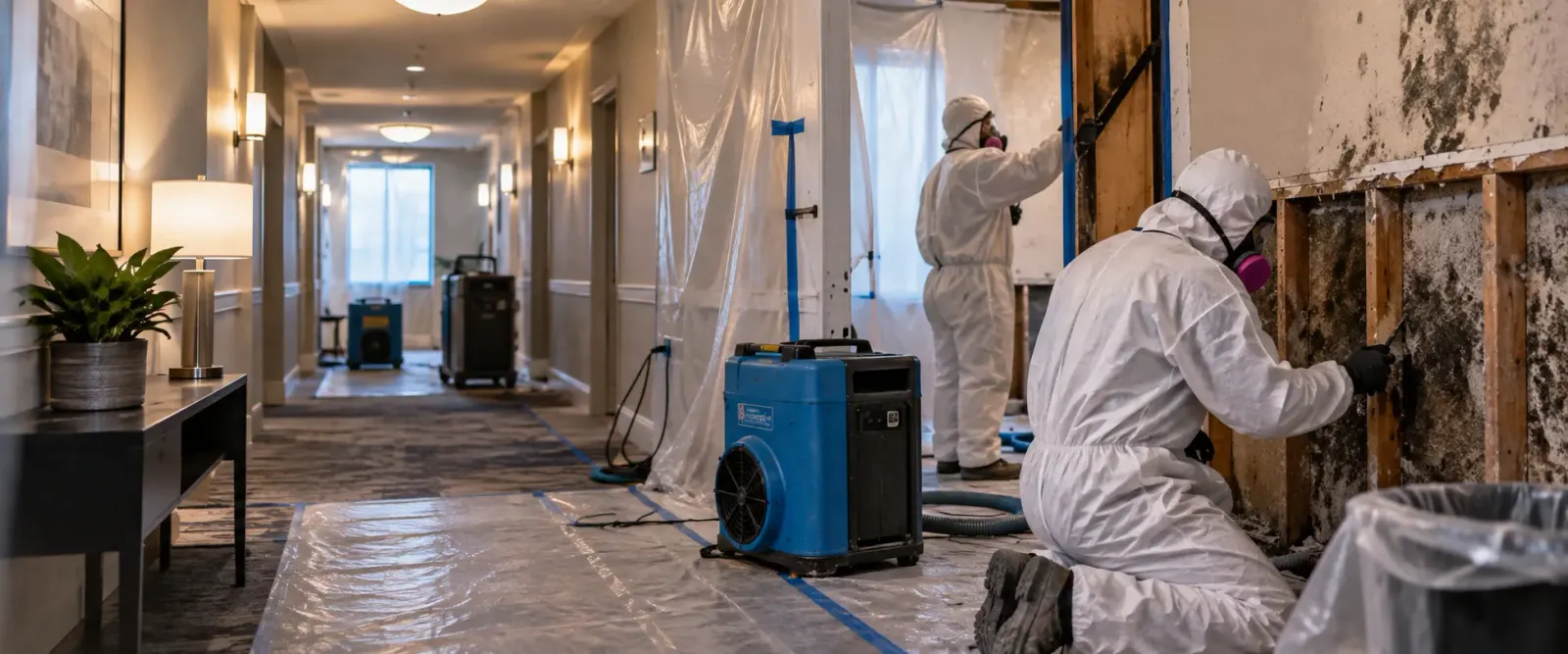
At Valley Manor on Driskell Avenue, an inspection found many balconies needing repair for dry rot, a sign that water has been getting into the wood. The 48-unit development at 719 Driskell Avenue is run by the Stanislaus Regional Housing Authority, and Newman Family Apartments, with 67 units, stands at 751. Water that gets past a failing balcony can wet the ceiling and wall of the unit below, where growth stays hidden. In apartments, containment keeps the work apart from the neighbours, and EPA asks that occupants be told what is happening at every stage.
Newman's newer subdivisions sit on former farmland with its own drainage history. The Newman Drainage District laid tile drains to lower high groundwater under the fields, and ground over them cannot be built on; the 2006 EIR expected a greenbelt over them along the eastern edge of Sherman Ranch. Creekbridge drains to the Clery Ditch, and Stephens Ranch and Creek Canyon to the Miller Ditch, both CCID. When a ditch runs full, yard water collects against slab edges, and growth shows first behind baseboards and on garage walls.
Newman's summers put its mold risk inside the cooling system. July at the Newman station averages a 100.0°F high, and the July and August normals show 0.00 inches of rain. Where air handlers run through that heat, EPA points to condensate drain pans and porous duct liners as places growth begins, and a blocked condensate line can wet a ceiling. At Westside Village Senior Apartments on Prince Street, 40 units for residents 55 and older, the crew works under a written Cal/OSHA 5144 respirator program, and containment keeps the work apart from residents.
Most of Newman's rain falls from December to March: 2.14, 2.66, 2.23 and 1.76 inches at the Newman station, of 11.71 in a normal year. Roof and plumbing leaks that open in those months and stay wet feed the growth found in spring.
Mold remediation, as delivered in Newman
State Route 33 brings the crew into Newman after 26 road miles from the Modesto base. At each visit the containment is checked first, and readings and photos go into one file for the owner and the adjuster.
The run ends on State Route 33, which crosses Newman beside the railroad. Road closures are the known delay: during the 1995 Orestimba Creek flood, many streets and Highway 33 shut, cutting emergency access. Propertyvendr confirms a time inside the 120 to 140 minute window with the request.
The water is stopped before removal. In Newman that tends to be a worn roof or old plumbing in a home the 2024 inspection flagged, Orestimba Creek sheetflow, a full CCID ditch or storm water backing up north of Inyo Avenue, or a failing Driskell Avenue balcony.
The area is measured in square feet against EPA Table 2 (under 10, 10 to 100, over 100), and hidden growth changes the plan.
Limited containment is single 6-mil fire-retardant sheeting under negative pressure; full containment adds a second layer, an airlock and HEPA-filtered exhaust.
Drywall, insulation and carpet with growth are bagged inside containment and thrown away; wood is damp wiped and HEPA vacuumed once dry. After creek silt, soaked wall bottoms are cut out with a margin above the stain. Biocide does not replace removal.
Readings with a moisture meter confirm dryness before closing up, and every reading enters the log.
Clearance uses EPA's checklist: no visible mold, no moldy odor, no damaged material, no regrowth on a revisit; then S520 verification and reconstruction.
Where mold happens in Newman
Newman's areas differ by age and by the water that reaches them: creek sheetflow, CCID ditches, the Inyo Avenue pipe or old roofs.
Downtown and Main Street
A grid of about six by six blocks: the commercial core, Newman's oldest houses and most of its unreinforced masonry, with much of it inside the 100-year flood zone. Brick walls wet by sheetflow stay damp, so the finishes against them are checked.
Central Residential District
Housing Element Area 1, where homes needing roofing and plumbing work concentrate most. A leaking roof here wets insulation and wall tops; an old pipe wets the base of a cabinet or wall.
Rehabilitation Areas 2 to 4
Area 2 runs from Inyo Street to Prince Road, Area 3 from Kern/Driskell Street to Eucalyptus Avenue and Area 4 from Lucille Avenue to Main Street. Deferred repairs let small leaks run long enough for growth to take hold.
Driskell Avenue apartments
Valley Manor's 48 units at 719, where many balconies needed dry-rot repair, and the 67 Newman Family Apartments at 751. Framing and ceilings under failing balconies are the places to inspect.
Highway 33 corridor and the Westside Shopping Center
In 2006, service commercial and gas stations along the highway and a then-new shopping center at the south end, plus 40 senior units on Prince Street. Where a store has a suspended ceiling, a roof leak grows mold on the tile tops.
Industrial zone east of Highway 33
From Kern Street to the Merced County line, with mini-storage and the F&A Dairy tanks noted in 2006. Stored contents in a storage unit that takes water can grow mold unseen until the door is opened.
Sherman Ranch and Lucas Ranch
North-east subdivisions drained by the Sherman Parkway channel, beside farmland whose tile drains were laid to lower high groundwater. Slab edges and garage walls are checked where yard water collects after rain.
Creekbridge, Stephens Ranch and Creek Canyon
Subdivisions draining into CCID's Clery and Miller ditches. When a ditch backs up, water reaches the lower walls of houses, and baseboards are pulled to look for growth behind them.
Inyo Avenue and Canal School Road
The pump station corner that most of the city drains to, with the 2006 bottleneck in the Inyo Avenue trunk pipe. Homes upstream, north of Inyo, are checked at wall bases after storm water backs up.
Mattos Ranch
A south-east master plan of homes and retail. Creek overflow that the railroad embankment diverts south ends up ponding in this part of the city, and ponded water soaks slab edges and garage walls.
Northwest Newman Master Plan area and Orestimba Road
A 362-acre plan adopted in 2017 outside city limits, partly in a 100-year flood hazard zone, next to the Orestimba Road and Fig Lane fringe of historic orchards, barns and farmhouses. Old farmhouses are inspected under sinks and at wall bases.
River Road parks on the San Joaquin
Mobile home and RV parks by the river, under evacuation in 2011 and 2023, when the County said some residents had severe water damage. Wet flooring and wall panels in a mobile home come out before growth spreads.
Mold sub-services available in Newman
Questions from Newman property owners and managers
It may be. EPA's water damage table asks for a response within 24-48 hours to prevent mold growth, so after a week any drywall, insulation and carpet that were not dried are treated as mold-damaged. They are bagged inside containment and discarded, and framing is cleaned, HEPA vacuumed and dried. Creek silt comes out with them, and any growth found behind the wall surface is added to the measured area.
In the older houses the 2024 inspection flagged, under worn roofs and at old plumbing inside walls. On the downtown grid and in some areas west of Main Street, in walls that Orestimba Creek sheetflow soaked. In Creekbridge, Stephens Ranch and Creek Canyon, at slab edges when a CCID ditch backs up. At Valley Manor, in framing under balconies with dry rot. In summer, at air handler drain pans; furniture and papers from a flooded room are packed out for cleaning.
The City of Newman Building Department, on the second floor of City Hall at 938 Fresno Street, taking applications Monday to Thursday, 8:00 am to noon. Work needing plan check is usually reviewed in about 10 days, and a permit expires 12 months after it is issued. On Main Street and elsewhere in the 100-year flood zone, Public Works must also receive an Elevation Certificate before final occupancy of a substantially damaged building.
Health and Safety Code section 17920.3 treats visible mold growth as a substandard condition where it exists to an extent that endangers the occupants, as determined by a health officer or code enforcement officer, and it excludes minor mold on surfaces that collect moisture in their normal use. Under Civil Code 1941.7, the landlord's duty to repair begins once the landlord has notice. HSC 26148 also requires the CDPH mold booklet for prospective tenants.
Testing is not how EPA judges a finished job. Its criteria are that the moisture problem is fixed, no visible mold, mold-damaged materials or moldy odors remain, a later revisit shows no new growth, and occupants return without complaints. Samples, where a plan calls for them, should look similar to outdoor air. CDPH advises against using measurements to judge health risk, and no federal limits for mold exist.
It can. Dry rot in balcony framing means the wood has stayed wet, and water that gets past a failing balcony can reach the ceiling and wall of the unit beneath. The inspection reads moisture in that ceiling and wall, opens them where readings are high, and measures any growth under EPA Table 2. The balcony repair is separate work, and it has to stop the water before remediation starts.
Mold remediation near Newman

