Why mold happens in Merced
When Bear Creek leaves its banks, hundreds of Merced homes are wet at the same time. The creek above McKee Road set a flood of record on 10 January 2023 at 26.18 feet, after 1.80 inches fell at the airport on 9 January, as the NWS Hanford report records. The City counted 1,600 residents displaced. In every flooded house the clock is the same: drywall, insulation and carpet that stay wet become mold-damaged material, and a wall that looks dry can still be wet inside its cavity.
Close to half of Merced's buildings stand in a mapped floodplain, and the same streets have flooded again and again. The Housing Element puts 48% of the city's buildings in the floodplain, and Bear Creek overflowed near Thornton Avenue and Highway 140 in 1969, 1997, 1998 and 2006. A house flooded more than once can carry growth from an earlier loss that was dried without being opened. EPA names wall cavities among the places hidden mold grows, so a repeat flood is checked behind the wallboard.
Most Merced homes are rented and many are old, and downtown the City rates a block of them for rehabilitation. Renters occupy 58.1% of homes, 12,357 of 26,673 are more than 40 years old, and between R and G Streets and 16th to 23rd Streets many pre-1980 homes lack basic plumbing or kitchen facilities. HSC 17920.3 makes visible mold substandard only where it endangers occupants, as determined by a health officer or code enforcement officer, and not where minor mold sits on surfaces meant to get wet.
Merced's enclosed mall and its industrial buildings put many ceilings under one roof, and a roof leak there wets tiles from above. The mall at 851 W. Olive Avenue, built in 1969, covers about 329,000 square feet, and a large share of the city's jobs are in the industrial areas of south and south-east Merced. EPA lists the top of ceiling tiles among the places hidden mold grows, and where a ceiling space serves as return air, growth on the tiles can reach the air handler.
In summer, Merced's heat moves the moisture problem indoors. The City's water plan gives about 12.2 inches of rain a year, most of it from November to April, and a July average maximum of 94.9°F. In the wet months, creeks and roofs are the sources. Once the cooling season starts, EPA names condensate drain pans and porous duct liners as places mold grows, in north Merced apartments, offices and homes rented to UC Merced students alike.
On 4 April 2006 a break in Black Rascal Creek flooded homes in north Merced while Bear Creek flooded part of West Merced: about 300 homes took water. When a flood reaches that many houses at once, each one runs on its own drying clock.
Mold remediation, as delivered in Merced
Merced is 40 road miles from the Modesto base on Highway 99, the freeway that split the city into north and south in the 1960s. The same file carries each reading, photo and clearance note.
Highway 99 runs through Merced past the G Street, R Street and Route 59 junctions, carrying 44,000 to 62,000 vehicles a day in 2024. December and January tule fog and harvest trucks push the drive toward 140 minutes. Propertyvendr confirms the time and runs the file.
In Merced the source can be a creek, with Bear Creek, Black Rascal, Fahrens or Cottonwood water left in the walls, a slow leak in an older downtown rental, or condensate from central air. The moisture is stopped before containment goes up.
The growth and the wet material around it are measured in square feet and given EPA Table 2's small, medium or large size, revised if the walls reveal more.
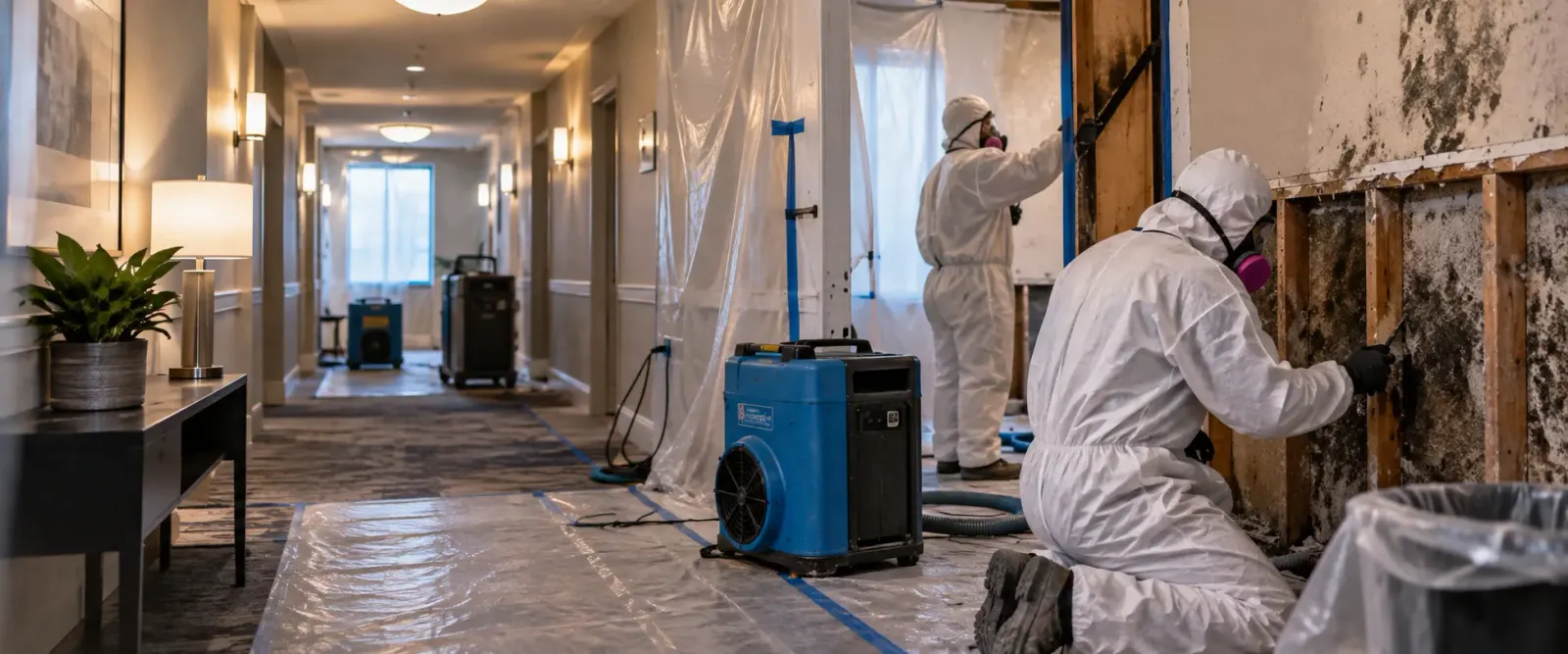
Sheeting around the area with a slit-and-flap entry, air kept negative, vents blocked, respirators on a Cal/OSHA 5144 program.
After a creek flood, drywall and insulation from the lower walls of Bear Creek houses are bagged inside containment and discarded. Framing left in place is HEPA-vacuumed once dry and damp-wiped; a biocide is no substitute for removing the growth.
Moisture meters confirm the cavity and framing are dry before insulation and wallboard go back, logged daily.
Clearance to EPA's completion criteria and S520 post-remediation verification, then photos and records to the owner or adjuster, and rebuild on the same file.
Where mold happens in Merced
Merced's areas split between creek-side streets that flood, the older rental blocks downtown and south, and newer north and northeast Merced.
Downtown Merced
Between R and G Streets and 16th to 23rd, many pre-1980 homes lack basic plumbing or kitchen facilities and are rated suitable for rehabilitation. In rentals like these, leaks hide under sinks and behind walls.
Applegate Park and the Bear Creek blocks north of downtown
The park follows Bear Creek between M and R Streets, and on 10 January 2023 the City lifted evacuation orders for blocks of W. 25th to 28th Streets. Ground floors that flooded are opened and dried before growth sets in.
North and South Bear Creek Drive
In January 2023 the creek came over its banks on W. North Bear Creek Drive and Bear Creek Court, and onto the road near E. South Bear Creek and Montana. Walls that took creek water are opened and read low.
West Merced at Thornton Avenue and Highway 140
Bear Creek overflowed here in 1969, 1997, 1998 and 2006, flooding a residential section of West Merced in April 2006. A house flooded more than once is checked for growth left from an earlier loss.
North Merced and Black Rascal Creek
Housing and apartments from the 1970s and 1980s, built to later street standards; a Black Rascal break flooded homes here in April 2006. In apartments, growth from a shared-wall leak is traced into the next unit.
Olive Avenue and M Street, the enclosed mall
The 1969 enclosed mall of 329,000 sq ft on 53 acres, whose sale to a new owner was announced in June 2024. Under its roof, growth on the tops of ceiling tiles is found by lifting them.
Fahrens Creek and Fahrens Park
Fahrens Creek overtopped slightly in January 2023, and the City is working to make the Fahrens Park basin a natural trail for bikes. Houses near the creek are checked at their lowest walls after high water.
Northeast Merced, the Bellevue Corridor and UC Merced
UC Merced has almost 10,000 students, and in Districts 4 and 6 newer homes rented by the room have pushed up overcrowding. CDPH's code enforcement sheet lists bathrooms without working fans as a cause of damp.
South Merced
Older homes on smaller lots with many apartments, and more neighborhoods without sidewalks than elsewhere, some first built on county land with older infrastructure. Old supply and drain lines inside walls are checked first.
South and south-east industrial areas and Merced Regional Airport
Industrial zones beside the freeway, the airport and the railroad hold a large share of the city's jobs. In offices inside industrial buildings, a roof leak over ceiling tiles is where hidden growth starts.
Highway 99 corridor
The freeway carries 44,000 to 62,000 vehicles a day between G Street and the Route 140 West junction, with older areas south of it and 1970s and 1980s building north. A building's age sets where the checks start.
16th Street and Route 59 (Martin Luther King Jr. Way)
Route 59 carries 23,000 to 27,500 vehicles a day at 16th and V Street, and the high-speed rail station is planned beside SR 99, with an alternative on 16th Street. Buildings here are scoped from the moisture source.
Mold sub-services available in Merced
Questions from Merced property owners and managers
It can, if wet material was left in place. The CDPH code enforcement sheet advises replacing materials that cannot be thoroughly dried within a day, and EPA names wall cavities among the places hidden mold grows. Readings are taken inside the lower wall cavities of a flooded house, not only on the surface. If growth turns up behind the wallboard, EPA says the plan is revised to cover the total area before removal starts.
Along the creeks, in the lower walls of houses that took floodwater from Bear Creek, Black Rascal, Fahrens or Cottonwood. Downtown and in south Merced, under sinks and behind walls in older rentals. In north Merced's 1970s and 1980s apartments, at shared walls between units. In the enclosed mall and the industrial buildings to the south, on the tops of ceiling tiles beneath a roof leak, where store stock and stored goods are packed out and cleaned off site.
The City of Merced Inspection Services Division, at 678 W. 18th Street, handles building permits, plan review and inspections through the City's online permit portal. The permit covers the rebuild of walls, floors and finishes taken out during remediation. Containment, removal and cleaning come first, and the reconstruction then follows under the same file, with the clearance record and photos available for the plan reviewer or adjuster.
Usually in the rooms away from the work. EPA uses containment to minimize the exposure of both the crew and the building's occupants, and asks that occupants be told what is happening at every stage. The work area is sealed and kept under negative pressure. A small area under 10 square feet needs little disruption, while a large one with full containment may take a bathroom or bedroom out of use for its duration.
Not automatically. Health and Safety Code 17920.3(a)(13) covers visible mold growth only as determined by a health officer or a code enforcement officer, only to an extent that endangers the occupants, and never for minor mold on surfaces that normally collect moisture. Civil Code 1941.7 makes the repair duty arise once the landlord has notice. Every prospective tenant must also receive the CDPH booklet under HSC 26148.
EPA's Table 2 puts areas under 10 square feet in its small category, with no containment required and at least an N-95 respirator, gloves and goggles. CDPH suggests soap and water for small amounts and warns against bleach, ammonia and vinegar. If the leak is not fixed, or the stain keeps returning or runs behind the wallboard, it may be larger than it looks and is measured first.
Mold remediation near Merced

