Why mold happens in Ripon
A Ripon cloudburst pushes water across lawns, into garages and up to front doors, and mold follows in whatever stays wet. In a storm the Manteca Bulletin reported in October 2018, 2½ inches fell in two hours and overwhelmed the storm system; manholes popped on Doak Boulevard and traffic wakes shoved street water into garages. EPA's Table 1 asks for a response within 24-48 hours to prevent mold growth. Garage drywall wet along its bottom edge is usually the first material to go.
South of Main Street, Ripon's bungalow blocks are old enough for leaks to run inside walls unseen. Bungalows, Mission Revival and Classical Revival cottages of about 1910 to 1920 line Stockton, Walnut, Locust, Elm, Orange, Palm and Acacia streets, and Queen Anne and Italianate cottages near the old depot are older still. In a 2009 survey of part of the older areas, 374 of 644 parcels showed signs of dilapidation or deterioration. The CDPH renters' booklet names leaks under kitchen and bathroom sinks as a common start.
At the Jack Tone Road interchange, motel rooms stay occupied while the room next door is remediated. The General Plan describes two travel plazas, fast-food restaurants and motels added there, at an interchange designed for large volumes of traffic, trucks above all, with Highway 99 carrying 139,000 vehicles a day. Where guest rooms are finished in vinyl wallcovering, it traps moisture in the drywall behind it, and EPA warns that stripping wallpaper from a moldy wall can release a massive amount of spores. The room is sealed before any wallcovering comes off.
Ripon's food plants run large buildings where condensation and roof leaks are the moisture sources to find. Diamond Pet Foods has operated at 942 South Stockton Avenue since 2013, and in 2015 the North Pointe plan area held food-processing plants, trucking yards and the Goodwin Business Park, beside almond orchards. EPA lists condensation at cold spots in a building among moisture sources, and a roof leak over plant offices wets the tops of ceiling tiles, where the growth stays hidden.
In the apartment buildings on West Main Street, one unit's leak can reach its neighbors, and one building is senior housing. The Housing Element lists Almond Blossom (42 units, 1984), Almond Queen Apartments (12 units, 1985) and Bethany Home Senior Apartments (94 units, 2006/2007) on West Main. EPA's guide for commercial buildings says containment is there to minimize the exposure of remediators and building occupants and asks for communication with occupants at all stages, so residents hear the plan before sheeting goes up.
The City gives Ripon about 13 inches of rain a year, some 85% of it between October and March. Those six months bring the roof, window and yard water that reaches buildings, and anything left wet past EPA's window turns into mold to remove.
Mold remediation, as delivered in Ripon
Ripon is 11 road miles from the Modesto base, north on Highway 99 over the Stanislaus River. One assigned crew handles containment, removal and clearance, adding each day's readings to the same record.
Highway 99 is the only direct crossing of the Stanislaus from Modesto, and the City notes it can be closed by emergencies. Inside Ripon, north-south traffic funnels onto the Main Street, Fulton Avenue and Jack Tone Road overpasses. Arrival is within 90 to 120 minutes; fog and harvest trucks push toward the long end.
The growth's water supply is cut off first. Ripon's common sources: cloudburst water in garages on Wilma Avenue or Doak Boulevard, sink leaks in the bungalows south of Main, roof leaks over plant offices, and moisture trapped behind motel wallcovering at Jack Tone Road.
Measured area sets the EPA Table 2 size, from under 10 square feet to over 100, and hidden growth found later is added to the plan.
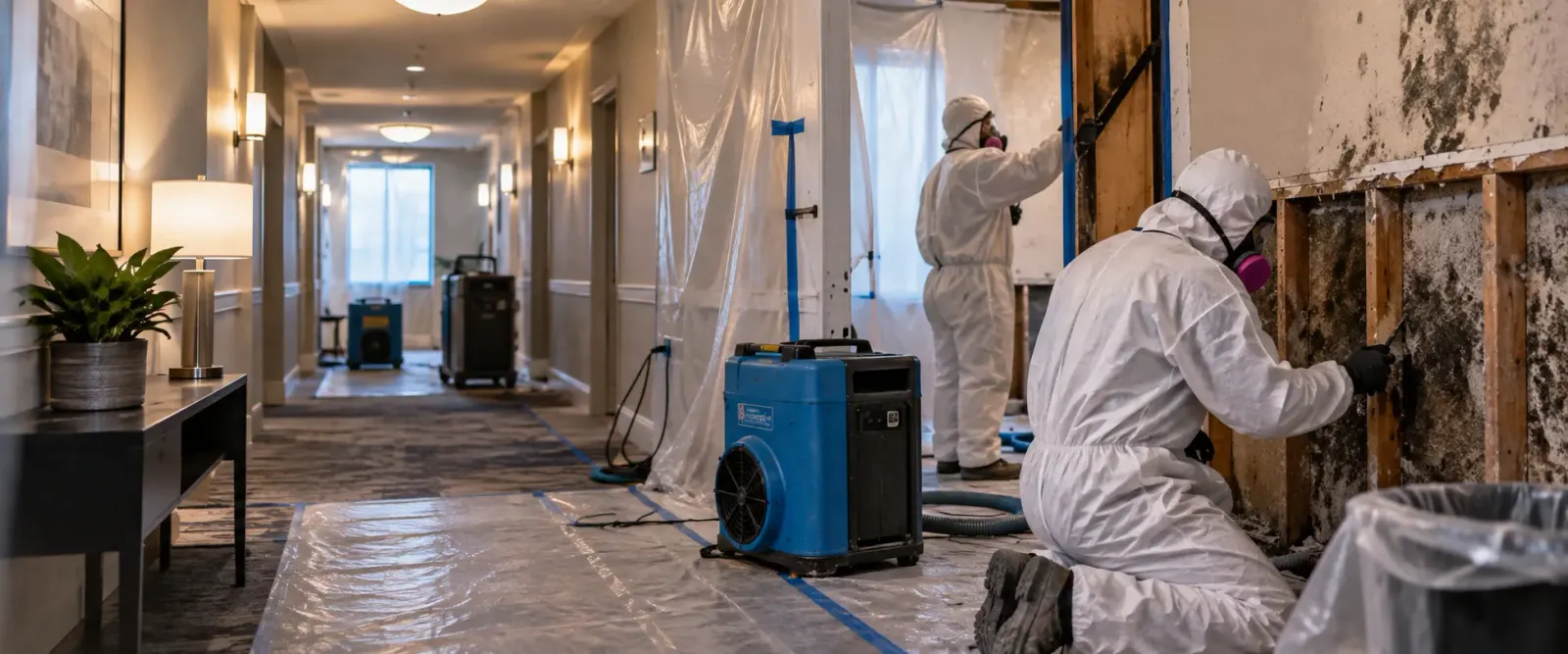
6-mil fire-retardant sheeting, negative air and sealed vents; large jobs get a double layer and an airlock. Respirators follow Cal/OSHA 5144.
Removal uses EPA's methods, from damp wiping hard surfaces to discarding porous material, which is bagged inside containment. Drywall along garage wall bases and behind motel wallcovering are Ripon's frequent discards. Biocide is not a routine step, because EPA notes that dead mold is still allergenic.
Before anything is closed up, moisture meter readings confirm the framing and slab are dry, and each is logged.
Clearance follows EPA's criteria and S520 post-remediation verification: no visible growth, no moldy odor, no regrowth on a revisit. Reconstruction takes over the same file.
Where mold happens in Ripon
Ripon's areas divide at Highway 99 and the railroad, and mold follows each one's building age, drainage and use.
Downtown Main Street
Two-story brick buildings from 1884 to 1912, including the Riddle Building, the Odd Fellows building and the Markham Hotel; downtown's substandard water lines were replaced or upgraded in 1996. Roof leaks over old brick reach ceilings and upper walls.
Stockton, Walnut, Locust, Elm, Orange, Palm and Acacia streets south of Main, and the depot area north of Main
Bungalows and Revival cottages of 1910 to 1920 south of Main, and older Queen Anne and Italianate cottages near the depot. Leaks under sinks and behind bath walls feed hidden growth in houses this old.
South Stockton Avenue industrial district
Most of the city's industry in 2006, including Diamond Pet Foods at 942 S. Stockton Avenue, opened in 2013. Plant offices are checked above the ceiling tiles, and cold surfaces for condensation.
Former paper mill by the Stanislaus River
Simpson Lee opened the mill in 1965; it passed to Fox River Paper and closed under Neenah Paper in 2009. Industrial buildings of that scale are traced for roof leaks before any scope is set.
Stanislaus River corridor and the Vera district
Ripon's only FEMA 100-year flood zone, with the wastewater ponds behind levees. A repair here costing 50% or more of market value counts as substantial damage under the City's flood code, whatever the cause.
Jack Tone Road and the SR 99 highway service corridor
Two travel plazas, fast-food restaurants and motels at the interchange, with runoff to a detention pond. Guest rooms beside a contained room stay occupied, and Canal Street just east of Jack Tone flooded in 2018.
North Pointe Specific Plan area
310 acres that in 2015 held orchards, food-processing plants, trucking yards and the Goodwin Business Park, with a detention basin at Mistlin Sports Park. Food-plant refrigeration lines and cold walls are checked for condensation.
Ripona Planning District
146 acres, 42 of them Urban Core, built out south of Milgeo Road. Commercial suites under one roof can share a leak, so the ceiling tiles across them are checked together.
Wilma Avenue and the North Wilma district
City Hall at 259 N. Wilma Avenue and a high school site. In 2018 water in the 600 block of Wilma reached front doors and garages; garage drywall wetted that way is checked in the days after.
Doak Boulevard and the southern edge
A through road along the south boundary, residential toward Mohler Road and industrial toward S. Stockton Street. At least three manholes were forced out in 2018, and buildings beside a road flooding that way are checked at floor level.
West Main Street and South Jack Tone district
437 acres of mostly low-density homes and commercial recreation land; along West Main stand the Almond Blossom, Almond Queen and Bethany Home Senior apartments. Residents of shared buildings hear the containment plan first.
2000s subdivisions
1,577 homes from 2000 to 2009, among them Chesapeake Landing, Brookline Estates, Montecito Estates and Seven Oaks. Irrigation overspray and yard drainage toward slabs show up behind baseboards and on garage walls.
Mold sub-services available in Ripon
Questions from Ripon property owners and managers
Getting the wet material dry or out quickly. EPA's Table 1 calls for a response within 24-48 hours to prevent mold growth. In the 2018 storm, water in the 600 block of Wilma covered lawns and reached garages and front doors before it receded, and drywall wet along its base, carpet and stored cardboard are the materials at risk. Anything porous that stays wet is removed; growth already showing is measured under Table 2.
In the bungalows and cottages south of Main and near the depot, it starts at sink and bath leaks inside old walls. In the 2000s subdivisions it grows behind baseboards and garage walls where irrigation and yard water reach the slab. At the Jack Tone Road motels it hides behind vinyl wallcovering, and in the South Stockton and North Pointe plants it follows condensation and roof leaks above office ceilings, where wet office contents are packed out for cleaning.
The City of Ripon Building Department at 259 N. Wilma Avenue, with applications online through its Permit Center. It checks residential and light commercial plans itself and sends heavy commercial and industrial plans to outside plan check services. The contractor assigned to the request files the application and books the inspections there.
They can. The City's flood damage prevention code defines substantial damage as damage of any origin where restoring the structure would cost 50% or more of its market value before the damage, so the cause does not decide it. The Director of Planning and Economic Development administers the ordinance and its floodplain permits, and confirms what a large repair must meet.
Health and Safety Code 17920.3(a)(13) treats visible mold growth, as determined by a health officer or code enforcement officer, as substandard only where it endangers the occupants, and excludes minor mold on surfaces that get wet in normal use. Where it applies, Civil Code 1941.7 starts the landlord's repair duty once the landlord has notice. Prospective tenants are also to receive CDPH's booklet on dampness and mold.
In most cases no. EPA says sampling is usually unnecessary where growth is visible, and no EPA or other federal limits have been set for mold. CDPH recommends against using measurements to judge the hazard. The room is sized under Table 2, contained and cleaned, then cleared on EPA's finish criteria, with samples taken only if a written plan calls for them.
Mold remediation near Ripon

