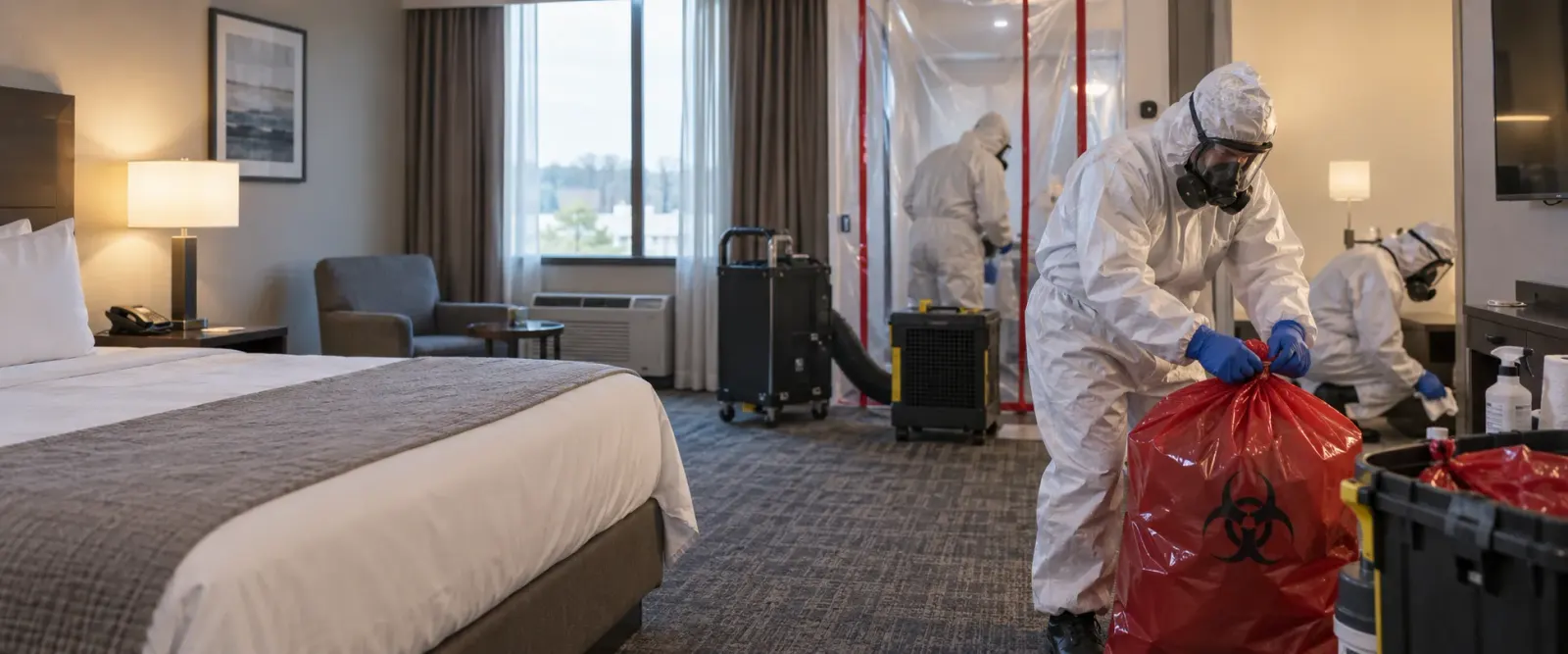
Why biohazard cleanup is needed in Westley
Housing that empties at the end of a season is checked for sharps before the cleanout begins. The Stanislaus Regional Housing Authority runs its Westley migrant center for a 180-day season, 18 May to 13 November in 2026, and its complex sits on the west side of town, just outside the Westley Community Services District boundary. Needles left in a vacated unit are home-generated sharps, which HSC 118286 keeps out of trash and roll-offs, so they are lifted with tongs and boxed in a rigid container before any bin is filled.
A backup from a small, overloaded sewer system brings human waste into the buildings it serves. The Housing Authority owns Westley's wastewater plant and runs it for both its own complex and the District; LAFCO reported in 2019 that the plant, designed for 90,000 gallons a day, was at capacity, and that the lift station and its two pumps had had short-term fixes and needed major repairs. A 2017 project would pump the town's sewage 3.25 miles to Grayson. The sanitation after a backup is this work; the drying is water damage restoration.
Public restrooms are where blood incidents and discarded needles are usually found, and Westley's include the freeway rest areas. Caltrans' Westley Safety Roadside Rest Areas on I-5, which carries 47,700 to 51,000 vehicles a day at Ingram Creek, run on their own water and septic leach fields, and Caltrans made emergency repairs to their bathroom plumbing in November 2012. Under Cal/OSHA 5193 the surfaces are decontaminated with an appropriate disinfectant as soon as feasible, and broken glass is never picked up by hand.
In a town with no city government, a hoarded house raises a county question, not a municipal one. Westley is unincorporated; the District provides water and sewer only, and LAFCO records that land use decisions within its boundaries stay with Stanislaus County. HSC 17920.3 counts rodent infestation, inadequate rubbish removal and accumulated junk and debris among the conditions of a substandard building. The crew's part is sanitation: sharps first, droppings wetted and wiped, and soiled porous items bagged.
Vehicles and trailers are trauma scene locations in their own right, and Westley sits between Highway 33 and I-5. Highway 33 runs through town past the packing sheds and warehouses along the railroad, and a 2024 County notice describes a proposal at the Westley Triangle for a truck stop and a 764-stall container yard open 24 hours. The IICRC S540 standard gives vehicle and other machinery remediation its own component, so a cab, trailer or forklift is cleaned as part of the scene.
The Housing Authority's Westley migrant center is open 180 days a year by regulation, from 18 May to 13 November in 2026, and its units stand empty through the wet months. Units that have been shut all winter are aired and checked before the next season opens.
Biohazard cleanup, as delivered in Westley
Westley is 16 road miles from the Modesto base, and the crew comes in on Highway 33 or by Howard Road from I-5. One scene log covers every visit, whether the address is a house, a packing shed or a seasonal unit.
Highway 33 through Westley is a two-lane undivided road with a four-way stop at Howard Road, carrying 2,500 to 3,000 vehicles a day at E Street. LAFCO notes long, narrow driveways and addresses that are hard to spot here, so a gate or landmark given with the request helps. Winter fog can stretch arrival toward 120 minutes.
Under S540 the crew starts only once law enforcement or the regulatory agency has released the scene. It then walks the Westley property for its inspection and preliminary determination: what is affected, which materials are porous, and whether a unit next door shares a wall.
Neighbouring units and household members are kept out of the work area. Universal precautions apply, protective gear stops fluids reaching skin or clothing, and respirators follow a 5144 program.
Soaked flooring and bedding are bagged and labelled as regulated waste; needles are boxed in rigid containers; glass is lifted with tongs.
Every affected surface is decontaminated with a List S disinfectant from the EPA and kept wet for the label's contact time. In a seasonal unit or farm building where rodents have been, doors and windows open for 30 minutes, and droppings are soaked, not swept.
Nothing stays on the property: bags go to a permitted transfer station or treatment facility, or a freezer up to 14 days.
Work closes with S540's confirmation of cleaning, which CDPH's cleaning information sheet helps the owner or manager check. Any floor or wall rebuild follows on the same file.
Where biohazard cleanup is needed in Westley
Westley's areas differ by use: the highway strip, seasonal farm labor housing, homes on the lettered streets, the District's sewer, and the I-5 edge.
Highway 33 commercial strip, Howard Road to E Street
The west side of Highway 33 is Westley's commercial area, with its two grocery stores, El Mercadito and the Westley Market/El Paisano Supermarket. A blood incident or needle in a store is cleaned and logged for the owner.
Packing sheds and warehouses along Highway 33 and the railroad
Agricultural warehouses and packing sheds line the highway and the tracks on the town's east side. An injury on a packing line is cleaned from floor to machinery under S540's machinery component.
Westley Migrant and Farm Labor Housing Complex
The Housing Authority's complex on the west and south-west side, with a community center and playground, and the wastewater plant and wells serving Westley. Its seasonal units are checked for sharps when a season ends.
Lettered streets, B Street to E Street
B, C, D and E streets and 2nd and 3rd streets inside the Community Plan boundary, with the WSID office at 116 E Street. A house on these blocks is cleaned under the same scene log as a larger building.
Howard Road and Livingston Circle
The southern edge of town and its road to I-5 at the McCracken Road interchange, about 3 miles west, with a bus stop at Livingston Circle. Street addresses here are given with a cross street to help arrival.
Kern Street fire station and Grayson Charter School
West Stanislaus Fire Station 53 at 8598 Kern Street and Grayson Charter School, a K-5 dual-language school. Staff who clean their own workplace do so under the employer's 5193 plan; a larger event goes to a crew.
Walt, Haidlen and Beall Avenues and Wildermuth Circle
Residential streets on the Community Plan map, with a bus stop at Griscott Way and Walt Avenue. A home here where a death went unnoticed loses carpet, pad and any soaked subfloor as regulated waste.
Westley wastewater plant and the River Road force main
The Housing Authority's plant, designed for 90,000 gallons a day and at capacity in 2019, and the 2017 plan to pump sewage 3.25 miles to Grayson. A backup into a home is sanitised before drying.
WSID South Lateral, the Westley Wasteway and Frank Cox Road
The canal and the railroad bound Westley on the east, where the town has no curbs, gutters or sidewalks. A needle found on a road shoulder is picked up with tongs and boxed.
Westley Airport, northern edge
A private airport owned by Valley Crop Dusters and used mainly by crop-dusting aircraft. An injury in a hangar or on an aircraft is scoped under the vehicle and machinery component of S540.
Westley Triangle, I-5 at McCracken Road
A 50-acre parcel between I-5 and the California Aqueduct, proposed in 2024 for a truck stop, a church and a 764-stall container yard. If built, its trucks and trailers would fall under S540 vehicle remediation.
Farmland edge and the I-5 rest areas
About 1,000 acres of prime farmland west and north-west of town, and the Caltrans rest areas on I-5 with their own septic leach fields. Rest area restrooms get blood and sharps handling to 5193.
Biohazard cleanup sub-services available in Westley
Questions from Westley property owners and managers
Units shut through the wet months are opened and aired first. Where rodent droppings or nests are found, CDC guidance is to ventilate for 30 minutes, soak them with disinfectant for 5 minutes or as the label directs, and wipe them up, never sweep or vacuum. Any needles are lifted with tongs into a rigid sharps container, since HSC 118286 keeps home-generated sharps out of trash and roll-offs. Each unit gets its own line in the log.
Not to the County. Stanislaus County's household hazardous waste facility at 1710 Morgan Road in Modesto lists biomedical waste among the items it does not accept. HSC 118321.5 has trauma scene waste removed immediately once the removal phase ends and taken to a permitted medical waste transfer station or treatment facility, or held in a dedicated freezer for not more than 14 days. The log records the time it left Westley.
LAFCO records that the Westley Community Services District has no land use authority and that those decisions stay with Stanislaus County. HSC 17920.3 names rodent infestation, as determined by a health officer or code enforcement officer, inadequate garbage and rubbish removal and heaped junk and debris among substandard conditions. Whether a house meets the test is the officer's call and what follows is the owner's; this is not legal advice.
The human-waste side comes first: soiled rugs, bedding and other porous items bagged, floors and fixtures decontaminated, and workers in goggles or a face shield, liquid-repellent coveralls, waterproof gloves and rubber boots. Pumping out the water and drying the house belong to water damage restoration under its sewage and Category 3 service. The plant and the lift station belong to the Housing Authority and the District.
Civil Code 1710.2 relieves an owner or agent of disclosing an occupant's death, or its manner, where the death happened more than three years before the offer to rent, and a tenant counts as a transferee. The section does not cover an intentional misrepresentation made in answer to a direct question. That is what the law states, not legal advice, and the decision stays with the owner or manager.
No. Hoarding cleanup handles what is hazardous: sharps, human and animal waste, rodent nests and droppings, and soiled porous belongings. Clearing the volume, sorting what stays and hauling the rest is a junk removal cleanout, requested separately. The sanitation is done first, so the haulers who follow do not handle needles or droppings.
Biohazard cleanup near Westley

