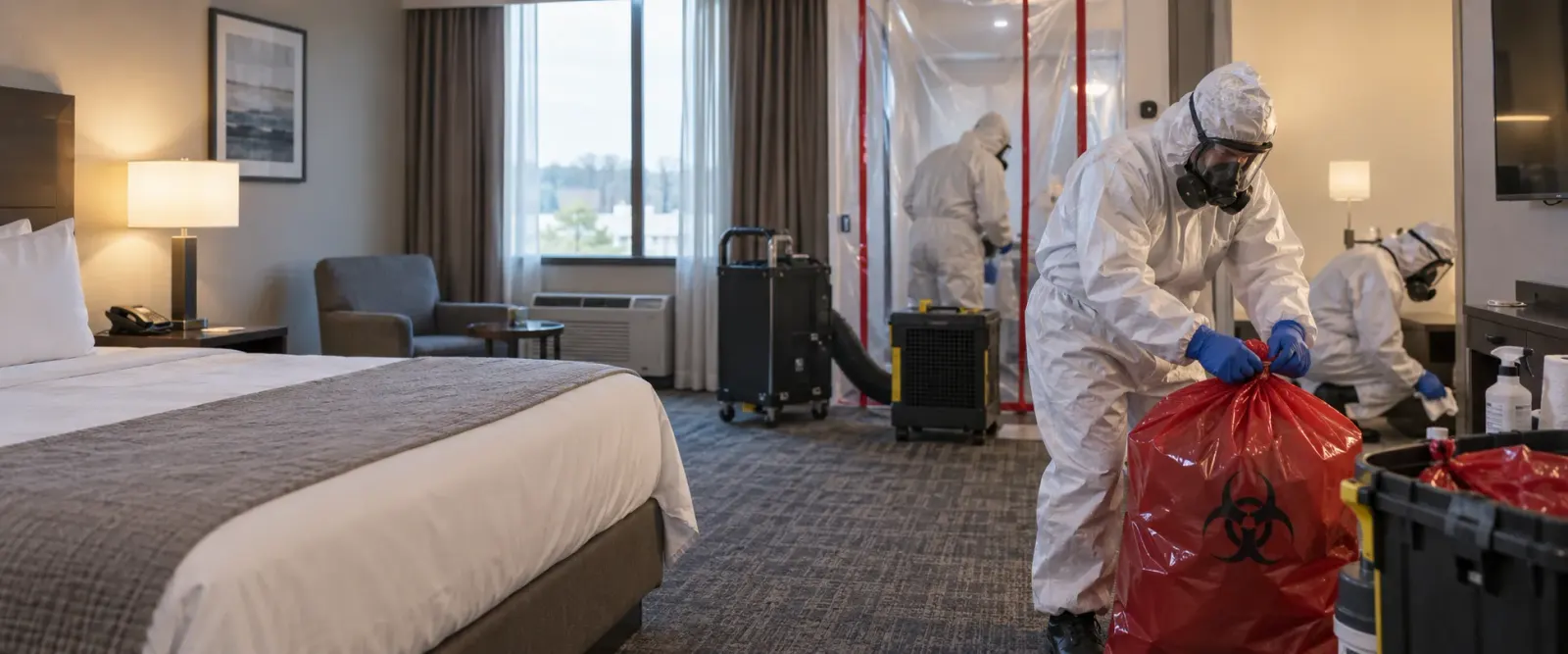
Why biohazard cleanup is needed in Modesto
When an unattended death in a rental is found late, fluids have already reached the floor structure. The College Area around Modesto Junior College is lined with 1940s to 1960s homes and rentals, and Census figures put the city's typical home at 1976, with much of the housing older than 1970. Fluids travel through carpet and pad into the subfloor beneath. Under Cal/OSHA section 5193, porous material that is saturated or caked, and could release blood or other potentially infectious materials when handled, counts as regulated waste, so it is cut out and bagged.
State law treats a mobile home as a trauma scene location, the same as a house. Modesto's mobile home parks sit on the low ground of the Riverdale Park and Tuolumne corridor, and there are trailer parks on 9th Street near downtown. The Health and Safety Code definitions name "mobile homes, trailers, or vehicles" in section 117776 as places a trauma scene may be. Homes in a park stand close together, so the work area is closed off and neighbours are kept clear of it until the waste is out.
Retail with public restrooms sees blood incidents and dropped needles in rooms that staff clean every day. McHenry and Standiford are Modesto's primary retail strips, with strip centers, pads, big-box stores and restaurant tenants, and the Standiford and Dale Road corridor adds 1990s and 2000s retail and medical centers on large parking fields. Staff who clean their own restroom work under their employer's 5193 plan. A manager who hands the room to a crew instead gets it back decontaminated, with each needle in a rigid container and a written record.
An injury on a warehouse floor spreads across slab, racking and machinery. Tilt-up warehouses, food processing plants and truck yards run along the Highway 99 industrial corridor from Kansas Avenue to Hatch Road. IICRC S540 lists vehicle and other machinery remediation among its components, so conveyors, forklifts and fleet trucks are cleaned as part of the same scene. Surfaces are decontaminated with a product from the EPA's List S for bloodborne pathogens, kept wet for the contact time on its label.
A hoarded house can meet the state's definition of a substandard building. Older housing with deferred maintenance stands in the Airport District and along Paradise and Carpenter roads in West Modesto. Health and Safety Code section 17920.3 lists rodent infestation, inadequate garbage removal and accumulations of debris and rodent harborages among its conditions. The sanitation side is cleaned by the CDC method: doors and windows open for 30 minutes first, and droppings are wetted and wiped, never swept or vacuumed.
Census figures date the typical Modesto home to 1976, and much of the city's housing predates 1970. In houses of that age, fluid that reaches the floor is traced through carpet and pad to the subfloor before the cleanup is scoped.
Biohazard cleanup, as delivered in Modesto
The base is inside Modesto, so a crew crosses town on city streets: McHenry Avenue to the north, Kansas Avenue to the west, Hatch Road to the south. Each visit adds to one scene log.
Most Modesto addresses are a short cross-town run from the base. The longest are at the city's edges, in Village One, Beyer Park and along Highway 99 below Hatch Road, where December and January fog or harvest trucks can stretch the drive toward 90 minutes. Propertyvendr gives the arrival time on acknowledgement.
IICRC S540 assumes law enforcement or the regulatory agency has released the scene before anyone starts. After release, the crew makes its inspection and preliminary determination: what is affected, which materials are regulated waste, and who in a shared building must be kept away.
Universal precautions apply from the door. PPE keeps blood and body fluids off skin, eyes and clothing, and respirators are worn under a written section 5144 program.
Saturated flooring and contents leave as regulated waste, sharps go into rigid containers, and each bag is labelled BIOHAZARDOUS WASTE.
Every affected surface is decontaminated with an appropriate disinfectant from EPA List S, held wet for the full label contact time. In a hoarded Airport District or West Modesto house, rodent droppings are soaked and wiped up by the CDC method, never swept.
Waste leaves as soon as removal ends, for a permitted medical waste facility or a dedicated freezer, 14 days at most (HSC 118321.5).
The job closes with S540's confirmation of cleaning, which CDPH's information sheet helps the owner judge. Floor rebuild moves to reconstruction.
Where biohazard cleanup is needed in Modesto
Modesto's areas differ by who shares the building: tenants, park residents, restaurant customers or shift crews.
Downtown
Pre-war brick and masonry mixed-use buildings on 10th and 11th streets, with shops below and space above. A scene on one floor is closed off so tenants on the others stay clear of the work area.
College Area
Homes and rentals from the 1940s to the 1960s around Modesto Junior College. When a unit is vacated, the cleanout can turn up needles, which go into a rigid sharps container and never into the roll-off.
La Loma
Houses from the middle of the last century sit on the Dry Creek bluffs among mature trees. Where rodents have nested in an older house here, droppings and nests are soaked with disinfectant for the label time and wiped up, never swept.
Village One
HOA subdivisions of the 1990s and 2000s on compacted fill. When an incident touches a common area, the HOA manager authorises the cleanup and the association receives the confirmation of cleaning.
McHenry and Standiford corridors
Strip centers, pads, big-box stores and restaurant tenants on the city's primary retail strips. Public restrooms and landscaped beds are where blood incidents and discarded needles tend to turn up in retail.
Highway 99 industrial corridor
From Kansas Avenue down to Hatch Road, the corridor holds tilt-up warehouses, food plants and truck yards. An injury on a line or dock is cleaned from slab to machinery, and fleet trucks fall under S540 vehicle remediation.
Airport District
East of the airport, older homes mix with light industry, and upkeep has often been deferred. A long-neglected house here may show the rodent and debris conditions HSC 17920.3 lists, and its sanitation is scoped apart from volume removal.
Sherwood Forest
Large-lot homes of the 1960s and 1970s under old canopy. Where rodents have reached a garage or shed on one of these lots, it is ventilated and cleaned by the same CDC method as the house.
Coffee-Sylvan
Established HOAs and 1970s to 1980s tracts. Shared space in an association is cleaned with the manager's sign-off, and the record of what was removed goes to the board.
Riverdale Park and Tuolumne corridor
Mobile home parks stand on low, flood-adjacent ground here, over a high water table. Each mobile home is a trauma scene location under HSC 117776, and neighbours on either side are kept clear of the work.
Beyer Park and Dry Creek subdivisions
Slab-built tracts put up on old farmland, with expansive soils beneath. When a drain line under the slab backs sewage into a house, the sanitation is this trade's and the drying goes to water damage restoration.
Shackelford
Unincorporated south Modesto, mixing industry and housing on septic systems and open drainage. A septic backup into a home is sanitised as sewage biohazard work, and any rebuild is permitted by Stanislaus County.
Bystrom
Outside city limits toward Ceres, Bystrom mixes older houses with light industrial sites. A vacated house here is walked for sharps and rodent waste before anyone begins clearing its contents.
Standiford and Dale Road
Retail and medical centers from the 1990s and 2000s line this northwest corridor, set on large parking fields. Broken glass or a needle found across a lot that size is picked up with tongs or forceps, never by hand.
Oakdale Road and Floyd
East-side tracts of the 1970s to 1990s and neighborhood retail. A small center's single restroom is cleaned, disinfected to the label contact time and logged, then handed back to the tenant.
Pelandale and North Modesto
Big-box stores and HOA tracts, the city's newest growth, spread from the Highway 99 interchange across former farmland. Big-box restrooms and parking fields get the same sharps and blood-incident handling as the older strips to the south.
West Modesto and Paradise Road
Along Paradise and Carpenter roads, older houses sit beside industrial lots, and upkeep has often been put off. A hoarded house or yard here is cleared of sharps and soiled items first, so the volume haul can follow safely.
Riverbank, Turlock and Manteca
Riverbank lies 9 road miles from the base, Turlock 12 and Manteca 18. Each has its own biohazard cleanup page, written from that city's housing, lodging and commercial stock.
Biohazard cleanup sub-services available in Modesto
Questions from Modesto property owners and managers
No. Stanislaus County's household hazardous waste facility at 1710 Morgan Road lists biomedical waste among the items it does not accept. Under HSC 118321.5, trauma scene waste is removed from the scene immediately once the removal phase is finished and taken to a permitted medical waste transfer station or treatment facility, or held in a dedicated freezer for not more than 14 days. The scene log records the day it left.
Usually more than the carpet. Fluids pass through carpet and pad into the subfloor, and Cal/OSHA 5193 treats all body fluids as potentially infectious where they cannot be told apart. Porous material that is saturated or caked is regulated waste, so it is cut out, bagged and labelled. Whatever can be cleaned is decontaminated, and replacement of the floor passes to reconstruction once the confirmation of cleaning is signed.
No. Section 117776 of the Health and Safety Code defines a trauma scene to include a physical structure that is not fixed geographically, naming mobile homes, trailers and vehicles. The same PPE, regulated waste handling and disinfection apply. What changes is the space: homes in a park stand close together, so the work area is kept small and closed, and residents next door are kept away from it until the waste has gone.
HSC 17920.3 lists conditions that make a building substandard, including rodent infestation where a health officer or code enforcement officer finds it, inadequate garbage and rubbish removal, and accumulations of debris, garbage and rodent harborages. Whether a particular house meets that test is for the officer, and what to do about it is the owner's decision; this is not legal advice. The crew handles the sanitation: sharps, droppings, nests and soiled porous items, while junk removal in Modesto clears the volume.
No. HSC 118286 bars home-generated sharps from trash, recycling and green waste containers and from any roll-off. Needles go into a rigid, puncture-resistant, leakproof sharps container, as Cal/OSHA 5193 describes, and are carried in it to an allowed destination such as a household hazardous waste facility or a sharps consolidation point. Broken glass nearby is picked up with a brush and dust pan, tongs or forceps.
Civil Code 1710.2 says an owner or agent need not disclose an occupant's death, or its manner, where it occurred more than three years before the offer to rent, and a renter counts as a transferee. It gives no protection for an intentional misrepresentation in answer to a direct question. This is what the statute states, not legal advice; the owner or manager makes the call.
Biohazard cleanup near Modesto

