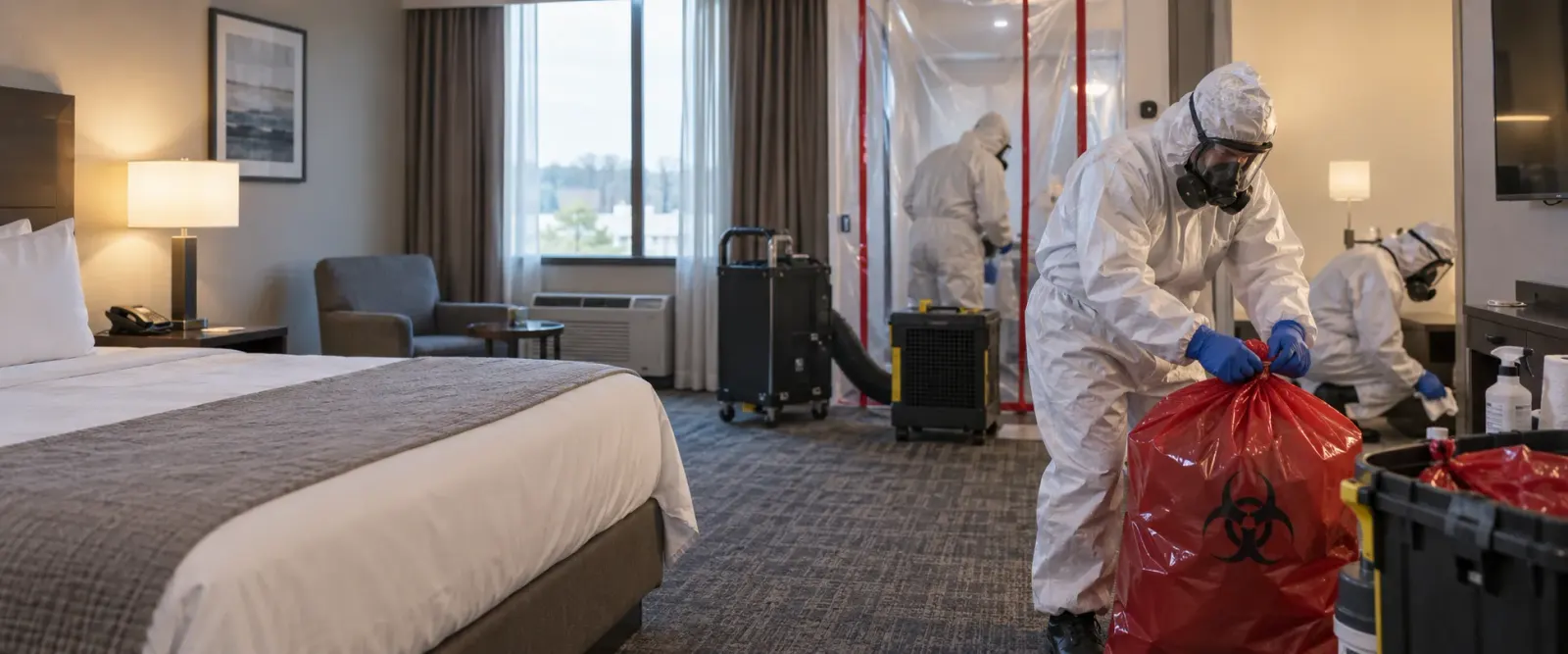
Why biohazard cleanup is needed in Hughson
Over a third of Hughson homes are rented, and a rented unit is handed back and let again on the owner's timetable. Rented homes made up 35.9 percent of those occupied in 2020, and 233 units stood in buildings of five or more. Needles left in a vacated apartment are home-generated sharps, and HSC 118286 keeps them out of the cleanout roll-off and the trash. At re-letting, Civil Code 1710.2 sets when an earlier death need not be disclosed, and the owner makes that call.
South of Fox Road, Hughson's older multifamily stock puts units wall to wall. Duplexes, fourplexes, 8-unit buildings and small-lot homes sit mainly below Fox Road and west of 7th Street, and describes that stock as generally older and less expensive than the suburban tracts. A cleanup in one unit is sealed from the next. Protective equipment is chosen so blood and body fluid cannot reach skin, eyes or clothing, which is the test Cal/OSHA 5193 sets.
In the pre-1970 core, the City already counts homes that need more than cosmetic repair. Of 2,748 Hughson homes, 528 predate 1970, and the City estimates 26 to 52 units need significant improvement or replacement. Where a home has slid into rodent infestation, missing garbage removal or piled debris, HSC 17920.3 can class it as substandard. The sanitation side follows the CDC rodent cleanup method: rooms aired for 30 minutes, droppings soaked in disinfectant, nothing swept or vacuumed.
Hughson's three mobile home parks hold 72 spaces, and a park home counts as a trauma scene location like any house. Meadow Lark on Charles Street has 27 permitted spaces, and the Big Sky and Trieweiler parks on Tully Road have 17 and 28. Because HSC 117776 extends a trauma scene to structures that are not fixed in place, mobile homes included, a park home gets the same removal of saturated flooring and the same decontamination of the structure beneath as a fixed house.
Below the BNSF tracks on the southwest side, a workplace injury leaves its scene on equipment as well as floors. Most of Hughson's industrial land is there: cold rooms, food processing, light manufacturing and agricultural support around Tully Road and Whitmore Avenue, including a farm supply, a tool shop and a truss plant. IICRC S540 includes vehicle and machinery remediation, so a line, a truck or a lift is decontaminated along with the slab. Staff who clean their own site are covered by their employer's bloodborne pathogens plan.
Rented homes were 35.9 percent of Hughson's occupied housing in 2020, and 233 of its 2,446 units stood in buildings of five or more. A turnover in a building like that is cleaned with the neighbours still at home.
Biohazard cleanup, as delivered in Hughson
Nine road miles lie between the Modesto base and Hughson, driven east from Highway 99 on Service Road, Hatch Road or Whitmore Avenue. One scene log runs from the release to the confirmation of cleaning, whatever the building.
No state highway runs into Hughson; the crew leaves Highway 99 for Hatch Road or Whitmore Avenue and finishes on the town grid, where the railroad-side Santa Fe Avenue cuts across the streets at an angle. Propertyvendr gives an arrival time inside the 75 to 100 minute window when it takes the request, and asks who holds the key.
Cleanup waits until law enforcement or the regulatory agency has let the scene go, the starting point IICRC S540 takes for granted. Then the crew inspects the apartment, park home or plant floor, records what is affected, and agrees the scope with whoever authorises it.
Neighbouring units stay shut off from the work. All blood and body fluid is handled as if infectious, with coveralls, gloves and eye protection, and respirators worn under an annually fit-tested program.
Saturated flooring and contents are bagged and labelled as regulated waste; needles go into rigid containers and broken glass is lifted with tongs.
Hard surfaces take an EPA List S product for the full contact time on its label. Rodent areas are ventilated for half an hour, then droppings are soaked with disinfectant and wiped up, never swept or vacuumed.
Hughson bags go when removal is complete, to permitted medical waste treatment or a freezer for 14 days, never the county hazardous waste site.
The owner or manager receives the S540 confirmation of cleaning. Any flooring or drywall that has to be replaced is a separate rebuild under a Hughson building permit, issued from Pine Street.
Where biohazard cleanup is needed in Hughson
Hughson runs from a century-old downtown to post-2000 tracts, mobile home parks and plants southwest of the tracks, and the neighbours of a scene differ in each.
Downtown and Hughson Avenue
Commercial and public uses cluster on Hughson Avenue in the southern half of the city, among several 100-year-old buildings. A shop or office incident is cleaned so the space can open to the public again, with the log sent to the owner.
Historic core (Fox Road, 7th Street, the railroad and Tully Road)
Most homes in this old core predate 1970, and the City finds a higher rate of worn roofs, siding, wiring, plumbing and foundations here. Where fluids reach old floorboards, the soaked boards are cut out and bagged and the joists beneath decontaminated.
South-central Hughson and Walker Lane
Duplexes, fourplexes, 8-unit buildings and small-lot homes that the City calls older and less expensive than the newer tracts. A unit cleaned here is sealed from the one beside it, and waste leaves by the shortest route outside.
Euclid Avenue subdivisions (Euclid South, Euclid North/Fieldstone, Province Place)
Euclid South's 69 lots, Fieldstone's 51 and the 39 gated homes of Province Place were permitted or built between 2018 and 2022. In a newer house, fluids are traced through carpet and pad to the subfloor, and the rebuild is scoped on its own.
Northwest Hughson (north of Locust Street, west of 7th Street)
Census block group 2, the corner of the city with the longest walk to a Route 61 bus, up to a mile and a quarter. The City has funded a restroom and concession stand at Lebright Fields. A public restroom is cleared of sharps and decontaminated before it reopens.
East Hughson and Samaritan Village
Block group 1 takes in the blocks north of Whitmore Avenue and east of 7th Street, and Samaritan Village, a senior and assisted living campus of 20 acres, sits at the city edge. Where residents stay in a building, the work area is closed off and the waste route kept apart from them.
Orchards and Heritage at Parkwood (Santa Fe Avenue and East Hatch Road)
Former walnut and almond orchard at Santa Fe Avenue and Hatch Road, laid out as 299 lots, 200 of them Courtyard Homes grouped on shared motor courts; 73 were complete by the Housing Element's count. Neighbours on a shared court are kept clear of the path the waste takes out.
Santa Fe Avenue and the BNSF line
The arterial runs beside the railroad and meets each cross street at a skew, and hazardous materials pass through on the BNSF line and on Hatch and Geer roads. A vehicle involved in a trauma scene is cleaned under S540's vehicle component.
Southwest industrial area (Tully Road, Roeding Road, Whitmore Avenue)
Cold rooms, food processing, light manufacturing and agricultural support around Tully and Roeding roads and Whitmore Avenue. A workplace scene takes in the machine as well as the slab, and plant staff stay out until the area is handed back.
Tully Road and Charles Street mobile home parks
Meadow Lark at 2612 Charles Street, Big Sky at 2042 Tully Road and Trieweiler at 2442 Tully Road hold 72 permitted spaces between them. The floor panels under a soaked carpet are checked and cut out where saturated.
Whitmore Avenue and Geer Road edge
Just outside the city, Country Villa's 20 apartments and the 18 spaces of Cobles Corner, both on Hughson water now by the 2026 Housing Element's account. A needle found in a shared yard goes straight into a rigid container.
Hatch Road, the Ceres Main Canal and the Tuolumne River side
Hatch Road runs beside TID's Ceres Main Canal, and beyond the city's north edge the Tuolumne corridor keeps the area's last wildlands. Needles found along a bank or path are picked up with tools, never by hand, and sealed in a sharps container.
Biohazard cleanup sub-services available in Hughson
Questions from Hughson property owners and managers
State law allows it. HSC 17920.3 lists infestation by insects, vermin or rodents, inadequate garbage and rubbish removal, and premises holding junk, debris, garbage, offal or rodent harborages that make a fire, health or safety hazard among the conditions that make a building substandard. Whether and how that is enforced is for the owner and the authorities to settle. The crew deals with the sanitation, and this is not legal advice.
HSC 118321.5 has it leave the scene as soon as the removal phase is finished. From Hughson it goes to a permitted medical waste transfer station or treatment facility, or into a dedicated freezer for 14 days at the longest. The county's household hazardous waste facility is not an option, since Stanislaus County lists biomedical waste as something it does not accept.
Parkwood's 200 Courtyard Homes share motor courts, so the work is planned around the people living off the same court. The affected home is contained, and bagged waste goes out as soon as removal ends rather than waiting on the court. Nothing from the scene is left in shared space, and the neighbours' homes are not entered.
No. HSC 117776 lists mobile homes, trailers and vehicles as trauma scene locations, so a home in any of the three Hughson parks is cleaned to the same standard as a house on a foundation. Saturated carpet, pad and floor panels are removed as regulated waste, the frame beneath is decontaminated, and the park manager and the homeowner receive the same record.
They are separate. Hoarding cleanup is the sanitation side of a Hughson home: sharps, human and animal waste, rodent droppings and nests, and soiled porous items, cleaned by the CDC method. Hauling away the volume of belongings is the junk removal service's hoarding cleanout. Where a home needs both, the sanitation comes first so the haulers are not handling needles or droppings.
Usually both, split between two services. Sewage backup biohazard cleanup covers the human-waste sanitation side, with the crew in splash-proof face protection, liquid-repellent coveralls, waterproof gloves and boots. Pulling out the water and drying the structure is the water damage trade's Sewage and Category 3 cleanup, which follows IICRC S500. One Hughson request can start both.
Biohazard cleanup near Hughson

