Why biohazard cleanup is needed in Turlock
Around Stanislaus State, tenants turn over often, and a vacated unit is where leftover needles get found. Along Monte Vista Avenue and Geer Road near the university, the rental stock is 1960s to 1980s apartment buildings and houses converted to units. Needles a tenant leaves behind are home-generated sharps from a multifamily residence, and HSC section 118286 bars them from trash, recycling and any roll-off container. The cleanout crew clears sharps into a rigid container first, so the haul that follows carries none.
A grease-line backup can put sewage on a restaurant's kitchen or restroom floor. Geer Road, the central retail corridor, carries about 21,000 vehicles a day near Monte Vista and is lined with older strip centers whose restaurant tenants run on grease lines. The human-waste sanitation of a backup is biohazard work, done in the splash-proof face shields, liquid-repellent coveralls, waterproof gloves and rubber boots CDC guidance sets for workers handling human waste. Pumping out the water and drying the floor belong to water damage restoration.
A retail center of Monte Vista Crossings' size has many public restrooms, each a possible blood or needle incident. Roughly 875,000 square feet of stores, from big boxes to in-line shops, stretch along the Highway 99 corridor. Universal precautions treat all blood and certain body fluids as infectious, so each incident is contained and cleaned as a scene of its own. Surfaces are disinfected with a product from EPA List S, left on for the contact time its label gives.
On a processing line or a cold-storage dock, an injury reaches the machinery as well as the floor. The Westside Industrial Specific Plan area west of Highway 99 is given over to food processing plants, cold storage rooms, distribution warehouses and truck yards. The IICRC S540 standard includes structural, contents, and vehicle and other machinery remediation, so a forklift, conveyor or trailer is cleaned within the same scope as the slab beneath it.
Farm dwellings and outbuildings at the city edge call for the CDC's rodent cleanup method. Dairies and ranchettes ring Turlock, many on wells, septic and on-site drainage. Following CDC rodent cleanup guidance, doors and windows stand open for 30 minutes, and droppings and nests are soaked for 5 minutes in 1 part bleach to 9 parts water before they are wiped up. Where rodents have reached heating or cooling ducts, the CDC says an exterminating service removes them first.
Turlock began as an 1871 railroad town, and the houses from its first decades cluster by the tracks, around downtown and in Crane Park, many of them on raised foundations. Where fluids pass through the floor of one of those houses, the crawl space beneath becomes part of the scope.
Biohazard cleanup, as delivered in Turlock
Turlock is a 12-road-mile run south from the Modesto base, by Highway 99 or Geer Road. The same record follows every Turlock scene: release noted, area contained, waste bagged and labelled, surfaces disinfected, cleaning confirmed.
Monte Vista Crossings and the Geer Road corridor sit at the near end of the 90 to 120 minute window. The Westside and the dairies are the far end, where December and January fog or harvest trucks on Highway 99 push calls toward two hours. Propertyvendr names an arrival time once the request is in.
No crew enters until law enforcement or the regulatory agency has released the scene, as IICRC S540 assumes. The first walk-through sets the scope: rooms and contents affected, porous items that are regulated waste and, in an apartment building, which neighbours stay out.
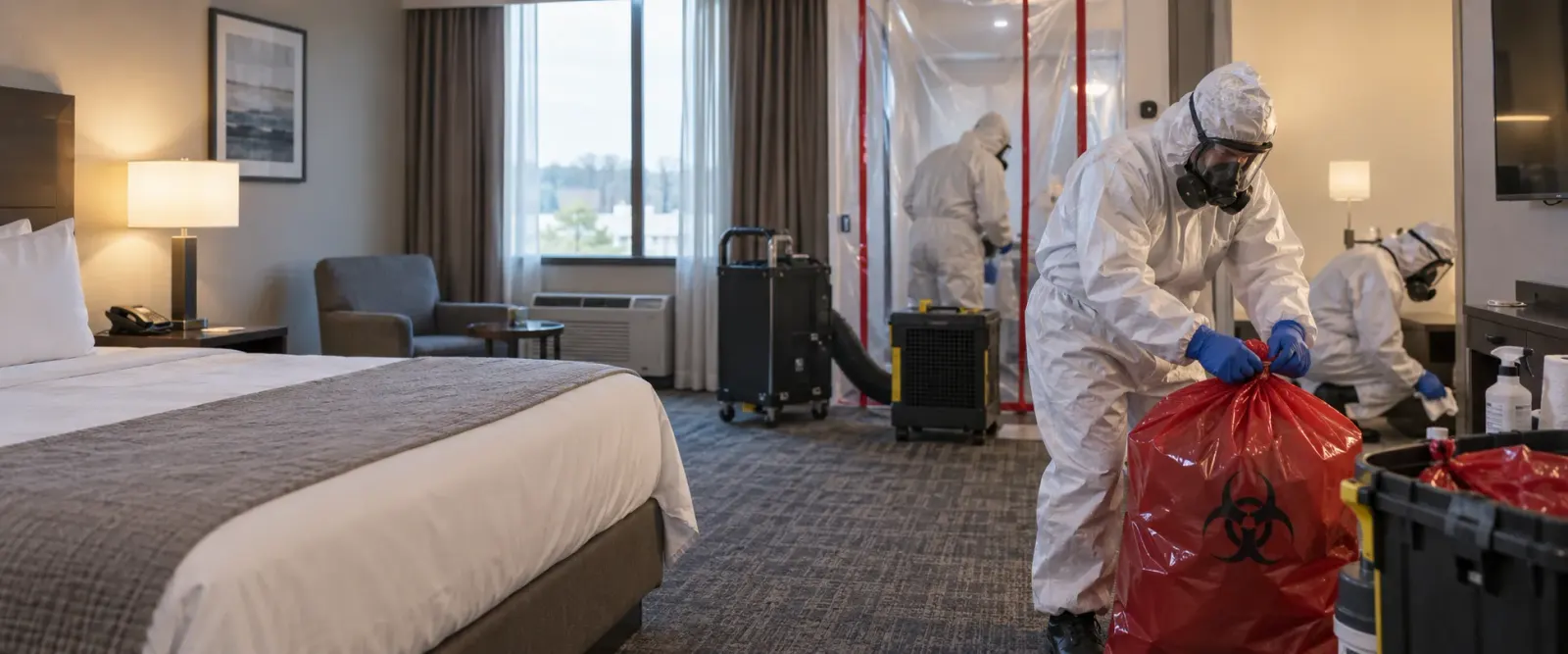
The work area is closed off and treated under universal precautions. Gloves, coveralls and face protection stop contact with blood, and respirator wearers are fit tested yearly.
Carpet, pad and soaked contents go out as regulated waste in closed, labelled bags, and needles go into rigid containers.
Hard surfaces are cleaned, then disinfected with an EPA List S product left on for its label contact time. In a converted house near Stanislaus State with rodent activity, droppings are wetted before they are wiped, and nothing is swept or vacuumed.
Regulated waste leaves Turlock the day removal ends, for a permitted facility or a dedicated freezer for up to 14 days (HSC 118321.5).
Confirmation of cleaning under S540 ends the visit. CDPH's trauma scene cleaning sheet gives the owner a way to check it, and floor rebuild goes to reconstruction.
Where biohazard cleanup is needed in Turlock
Turlock's areas split between rental housing near the university, retail and industry along Highway 99, and farm edges on wells and septic.
Downtown and the Main Street grid
Between the railroad and Lander Avenue, pre-war shops and houses share the old grid. A scene above a storefront is sealed off from the business below while regulated waste is bagged and carried out.
Crane Park and the historic district
The historic district's early houses are built up on raised foundations, with crawl spaces below. When fluids pass through a floor, the crawl space is opened and checked before the floor is closed back up.
Stanislaus State and university rentals
Tenants come and go often in these 1960s to 1980s apartments and converted houses. A vacated unit's cleanout starts with a sharps sweep, so needles never reach the trash.
Monte Vista Crossings and Highway 99 corridor
National tenants fill big boxes and in-line shops across some 875,000 square feet. A restroom incident in one store is logged as its own scene, with a record for the tenant and the property manager.
Geer Road retail
Restaurants in the older strip centers here run on grease lines. A grease-line backup into a dining room or kitchen is sanitised on its human-waste side, and the floor is disinfected before staff return to it.
Westside Industrial Specific Plan area
Processing lines, cold rooms, docks and truck yards west of Highway 99. An injury here can involve a forklift or a trailer, which S540 covers under vehicle and machinery remediation.
Northeast Turlock
HOA subdivisions of the 1990s to 2010s on former orchard land. Needles in a greenbelt or a shared restroom are cleared with the HOA manager's go-ahead, and the board receives the log.
East Turlock and Canal Drive basins
Homes around Donnelly Lake and Dianne Pond, the storm basins that drain last in back-to-back storms. Where a wet spell also backs sewage into a house, the biohazard sanitation comes before any drying.
South Turlock and Lander Avenue
Along Lander Avenue, houses and light commercial buildings stand side by side. A vacated shop or house here is walked for sharps and rodent waste before anyone starts clearing its contents.
West Turlock along Fulkerth and Tuolumne
Fulkerth and Tuolumne roads pass mid-century tracts and newer commercial buildings. In a house of that age, an unattended death is traced from the carpet through the pad to the subfloor.
Dairies and ranchettes at the city edge
Outside city limits, farm homes draw from wells and drain to septic. A septic backup into one is sanitised in full splash protection, and any rebuild permit comes from Stanislaus County.
Keyes, Denair and Hilmar
Keyes and Denair each lie 5 road miles away, and Hilmar 7. Each is covered on its own biohazard cleanup page, written from that community's buildings.
Biohazard cleanup sub-services available in Turlock
Questions from Turlock property owners and managers
No. HSC 117671 treats sharps used at home, including in a multifamily residence, as home-generated sharps waste, and HSC 118286 keeps them out of trash, recycling, green waste and roll-off containers. They are carried in a sharps container to a household hazardous waste facility, a consolidation point or another allowed destination. The crew sweeps the unit for sharps before the cleanout starts, so the dumpster gets none.
HSC 118321.5 requires trauma scene waste to leave the scene immediately when the removal phase is finished, going to a permitted medical waste transfer station or treatment facility, or into a dedicated freezer for not more than 14 days. Stanislaus County's household hazardous waste program lists biomedical waste as a material it does not accept, so it never goes there. The scene log notes when the waste left Turlock.
Both, in two parts. The human-waste sanitation side, removing contaminated material and disinfecting floors and fixtures, is biohazard work, done in the face shields, liquid-repellent coveralls, waterproof gloves and rubber boots CDC guidance lists for handling human waste. Extraction and drying are water damage restoration, on its Sewage and Category 3 cleanup page. One request can start both, and each keeps its own scope.
It can be. In an unattended death, fluids pass through the carpet and pad into the subfloor, and on a raised floor they can reach the framing and crawl space below. Cal/OSHA 5193 counts saturated or caked porous material as regulated waste, so affected subfloor is cut out. The crawl space is inspected, and anything contaminated there is removed or decontaminated before the floor is rebuilt.
No. Hoarding cleanup is the sanitation work: sharps, human and animal waste, rodent droppings and nests, and soiled porous items, cleaned by the CDC method without sweeping or vacuuming. Clearing the volume of contents is a junk removal hoarding cleanout. The two usually run in order, sanitation first, so the haul crew is not handling contaminated items.
Yes. IICRC S540, the standard for trauma and crime scene cleanup, assumes every scene has been released by law enforcement or a regulatory agency before work begins. Once it is, the crew makes an inspection and preliminary determination and scopes the job. CDPH's trauma scene cleaning information sheet is written so the owner can understand the work and judge whether it was done satisfactorily.
Biohazard cleanup near Turlock

