Why biohazard cleanup is needed in Hilmar
Hilmar has no large apartment blocks, so most tenancies are single houses and duplexes. The Census Bureau's 2020-2024 survey, whose margins are wide for a place this size, counts 104 homes in duplexes, 54 in three- to nine-unit buildings and none in anything larger, and the County calls the community's multifamily housing limited. When a tenant living alone dies and is not found for some days, fluids soak down through the carpet and pad, and flooring left caked or saturated is regulated waste under Cal/OSHA section 5193.
State law treats a mobile home the same way it treats a house. Among the locations a trauma scene can include, the Health and Safety Code definitions list mobile homes, trailers and vehicles. The same survey finds 238 mobile homes in the Hilmar-Irwin area, more than one home in ten, and the 2008 Community Plan mentions the parks in its Villa Cordoba sewer proposal. A park unit gets the release, containment and disinfection a fixed house gets.
West of Lander Avenue, sewage leaves many homes by pump rather than by fall. The Community Plan explains that on the west side's low ground sewage has to be pushed through force mains and lift stations, and the water district's sewer runs through five lift stations to its plant on Griffith Road; homes and businesses outside the district use septic tanks. When a line or a tank backs up into a room, human waste is on the floor. The sanitation side is biohazard work, and extraction and drying of the same water go to water damage restoration.
In Hilmar's older houses, hoarding and rodent conditions can turn into a code question. The survey puts 94 homes before 1940 and another 155 in the 1940s and 1950s, and the County notes that older neighbourhoods may lack sidewalks and modern drainage. Under HSC 17920.3, rodent infestation, poor garbage removal and piled debris or rodent harborage can make a building substandard. The crew clears the sanitation side: sharps, waste, droppings and soiled belongings.
Lander Avenue is Hilmar's only arterial, and its shops face steady public traffic. Caltrans counts between 10,800 and 14,600 vehicles daily from 1st Street to American Avenue, past the Covenant church and the water district office at 8319 Lander. A business that finds blood in a restroom or a needle in a planter needs the space cleaned and reopened. Needles go into a rigid, puncture-resistant container, never a trash bin, and broken glass is lifted with tongs or a dust pan.
In the 2020 LAFCO review, Hilmar County Water District's sewer served about 1,558 connections through five lift stations, while homes outside the district rely on their own septic systems. A Hilmar backup can therefore start in either system, and the sanitation work begins the same way.
Biohazard cleanup, as delivered in Hilmar
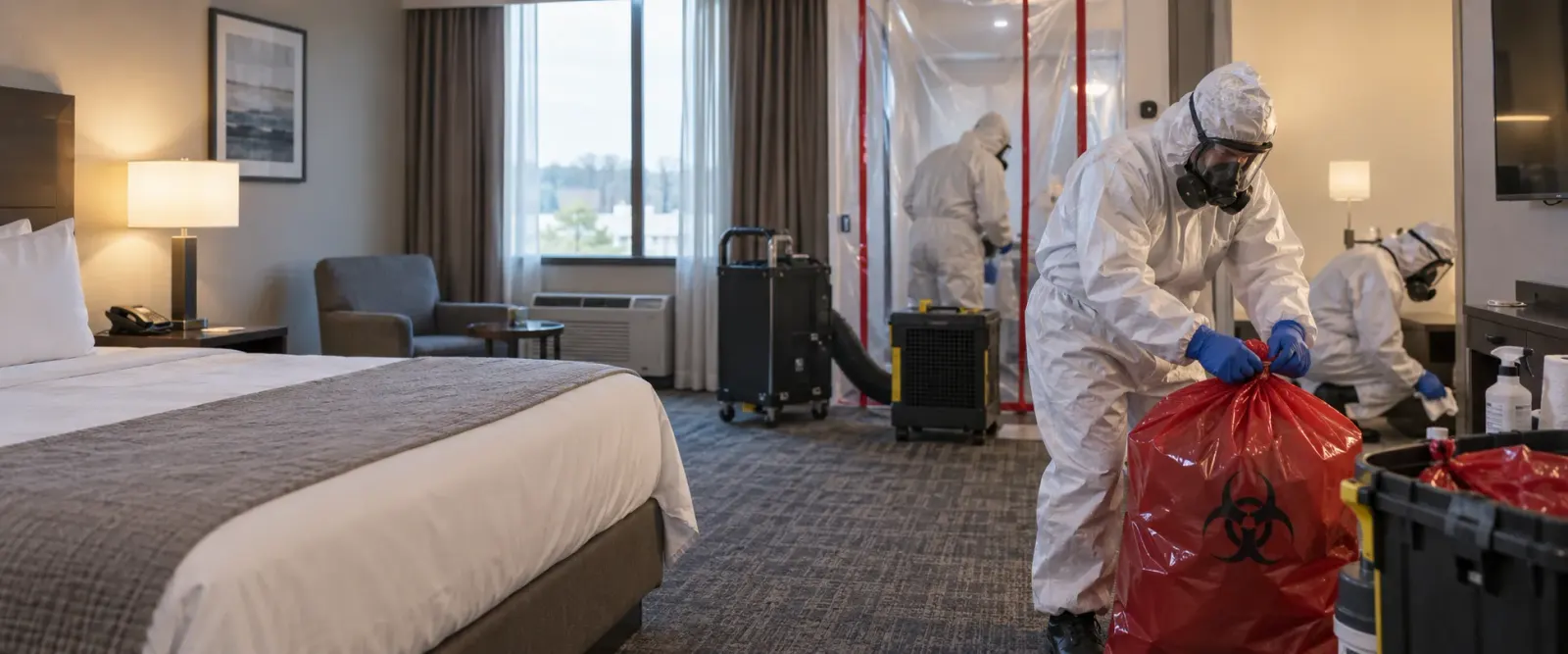
From the Modesto base the crew covers 19 road miles: Highway 99 south to Turlock, then Lander Avenue, Highway 165, into town. On every job the order holds: release, scope, containment, regulated waste out, surfaces disinfected, confirmation.
The crew leaves Highway 99 in Turlock for Lander Avenue, which carries 14,900 vehicles a day at the county line and is the only major north-south road into Hilmar. Merced County's hazard plan says fog from November to March slows emergency vehicles, so fog mornings sit near 120 minutes. Propertyvendr confirms the time.
IICRC S540 assumes the scene is released first. The 2008 Community Plan names the Sheriff's C.F. Bullworth (North) Station in Delhi, about five miles off, as Hilmar's law enforcement. Once the release is given, the crew inspects and makes a preliminary determination of what has to come out.
Universal precautions apply from the doorway. Protective gear is chosen so blood or body fluids cannot reach skin or clothing, and respiratory protection follows a written 5144 program with fit testing.
Soaked carpet, pad and subfloor are cut out and bagged as regulated waste; needles into rigid containers, glass by tongs.
Hard surfaces get an EPA List S disinfectant, left wet as long as its label's contact time requires. In a farm outbuilding with rodent droppings, doors and windows stand open 30 minutes first, and the droppings are wetted and lifted, never swept or vacuumed.
HSC 118321.5: once removal ends, waste leaves Hilmar for a permitted transfer station or treatment facility, or a freezer, 14 days.
The job ends with the S540 confirmation of cleaning, and the record goes to the owner or manager. Rebuilding floor, subfloor or walls passes to the reconstruction trade.
Where biohazard cleanup is needed in Hilmar
Hilmar's areas differ in who occupies them, from tenants and park residents to plant workers, and in whether sewage is pumped or held in a septic tank.
Downtown Hilmar, Lander Avenue from American Avenue to 1st Street
The mixed-use downtown the Plan sets out, with highway traffic passing all day. Shops here need a restroom or sales-floor incident cleaned and logged so the business can reopen.
Lander Avenue corridor south of Bloss Avenue and the old Irwin town site
Big-lot houses, some now used as offices, line the frontage, and Irwin's renovated town-centre buildings stand south of Geer. In a house turned office, the scene is scoped room by room and sealed from the rooms still in use.
West of Lander Avenue (Census Tract 4.04)
Mostly single-family streets with one small R3 multifamily pocket and farmland to the west. Sewage here is pumped off low ground, and a backup indoors is treated first as human-waste sanitation, before any drying.
East of Lander Avenue and the TID Lateral No. 7 edge
Near Lander the zoning allows shops, light industry and mixed uses; farther east toward the lateral it is houses, with a trail planned in 2008. Needles found along a path or canal edge go into a rigid container on the spot.
1st Street golf-course drainage basin
A non-operating private course off 1st Street doubles as the storm basin in peak storms. If needles or soiled waste turn up on open ground like this, they are picked up by tongs, never bagged with ordinary trash.
Bloss Avenue industrial strip and Hilmar Lumber
Industrial lots on Bloss Avenue, the road taking traffic toward Highway 99 and Livingston. After an injury on any industrial floor, IICRC S540 covers the machinery and vehicles involved as well as the slab.
Hilmar Cheese Company plant, north of the Plan area
Over 500 people work at this plant, the one top-12 Merced County employer on unincorporated land, just beyond the Plan's northern line. Plant staff who clean their own workplace are covered by the employer's 5193 plan.
Schools, Community Center and Fire Station 95, Lander and Geer
Schools sit beside Lander near Geer Avenue, and the Community Center and the town's park are reached by Falke Street. In a shared public building, the work area is closed off from the rooms around it.
Villa Cordoba, the mobile home parks and sewer Trunk Line "C"
The 2008 Plan proposed a Trunk Line C sewer for land beside Villa Cordoba, north of the parks. Park units are trauma scene locations under state law, cleaned to the standard of any fixed house.
Camden Drive, American Avenue and Bloss Avenue housing sites
The County's housing inventory lists these R-1 farm parcels: 179 units at Camden and American, 122 at 19272 Bloss and about 100 on each American Avenue parcel. Until homes go up, a shed with droppings is cleaned by the CDC method.
Golf Link Road, Lana Lane and Country Club CWD
Twenty-three homes on 10.4 acres draw on the Country Club district's own well, and every lot in the 22-lot Lana Lane tract has a private well. Porous items soiled by a backup are bagged and removed before hard surfaces are disinfected.
Dairy and orchard fringe
Farmland rings the town: dairies west, orchards east and field crops south. A farm dwelling or outbuilding with droppings is aired for 30 minutes, then wetted with disinfectant, as the CDC advises.
Biohazard cleanup sub-services available in Hilmar
Questions from Hilmar property owners and managers
IICRC S540 takes it as given that a scene has been released, by law enforcement or a regulatory agency, before any cleanup. Hilmar's 2008 Community Plan names the Sheriff's C.F. Bullworth (North) Station in Delhi, about five miles from town, as its law enforcement. Nothing at the scene is moved before the release, and the crew begins its inspection once it is given.
Under HSC 118321.5 the waste is taken out the moment the removal phase is over, to a permitted medical waste transfer station or treatment facility; the other lawful option is a dedicated freezer, for 14 days at most. It never goes in a Hilmar trash cart, since state law excludes trauma scene waste from household waste. Bags are labelled BIOHAZARDOUS WASTE, in fluorescent orange or orange-red, before they leave the house.
It is. The Health and Safety Code counts mobile homes, trailers and vehicles among the places a trauma scene can be, and Hilmar has 238 mobile homes in the Census Bureau's latest survey. After the release, carpet, pad and floor panels that fluids have reached are removed as regulated waste, the framing beneath is decontaminated, and the owner receives the same record a house would produce.
Partly. The Community Plan says the low ground west of Lander relies on force mains and lift stations for sewage. The human-waste side, removing soiled belongings and cleaning under protective gear, is sewage backup biohazard cleanup; water extraction and drying fall to water damage restoration. CDC guidance for workers handling human waste calls for goggles and a splash-proof face shield, liquid-repellent coveralls, waterproof gloves and rubber boots.
Not when the death happened more than three years before the tenant's offer to rent: Civil Code 1710.2 relieves the owner or agent of disclosing it, or the manner of death, and it treats a renter as a transferee. It does not protect an intentional misrepresentation made in answer to a prospective tenant's direct question. The owner decides what to say, and the crew gives no legal advice.
They are separate jobs. Hoarding cleanup deals with what makes the house unsanitary: sharps removed first, human and animal waste, droppings and nests, and porous belongings too soiled to keep. Clearing out the sheer volume of belongings is a junk removal cleanout. Where a Hilmar home needs both, the sanitation work is done first.
Biohazard cleanup near Hilmar

