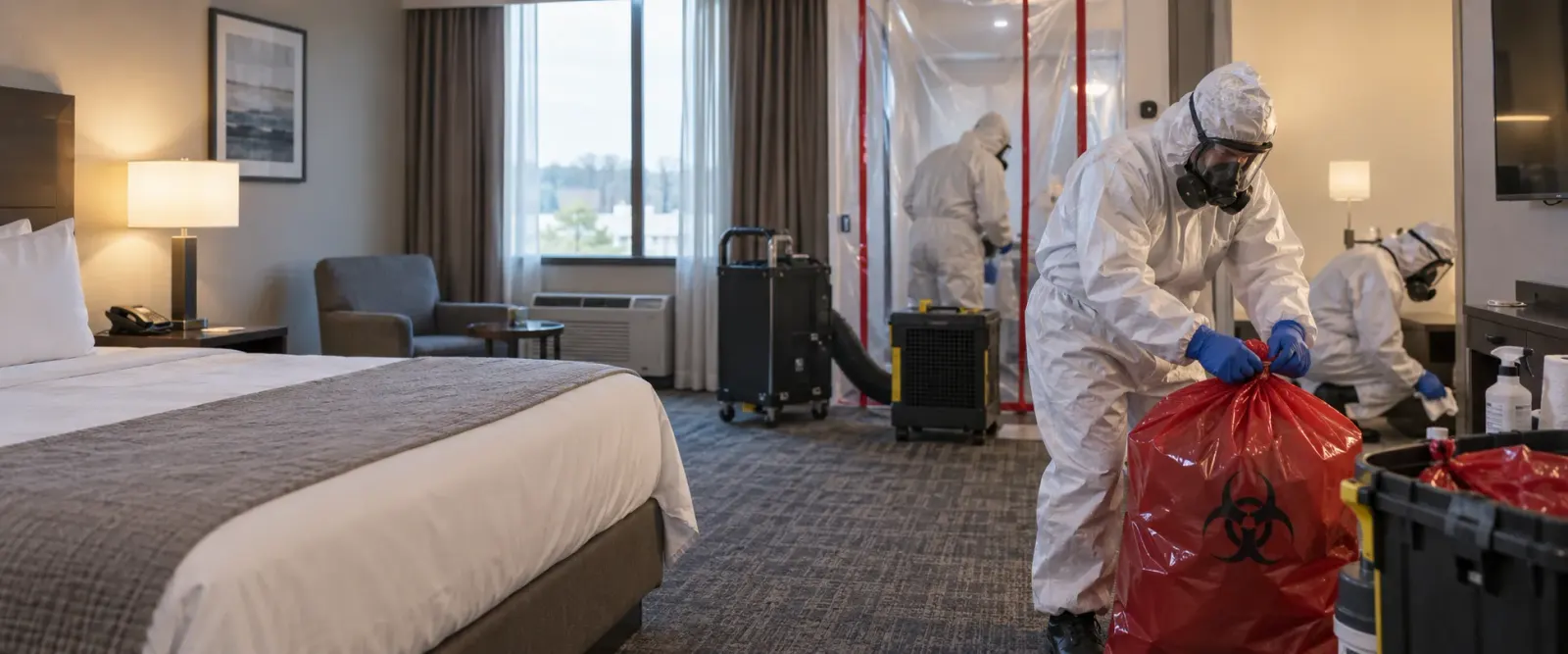
Why biohazard cleanup is needed in Livingston
Four in ten Livingston homes are rented, and a rental turnover is when problems left behind come to light. The Housing Element counts 3,299 occupied homes, 43% of them renter-occupied and 1,233 more than 40 years old. Needles left in a vacated apartment or house are home-generated sharps from a multifamily or single-family residence, and HSC 118286 keeps them out of household bins and any roll-off hired for the cleanout. They leave in a rigid sharps container before the unit is cleared.
Central eastern Livingston is where the City's Code Enforcement finds its substandard housing. The Housing Element reports that concentration, and Central Livingston, between the Union Pacific tracks and F Street, is a district of small lots, typically under 5,000 sq ft. Rodents, garbage that is not removed and debris or rodent harborage that threatens health are conditions HSC 17920.3 names for a substandard building. In a hoarded unit the crew handles sharps, waste and droppings; carting away the volume is a separate junk removal cleanout.
Livingston's affordable apartment complexes put many households under one roof. The Orchards on Newcastle at 1972 Main Street holds 48 affordable units, the New Castle complex stands in the south of the city, and Tierra Santa Villas, 80 units, was being built on B Street. When a tenant dies unnoticed, the neighbouring apartments stay occupied, so the unit is sealed from shared halls while soaked flooring is removed. At the next letting, Civil Code 1710.2 sets a three-year line for disclosing a death, and the owner decides.
Livingston's sewer dates from its first years as a city. Water and sewer service arrived in 1928, and among the four routes the City lists for storm water leaving town is a limited discharge into the sanitary sewer. When sewage rises through a floor drain or toilet, the sanitation side, soiled items bagged and surfaces disinfected under splash protection, is biohazard work. Water extraction and drying go to water damage restoration, which runs alongside.
Industrial workplaces in Livingston keep their own bloodborne pathogens plans. Foster Farms, the city's largest employer with 1,000 to 4,999 staff, has its headquarters here, and Sensient Natural Ingredients employs 250 to 499; the assessor counts 19 industrial parcels with 33 buildings. Staff who clean their own workplace fall under the employer's plan required by Cal/OSHA 5193. Where an outside crew is called instead, IICRC S540 covers machinery and vehicles as well as floors.
The City laid its water and sewer systems in 1928, six years after Livingston incorporated on 11 September 1922. When a backup brings sewage indoors, it is handled as sanitation work before any drying starts.
Biohazard cleanup, as delivered in Livingston
Livingston is 24 road miles from the Modesto base. Highway 99 crosses the city on a diagonal, with exits at Hammatt Avenue and Winton Parkway. Each job follows one sequence: release, scope, containment, waste out, disinfection, confirmation.
The crew comes down Highway 99 and leaves at Hammatt Avenue or Winton Parkway, where Caltrans counts at least 60,000 vehicles a day at each exit. Merced County's hazard plan says tule fog from November to March delays emergency vehicles, so fog nights run toward 140 minutes. Propertyvendr sets the time.
IICRC S540 is written for released scenes, so the crew waits for law enforcement or the regulatory agency to release this one. It then inspects the house, apartment or workplace, records what fluids have reached and agrees a preliminary scope with the owner or manager.
Neighbours in adjoining units are kept clear of the work area. Every fluid is handled as infectious, suits and gloves block contact, and respirators are fit-tested under 5144.
Soaked carpet, pad and subfloor are removed as regulated waste, sharps placed in rigid containers, glass lifted by tongs.
Floors, walls and fixtures receive an EPA List S disinfectant, kept wet for as long as the label says. Rodent droppings in a hoarded unit are sprayed and soaked for five minutes, following the CDC method, and are never swept or vacuumed.
Bagged waste leaves Livingston the moment removal ends, headed to a permitted facility or a dedicated freezer for up to 14 days.
The S540 confirmation of cleaning is recorded and handed to the owner or manager. New flooring, subfloor or drywall is a separate reconstruction job.
Where biohazard cleanup is needed in Livingston
Highway 99 splits Livingston into north and south, and its areas differ in how old the homes are, how many are rented and who works nearby.
Downtown and Main Street
Where shops and older homes share alleys and overhead lines, a scene in one building is sealed off from its neighbour. Downtown mixes aging commercial and residential structures, and North Main holds medium-density housing.
Central Livingston east of Lincoln Boulevard
Code Enforcement's substandard-housing cluster lies here, on lots mostly smaller than 5,000 sq ft zoned for the city's highest densities. A hoarded unit is sanitised first, before anything is hauled away.
B Street corridor
Affordable apartments from Self-Help Enterprises and the Housing Authority stand near the clinic complex, with the 80-unit Tierra Santa Villas under construction when the Housing Element was written. Next-door households stay home while one unit is cleaned.
Winton Parkway interchange
Freeway traffic of up to 62,000 vehicles a day passes this exit, where Self-Help Enterprises has sought approval for 80 low-income homes at B Street. Businesses by the ramp need restrooms and parking cleared of sharps.
Hammatt Avenue interchange and the Highway 99 frontage
Commercial and medical buildings fill the land beside the freeway on its south side. After a blood or needle incident in a public restroom, that room is closed off and cleaned while the rest of the building carries on.
North Livingston
Older houses north of the tracks, about a third of the stock here dating from before 1985, are largely rentals or homes of older residents. An unattended death in one is traced from carpet down to the subfloor.
Industrial west side and Foster Farms
Very few people live west of North Main, where the land is given to industry, commerce and farming. After a workplace injury, IICRC S540 extends decontamination to the machinery and any vehicle involved.
Northern edge along the Merced River
Livingston's flood problems sit here, nearest the river, with a small Zone A pocket. If a flood ever carried sewage indoors, soiled porous items would be bagged before the water trade began drying.
South Livingston west of Prusso Street
Big lots of 7,000 sq ft and up, and houses mostly from the past twenty years. A newer house gets the same release, containment, regulated waste removal and disinfection as an old one.
South Livingston east side and The Villages at Main Street
Higher-density zoning is gathered on this side, with 48 affordable units at the Orchards on Newcastle and an entitled plan for 480 apartments at The Villages at Main Street. Shared halls are sealed while a unit is worked on.
South Livingston mobile home park
South Livingston's single large park was about half full, with new mobile homes, in the Housing Element's account. Under state law a mobile home can be a trauma scene, and a park home is cleaned to a house's standard.
Arena and Livingston canals and the detention-basin watersheds
Pump stations send storm water from these neighbourhoods into MID's Arena and Livingston canals. Needles found on a canal bank or basin edge are lifted mechanically into a rigid container.
Biohazard cleanup sub-services available in Livingston
Questions from Livingston property owners and managers
It can be. According to the Housing Element, the city's Code Enforcement staff see substandard housing clustered in central eastern Livingston, and HSC 17920.3 counts rodent infestation, inadequate garbage removal and heaped debris, garbage or rodent harborage that endangers health or safety among the grounds. The finding belongs to code enforcement or a health officer, and the response to the owner. The crew does the sanitation work and gives no legal advice.
HSC 118321.5 has it carried out as soon as the removal phase ends and taken to a permitted medical waste transfer station or treatment facility; a dedicated freezer is the only other lawful holding place, and then for 14 days at most. No Livingston cart or dumpster takes it, since the Health and Safety Code leaves trauma scene waste out of household waste. Each bag is closed, labelled and leakproof.
No. Sharps from an apartment are home-generated sharps under HSC 117671, which names multifamily residences, and HSC 118286 bars them from trash, recycling and commercial containers and from any roll-off used for the cleanout. The crew collects them into a rigid, puncture-resistant, leakproof container before anything else in the unit is moved, and Cal/OSHA 5193 rules out picking up broken glass by hand.
It can. Health and Safety Code 117776 extends the definition of a trauma scene to structures that move, and mobile homes, trailers and vehicles are its examples. The park home gets the full house-standard cleanup: released first, contained, soaked carpet, pad and floor panels removed as regulated waste, and the framing disinfected. The owner receives the complete record.
It is split between two services. Sewage backup biohazard cleanup is the human-waste side: soiled belongings bagged and surfaces sanitised by a crew wearing the splash protection the CDC recommends for anyone handling human waste. Extraction and structural drying come under water damage restoration and its Category 3 sewage page. A Livingston request can start both at once.
Civil Code 1710.2 sets three years as the limit. If the death took place over three years before a renter or buyer made an offer, the owner or agent is not required to disclose it or its manner, and a renter counts as a transferee. The section offers no protection for an intentional misrepresentation to someone who asks directly. The owner decides; the crew does not give legal advice.
Biohazard cleanup near Livingston

