Why biohazard cleanup is needed in Merced
Most Merced homes are rented, and every vacated rental has to be checked for what was left behind. Renters occupy 58.1% of the city's 26,673 occupied homes against 48.4% countywide, the Housing Element finds. When a unit is emptied, needles found among the contents count as home-generated sharps. HSC 118286 bars them from the household cart, the recycling and any roll-off brought in for the cleanout, so they go into a rigid container before the rest of the unit is cleared.
In northeast Merced, one house can hold several separate tenancies. The Housing Element reports investors buying newer homes in Districts 4 and 6 and renting each room to UC Merced students, a campus of almost 10,000 with about 4,200 living on it. A scene in one room of a house like that is sealed off from the shared kitchen and hall, and the other tenants stay out of the work area until the room has been cleaned and disinfected.
Downtown holds the city's concentration of substandard housing. In the blocks bounded by G and R Streets and by 16th and 23rd, the Housing Element finds many pre-1980 homes lacking basic plumbing or kitchen facilities. Where a unit there is also hoarded or overrun by rodents, HSC 17920.3 names infestation, garbage left unremoved and debris or harborage that threatens health among the grounds for a substandard building. The crew clears the sanitation side, junk removal in Merced takes the volume, and the owner deals with the code.
Merced's apartments are spread across the older south and the newer north. Central and south Merced are older areas of smaller homes and many apartments, while the north took most of the 1970s and 1980s construction, apartments among it. When a tenant dies alone and is not found quickly, fluids pass through carpet and pad, and anything left saturated or caked is regulated waste under Cal/OSHA 5193. Adjoining units stay occupied while the one affected is worked on.
A large enclosed mall and industrial land bring public-facing and workplace scenes. The enclosed mall on W. Olive Avenue has stood since 1969, some 329,000 sq ft on a 53-acre site, and industry in south and south-east Merced provides many of the city's jobs. Staff cleaning their own restrooms or floors do so under their employer's plan; beyond it, IICRC S540 carries the cleanup from the floor to the machinery and vehicles involved.
Renters occupy 58.1% of Merced's 26,673 occupied homes, against 48.4% across Merced County, in the City's 2024-2032 Housing Element. Most of the city's homes pass from tenant to tenant, and a vacant unit is checked for sharps before its contents are cleared.
Biohazard cleanup, as delivered in Merced
From the Modesto base to Merced is 40 road miles, all of it Highway 99, with exits from G Street to the Route 59 and 140 junctions. Each cleanup keeps one shape: released, scoped, contained, cleared, disinfected, confirmed.
Highway 99 carries the crew the 40 miles from the base to Merced. Tule fog in December and January, and trucks at harvest, hold arrival near 140 minutes. Propertyvendr confirms the time on acknowledging the request and asks who will open the door.
S540 assumes law enforcement or a regulatory agency has released the scene, and the crew waits until it has. The inspection then covers the room, the house or the store, tracing where fluids went, and ends in a preliminary scope for the owner or manager.
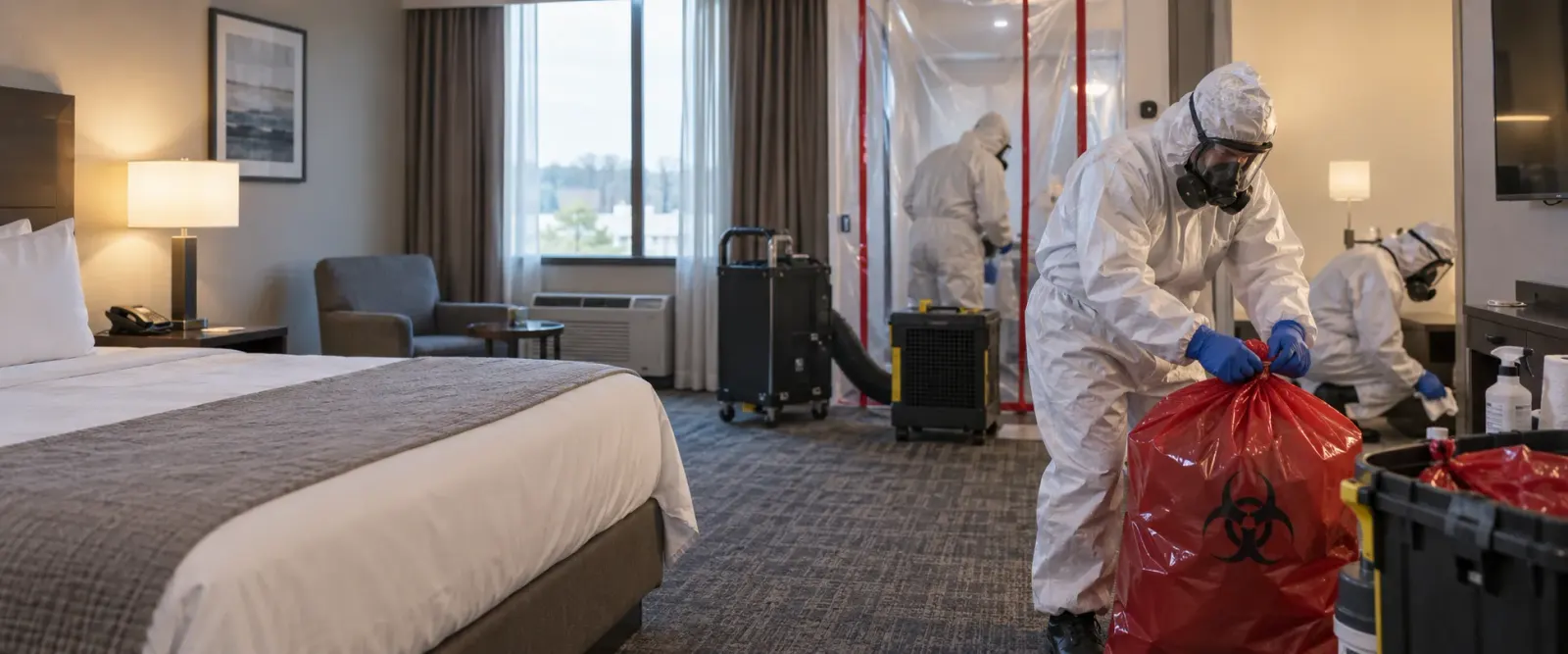
Housemates and neighbours stay outside a sealed work area. Fluids are all treated as infectious, coveralls and gloves stop skin contact, and fitted respirators are worn under a 5144 program.
Mattresses, carpet, pad and subfloor that fluids have soaked go out as regulated waste; needles in rigid containers.
The disinfectant comes from EPA List S and stays on each surface as long as its label requires. In a unit with droppings, the rooms are aired half an hour before cleaning and the droppings soaked five minutes, per the CDC.
Waste moves out of Merced when the removal phase ends, to a permitted transfer station or treatment facility, or a 14-day freezer.
The owner or manager receives the record once the S540 confirmation of cleaning is complete. Flooring, walls and subfloor are rebuilt later by the reconstruction trade.
Where biohazard cleanup is needed in Merced
Merced's areas differ in who shares the building: students renting rooms, apartment neighbours, older downtown tenants, shoppers or a plant crew.
Downtown Merced
The Housing Element's substandard-housing cluster, bounded by R and G Streets and 16th and 23rd, with many pre-1980 homes rated for rehabilitation. A hoarded unit here is sanitised before any contents are hauled away.
Applegate Park and the Bear Creek blocks north of downtown
Applegate Park follows the creek from M to R Streets, with homes on the blocks of 25th to 28th Streets beside it. Needles found in a park or on a creek path are picked up by tongs and boxed in a rigid container.
North and South Bear Creek Drive
In January 2023 creek water ran down W. North Bear Creek Drive and through a trailer park and Cooper Avenue. State law counts trailers and mobile homes as possible trauma scene locations, cleaned like houses.
West Merced at Thornton Avenue and Highway 140
Homes by Thornton Avenue and Highway 140, where Bear Creek has overflowed in several past floods. An unattended death in a house here is traced through the flooring to the subfloor and removed.
North Merced and Black Rascal Creek
Houses and apartments built in the 1970s and 1980s to later street standards. In an apartment building, the affected unit is sealed from the shared hall while its neighbours stay at home.
Olive Avenue, M Street and the Merced Mall
The 1969 mall on W. Olive Avenue, whose buyer announced a new name for it in June 2024, with higher-density housing allowed around it since 1981. Restrooms in a public building are cleaned while the rest stays open.
Fahrens Creek and Fahrens Park
The City plans to make the Fahrens Park basin in north-central Merced a natural trail for bikes. Sharps turned up along a trail are placed in a puncture-resistant container, never a trash can.
Northeast Merced, the Bellevue Corridor and UC Merced
Newer homes in Districts 4 and 6 rented room by room to students, with the Bellevue Corridor plan covering 2.42 square miles, much of it county land. One room is cleaned while the others are kept clear of it.
South Merced
Smaller homes and plenty of apartments, with sidewalks missing on more streets than anywhere else in the city, some built first on county land. In older rentals, a vacated unit is checked for sharps before the contents move.
South and south-east industrial areas and Merced Regional Airport
Industry sits at the city's edges, next to the freeway, airport and rail lines, and employs a large share of Merced's workforce. After a workplace injury, S540 covers the machinery and any vehicle as well as the slab.
Highway 99 corridor
Since the 1960s the freeway has split the city, older south from newer north. It is also the crew's road into Merced, so the exit taken depends on which side of town the address is on.
16th Street and Route 59 (Martin Luther King Jr. Way)
Counts on Route 59 at 16th and V Street reach 27,500 vehicles a day, and the planned high-speed rail station would sit next to SR 99 and the Union Pacific line, or on 16th Street as the alternative. Roadside businesses need restrooms cleared of needles.
Biohazard cleanup sub-services available in Merced
Questions from Merced property owners and managers
Usually, yes. The Housing Element notes that houses in Districts 4 and 6 are often rented room by room. The affected room is sealed and placed off limits, the crew works in protective gear, soaked material leaves in closed and labelled bags, and the room is disinfected with an EPA List S product before anyone goes back in. The other tenants are kept out of the work area and the shared rooms along the route out.
HSC 118321.5 requires it to leave the building the moment removal is complete, bound for a permitted medical waste transfer station or treatment facility, or a dedicated freezer for up to 14 days. Merced household carts and dumpsters are off limits for it, because the Health and Safety Code keeps trauma scene waste out of the household waste category. The bags carry fluorescent orange or orange-red BIOHAZARDOUS WASTE labels.
It can. The City's Housing Element already places Merced's concentration of substandard housing in those blocks, between 16th and 23rd. HSC 17920.3 adds infestation by rodents or vermin, inadequate garbage removal, and accumulated junk, debris or rodent harborage amounting to a fire, health or safety hazard. An officer, health or code enforcement, makes the finding; the owner decides, and the crew offers no legal opinion.
Not if the death came more than three years before the tenant's offer. Civil Code 1710.2 excuses the owner or agent from disclosing the death or its manner after that point, and it includes renters as transferees. It gives no shelter to an intentional misrepresentation when a prospective tenant asks directly. The owner makes the call; the crew's part ends with the cleanup, and it does not advise on the law.
They cannot. HSC 117671 puts sharps from a multifamily residence in the home-generated category. Under HSC 118286 they may not go in trash, recycling, green waste or commercial containers, or in roll-offs for construction or cleanout debris. The crew picks them out first, with tongs rather than hands, into a rigid, puncture-resistant, leakproof container, and the rest of the unit is cleared after.
Two trades share it. Removing what the sewage soiled and sanitising the rooms is sewage backup biohazard cleanup, and the CDC's guidance for anyone handling human waste sets the gear: splash-proof face protection, liquid-repellent coveralls, waterproof gloves and rubber boots. Drying the building is a separate job under water damage restoration's Category 3 sewage page. A single Merced request covers both.
Biohazard cleanup near Merced

