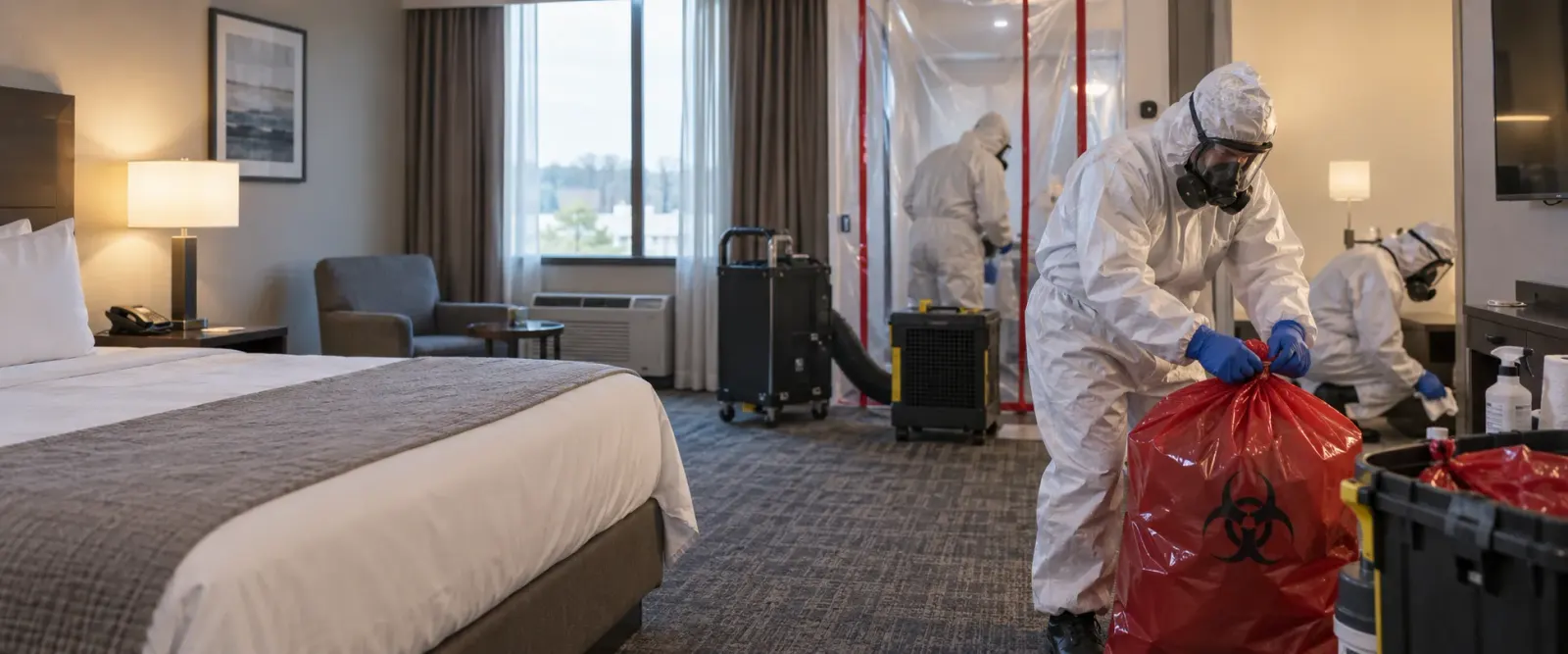
Why biohazard cleanup is needed in Grayson
A sewer plant running at capacity leaves little margin, and when a system backs up the human waste comes into the houses it serves. The Grayson Community Services District provides only street lighting and sewer, to 240 residential customers and one commercial customer, and says its plant, designed for 100,000 gallons a day, is at capacity. The County lists the plant, with its lagoons and leach fields, as at risk in high water. The sanitation after a backup is this trade's, and the drying goes to water damage restoration.
In a rented house, a death that goes unnoticed leaves fluids in the carpet, the pad and the floor beneath. The 2010 Census found 89 of Grayson's 250 occupied homes rented, with renter households averaging 4.20 people. Under Cal/OSHA 5193, all body fluids are treated as potentially infectious where they cannot be told apart, and porous material that is saturated or caked is regulated waste. It is taken up, sealed and labelled, and the room is decontaminated before the landlord plans the repair.
No cleanup begins until law enforcement has released the scene, and in Grayson that is the Stanislaus County Sheriff's Department. The County's 2015 study records that the Sheriff polices Grayson, and that its nearest station then was the main station about 10.5 miles east at 250 East Hackett Road in Ceres. The IICRC S540 standard assumes that release has happened before the crew arrives. After it, the crew inspects and makes a preliminary determination, and the owner approves the scope.
A house filled with refuse and rodent nests can count as substandard under state law, and in Grayson the County holds land use authority. LAFCO records that the District has no land use authority and that those decisions stay with Stanislaus County; farmland zoned General Agriculture wraps the town on three sides. HSC 17920.3 lists rodent infestation and heaped junk and rodent harborages. The crew follows CDC rodent cleanup: 30 minutes of airing, then droppings soaked and wiped.
In a small town the shared spaces are a park and a community hall, and a needle left in either is a hazard to everyone who uses it. Grayson has the 5-acre United Community Center and Park at Laird and Mary Streets with its 3,165 square foot building, the half-acre Leroy F. Fitzsimmons Memorial Park at Amelia and Stakes with a playground and picnic shelter, and nearby Laird Regional Park, 97 acres on the river. A needle there is picked up with tongs, never fingers, and carried off in a rigid, leakproof sharps container.
The 2020 Census counted 1,041 people in Grayson, and the County's 2015 study found one store serving them, the One-Stop Market. In a town that size, a scene in one home is contained so the households around it are kept clear until the waste has gone.
Biohazard cleanup, as delivered in Grayson
Grayson lies 14 road miles from the Modesto base, reached by West Grayson Road from Highway 33 at Westley. Every visit is written into one scene log, from the Sheriff's release to the confirmation of cleaning.
West Grayson Road leaves Highway 33 at Westley, where Caltrans counts 3,100 to 3,800 vehicles a day, and runs 1.3 miles east into town. When the river is high, Grayson Road over the San Joaquin can close, as it did in 2011 and 2017, and winter fog can hold arrival near 120 minutes.
The Stanislaus County Sheriff's Department, which polices Grayson, releases the scene before anything moves, as S540 assumes. The crew then inspects the house and makes a preliminary determination: what is affected, which materials are porous and whether the room shares a wall.
The household and neighbours are kept out of the work area. Universal precautions apply, protective gear keeps fluids off skin and clothing, and respirators follow a written 5144 program.
Soaked carpet, pad and bedding go into labelled BIOHAZARDOUS WASTE bags; needles go into rigid containers; broken glass is taken up with forceps.
Affected surfaces are decontaminated with a disinfectant from EPA List S, held wet for the contact time on its label. In a house or shed on the farmland edge where rodents have been, doors and windows stand open for 30 minutes before droppings are soaked and wiped.
Bags leave Grayson once removal is done, for a permitted medical waste facility or a freezer up to 14 days, not the county site.
The job closes with S540's confirmation of cleaning, and CDPH's trauma scene information lets the owner judge the work. Floor or wall replacement follows under the same file.
Where biohazard cleanup is needed in Grayson
Grayson covers about 100 acres, so its areas differ by what lies beside them: the community center, parks, farmland, the sewer plant or the river.
Laird Street and the United Community Center
The 5-acre United Community Center and Park at Laird and Mary Streets, with a 3,165 square foot building and a bus stop outside. Restrooms in the center are cleaned, disinfected to label contact time and logged.
Charles and Mary Streets
Residential blocks around the City of Modesto's Well 69 at the southeast corner of Charles and Mary Streets. A house here where fluids reached the floor loses its carpet, pad and any soaked subfloor as regulated waste.
Yamamoto Way and Grayson Park
Homes along Yamamoto Way, where Well 295 at Grayson Park carried the water system's treatment in 2010. A needle found in a yard here is lifted with tongs into a rigid sharps container, never dropped in a trash cart.
Amelia Street and Stakes Street, by the river
The eastern edge, with the half-acre Leroy F. Fitzsimmons Memorial Park, its basketball court, picnic shelter and playground, and the San Joaquin River just east. Sharps near a playground are cleared first.
West Grayson Road, the southern edge
A two-lane major road forming the town's southern border and linking it to Highway 33 and Westley. A car or truck involved in a scene is cleaned under the vehicle and machinery component of S540.
Hito Drive, River Road and the land to the north
The northern and western edges, with former Planned Development land now limited to agriculture. A farm outbuilding with rodent droppings is aired for 30 minutes and cleaned wet, never swept.
Grayson CSD wastewater plant on the river
Lagoons and leach fields designed for 100,000 gallons a day and at capacity, the site proposed for a new plant serving Grayson and Westley, and listed at risk in high water. A backup into a home is sanitised first.
Grayson Road Bridge, Laird Slough and Laird Regional Park
The river crossing that closed in the 2011 and 2017 high water, and 97 acres of ball fields, picnic shelters and river access at 8250 W Grayson Road. Park staff clean under their employer's 5193 plan.
Biohazard cleanup sub-services available in Grayson
Questions from Grayson property owners and managers
Law enforcement. The Stanislaus County Sheriff's Department polices Grayson; in 2015 its nearest station was the main station about 10.5 miles east at 250 East Hackett Road in Ceres. IICRC S540 is written on the assumption that every scene has been released by law enforcement or a regulatory agency, so nothing is touched until then. After release, the crew inspects and the owner approves the scope.
The human waste. Soiled rugs, bedding and other porous items are bagged, floors and fixtures are decontaminated, and the workers wear goggles or a face shield, liquid-repellent coveralls, waterproof gloves and rubber boots. Pumping out and drying are water damage restoration, under its sewage and Category 3 service. The plant itself is the Grayson Community Services District's.
Not to the County's household hazardous waste facility at 1710 Morgan Road in Modesto, which lists biomedical waste among what it refuses. HSC 118321.5 requires trauma scene waste to be removed right after the removal phase and taken to a permitted medical waste transfer station or treatment facility, or kept in a dedicated freezer for not more than 14 days. The log records when it left.
Yes, if it meets the test. HSC 17920.3 counts rodent infestation, as determined by a health officer or code enforcement officer, inadequate rubbish removal and accumulations of junk, garbage and rodent harborages among substandard conditions, and LAFCO records that land use decisions in Grayson stay with Stanislaus County. Whether a unit is cited is the officer's call; this is not legal advice. The crew handles the sanitation, while the volume is a junk removal cleanout.
No. HSC 118286 bars home-generated sharps from trash, recycling and green waste containers and from any roll-off used for solid waste or demolition debris. Needles are carried only in a sharps container, to a household hazardous waste facility, a sharps consolidation point, a medical waste generator's facility or an approved mail-back. They are picked up with tongs, never by hand.
Usually the carpet and pad, and often part of the floor beneath. Porous material that is soaked or caked with body fluids is regulated waste under Cal/OSHA 5193, so it is taken up, bagged and labelled. What remains is decontaminated with a List S disinfectant, the confirmation of cleaning is signed, and any floor replacement is scoped after that under the same file.
Biohazard cleanup near Grayson

