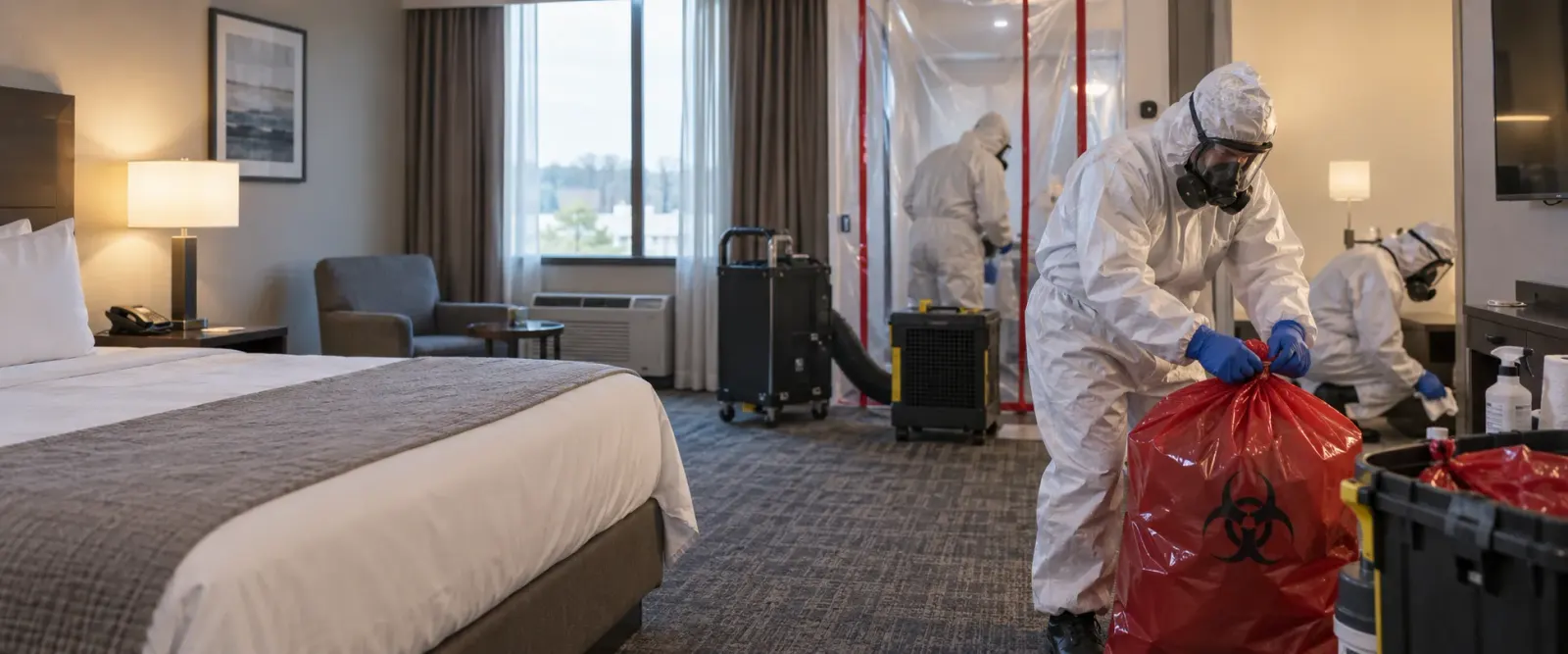
Why biohazard cleanup is needed in Crows Landing
In a town with no sewer, a backup comes from the house's own septic tank, and the waste it pushes indoors stays until it is cleaned. LAFCO records that Crows Landing has no sanitary sewer and that homes and businesses use private septic systems, since there is no public wastewater service nearby. There are no storm drains either, only roadside percolation, and December to February are the wettest months. The human-waste side of a backup is this trade's; extraction and drying are water damage restoration.
A house left in poor repair can reach the conditions that make a building legally substandard. The County's 2015 study found 41% of the housing units in Crows Landing in need of rehabilitation, sixth among its unincorporated communities by that share, and the Housing Element proposes no rezoning there because of the aging water system and the lack of sewer. HSC 17920.3 names rodent infestation, inadequate rubbish removal and accumulated junk, debris and rodent harborages. The sanitation side is removed and logged room by room.
A community clean-up fills dumpsters fast, and needles thrown in with the rest put everyone who handles the load at risk. A June 2021 community clean-up in Crows Landing, announced by Stanislaus County, set dumpsters at 22001 G Street, ten years after the previous one. HSC 118286 bars home-generated sharps from trash, recycling and green waste containers and from roll-offs for construction and demolition debris. Before a house is cleared into a bin, each needle is lifted with tongs into a rigid, puncture-resistant container.
The county landfill down Fink Road takes household trash, and trauma scene waste is not household trash. Fink Road Landfill at 4000 Fink Road is the County's Class III site for non-hazardous municipal solid waste, open Monday to Saturday, with its closure date moved to 2050. The Health and Safety Code excludes trauma scene waste from household waste, and HSC 118321.5 sends it to a permitted medical waste transfer station or treatment facility, or a dedicated freezer for up to 14 days.
On a packing floor or in a yard, an injury involves the machines and vehicles as well as the concrete. Agricultural warehouses and packing sheds line Highway 33 and the railroad beside it, and the County's 2018 specific plan for the Crows Landing Industrial Business Park plans 14 million square feet over 30 years. The IICRC S540 standard gives vehicle and other machinery remediation its own component, so a forklift or truck is cleaned in the same scope.
At the 2010 Census Crows Landing had 143 housing units, 22 of them vacant, and 44 of its 121 occupied homes were rented. A house that has stood empty is walked for sharps and rodent waste before anyone starts clearing it.
Biohazard cleanup, as delivered in Crows Landing
Crows Landing is 20 road miles from the Modesto base, and the crew comes in on Highway 33 or from I-5 by the Fink Road interchange. A single scene log records each visit, from the release to the confirmation of cleaning.
Highway 33 is two-lane through town, with a four-way stop at Fink Road and 4,600 to 6,000 vehicles a day either side of that junction. Winter fog and harvest trucks can push arrival toward 140 minutes, and LAFCO notes long driveways and addresses that are hard to see, so a landmark helps. Propertyvendr confirms the time.
S540 treats release by law enforcement or a regulatory agency as done before it applies, so the crew waits for it. At the Crows Landing address it then inspects and records what is affected, which materials are porous, and whether a duplex or the house next door is involved.
Household members and neighbours are kept clear of the work area. Universal precautions apply, gear stops fluids reaching skin or clothing, and respirators follow a written 5144 program.
Soaked flooring, bedding and contents are bagged and labelled BIOHAZARDOUS WASTE; needles are boxed in rigid containers; glass is taken up with forceps.
Surfaces are decontaminated with an EPA List S disinfectant that stays wet for its label contact time. In an older house or farm building where rodents have been, doors and windows open for 30 minutes before droppings are soaked and wiped, never swept.
Bags go to a permitted medical waste facility or a freezer, 14 days at most (HSC 118321.5), never Fink Road Landfill.
Work ends with S540's confirmation of cleaning, and CDPH's trauma scene information lets the owner check it. Any rebuild is permitted by Stanislaus County's Building Permits Division.
Where biohazard cleanup is needed in Crows Landing
Crows Landing's areas differ by use more than age: the highway strip, packing sheds, the civic block, homes on septic, and farmland out to the river.
Highway 33 and the 5th Street commercial strip
The commercial area on the west side of the highway and along 5th Street, where a typical lot holds a 625 square foot building on its own septic system. Shop restrooms are cleaned and disinfected to label time.
Packing sheds and warehouses along Highway 33 and the Union Pacific
Agricultural warehouses and packing sheds line the highway and the tracks, zoned for general commercial and limited industrial use. An injury on a packing line is cleaned from floor to machinery.
G Street and the civic block
The civic block, where the Community Services District meets in the fire station's conference room and the 2021 clean-up set its dumpsters at 22001 G Street. Needles from a cleanout are boxed before anything is binned.
West 5th Street, I Street and Fink Road
The south-west edge, where an 1893 church stands with homes on three sides and farmland across Fink Road, in FEMA Zone X. A septic backup into a house here is sanitised before the drying.
Bonita Avenue: Bonita Elementary and Bonita Park and Pool
The town's K-5 school and the 1-acre park and pool across the street on the north-western edge. A needle found near the school or park is picked up with tongs, never by hand.
4th Street well sites
Residential blocks around the Community Services District's well site on 4th Street, where a replacement well was proposed in 2024. A house here where fluids reached the floor loses carpet, pad and soaked subfloor as regulated waste.
East side: E Street, Armstrong Road and the CCID Main Canal
The north-eastern edge of the community, with walnut storage buildings on Crows Landing Road that take 10 to 12 truckloads a day from September to March. Trucks and forklifts fall under S540's vehicle component.
Highway 33 and Fink Road junction
The town's four-way stop on the two-lane highway, which the General Plan would widen to a four-lane expressway. A car or truck involved in a scene is cleaned as its own part of the scope.
Crows Landing Industrial Business Park, former Naval Auxiliary Landing Field
1,528 acres north-west of town, conveyed to the County in 2004 and planned in 2018 for a public-use airport, business park uses and about 14,000 to 15,000 jobs. Built space would get the same workplace cleanup.
Fink Road Landfill
The County's Class III landfill at 4000 Fink Road for non-hazardous municipal solid waste, with its closure date now 2050. Trauma scene waste from any Crows Landing address goes to a permitted medical waste facility instead.
San Joaquin River and the Crows Landing Road bridge
The original ferry landing of the 1850s, three miles east of today's town, and the old river bridge slated for replacement. Any farm building out toward the river is aired for 30 minutes before rodent cleanup.
Orestimba Creek at Kilburn Road
About 2.4 miles east of town in FEMA Zone AE, where the house at 21942 Kilburn Road was built as ranch employee housing in the 1890s. Rodents in an old dwelling's ducts call for an exterminator before cleanup.
Biohazard cleanup sub-services available in Crows Landing
Questions from Crows Landing property owners and managers
Inside the house it is two jobs. Sewage backup biohazard cleanup handles the human waste: soiled rugs, bedding and porous contents bagged, floors and fixtures decontaminated, and workers in goggles or a face shield, liquid-repellent coveralls, waterproof gloves and rubber boots. Water damage restoration extracts the Category 3 water and dries the structure. The tank and leach field themselves are a septic service's work.
No. Fink Road is a Class III landfill for non-hazardous municipal solid waste, and trauma scene waste is excluded from household waste by the Health and Safety Code. Nor does the County's household hazardous waste facility at 1710 Morgan Road in Modesto accept biomedical waste. Under HSC 118321.5 it goes to a permitted medical waste transfer station or treatment facility, or a dedicated freezer for up to 14 days.
No. HSC 118286 keeps home-generated sharps out of trash, recycling and green waste containers, commercial collection containers and any roll-off for solid waste or demolition debris. Needles are lifted with tongs or forceps and carried only in a sharps container, to a household hazardous waste facility, a consolidation point, a medical waste generator's facility or an approved mail-back.
It can. LAFCO records that land use decisions within the Community Services District stay with Stanislaus County, and HSC 17920.3 counts rodent infestation, as determined by a health officer or code enforcement officer, inadequate rubbish removal and heaped junk, garbage and rodent harborages as substandard conditions. Whether a house is cited is the officer's call and the response is the owner's; this is not legal advice.
Civil Code 1710.2 says an owner or agent need not disclose an occupant's death on the property, or how it happened, if it occurred more than three years before the offer to rent, and a renter is a transferee under the section. The section gives no protection for an intentional misrepresentation in answer to a direct question. That is the statute, not legal advice; the owner or manager decides.
Not as part of hoarding cleanup. That service is the sanitation: sharps, human and animal waste, rodent droppings and nests, and soiled porous items, removed and logged. Hauling the volume is a junk removal cleanout, requested as its own job, and it follows once the house is safe to work in.
Biohazard cleanup near Crows Landing

