Why biohazard cleanup is needed in Vernalis
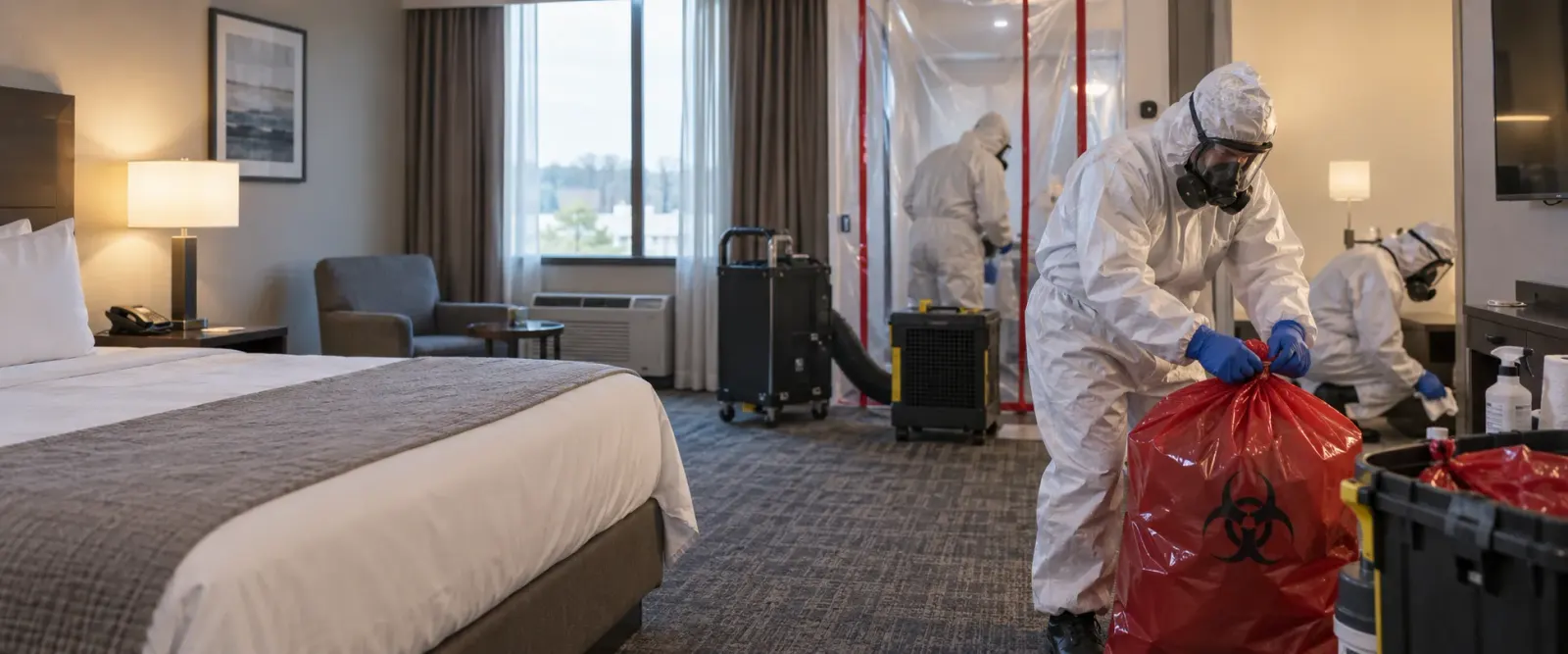
With no public sewer, a backup in a Vernalis house comes from its own septic system, and the waste stays inside until it is cleaned out. San Joaquin County's General Plan records that homes here use domestic wells and septic systems, with no water, sewer or drainage system, and storm water runs to ditches and ponds. Pumping the tank and drying the rooms are separate trades. The sanitation is this one: soiled rugs and bedding bagged, floors and fixtures decontaminated, and workers in face shields, liquid-repellent coveralls, waterproof gloves and rubber boots.
In an older house, fluids from a death found late pass through the floor covering into the structure below it. The Housing Element places Vernalis in a census tract, shared with New Jerusalem, where more than half of the homes were built before 1990, and three of the houses with a recorded year are two-storey. Under Cal/OSHA 5193 porous material that is soaked or caked with body fluids is regulated waste. On a two-storey house the ceiling of the room below is checked as well.
Cleanup waits for law enforcement to release the scene, and the County lists the Sheriff among the services Vernalis relies on. San Joaquin County's summary of services for the community ticks the Sheriff for law enforcement and the Tracy Rural fire district for fire protection, whose services include emergency medical care. The IICRC S540 standard assumes a scene has been released before the crew arrives, so nothing is moved until then. Part of the settlement lies over the line in Stanislaus County.
On a farm, rodents that reach a house's heating and cooling ducts need an exterminator before any cleanup. Agriculture covers 67 percent of the 142-acre Vernalis community, and the General Plan describes it as surrounded by active, large-scale farming on prime soils. Where rodents have got into the ventilation, CDC guidance is to bring in a professional rodent exterminating service first. The rooms are then aired for 30 minutes, droppings and nests are soaked with disinfectant and wiped, never swept or vacuumed, and clearing the volume that remains is junk removal in Vernalis.
A vehicle can be a trauma scene in California law, and Vernalis sits where two state highways meet. Caltrans counts 16,600 to 17,600 vehicles a day on Route 132 at its junction with SR 33, where the community's small commercial corner stands, and about 12 acres inside the boundary are industrial. Section 117776 of the Health and Safety Code definitions names vehicles and trailers among trauma scene locations. A car, truck or forklift is cleaned under S540's vehicle and machinery component.
Of the 19 Assessor parcels that touch San Joaquin County's Vernalis boundary, six carry a year built: 1914, 1923, 1940, 1941, 1948 and 1959, and none is later than 1959. A house of that age is checked below the floor covering before any cleanup is scoped.
Biohazard cleanup, as delivered in Vernalis
The crew drives 16 road miles west from the Modesto base on Route 132 to its junction with SR 33 at Vernalis. A single scene log records every visit, from the release through removal to the confirmation of cleaning.
Route 132 carries 15,000 vehicles a day at the county line and up to 17,600 at the SR 33 junction. San Joaquin County's hazard plan warns of thick winter tule fog on its roads, which can hold arrival toward 120 minutes. County address points here use a Tracy mailing address, so the road name and nearest junction help.
The Sheriff, listed for law enforcement in the County's summary for Vernalis, or the regulatory agency releases the scene first, as S540 assumes. The crew then inspects and makes a preliminary determination: affected rooms, porous materials, and whether fluid on an upper floor reached the ceiling below.
The household is kept out of the work area. Universal precautions apply, gear keeps fluids off skin and clothing, and respirators are worn under a written 5144 program.
Soaked flooring, bedding and contents are bagged and labelled BIOHAZARDOUS WASTE; any needles go into rigid containers; glass is lifted with tongs.
Affected surfaces are decontaminated with an EPA List S disinfectant, left wet for the contact time on its label. In a farmhouse or shed where rodents have been, ducts are checked first, the space is aired for 30 minutes, and droppings are soaked, then wiped up.
No bag waits at the house: when removal ends it goes to a permitted transfer station or treatment facility, or a 14-day freezer.
The work ends with S540's confirmation of cleaning, which CDPH's trauma scene cleaning information helps the owner judge. Any floor or ceiling repair is scoped afterwards under the same file.
Where biohazard cleanup is needed in Vernalis
Vernalis is a 142-acre rural community of about 36 people, so its areas differ by use: highway corner, old houses, farmland and the county line.
SR 132 and SR 33 junction, Rural Service Commercial corner
Caltrans names two count points Vernalis where the routes meet, and the commercial use in the whole community is 0.8 acres on this corner. A vehicle towed off the highway after a scene is cleaned as its own item.
State Route 33 frontage homes
The addressed houses along SR 33, with recorded building years from 1914 to 1959, three of them two-storey, each on its own well and septic system. A septic backup into one of these homes is sanitised before any drying.
S Welty Road
The other addressed street, with a house recorded as built in 1940 and parcels of about 5.7 to 139 acres, the largest under a Williamson Act contract. Outbuildings on large parcels are aired before any rodent cleanup.
Warehouse Industrial parcels
About 12 acres of industrial use in an I-W Warehouse Industrial zone. Staff who clean their own workplace do so under the employer's 5193 plan; an injury on a dock or machine can go to a crew.
Sacramento Northern Railroad corridor and the old train stop
The former Southern Pacific line, where Vernalis began in the 1880s as a stop with a few stores and a post office. Broken glass or a needle along the corridor is lifted with tongs, never by hand.
Stanislaus County side and the Vernalis General Store
The part of the settlement over the county line, where the General Plan places the Vernalis General Store. Waste from here cannot go to Stanislaus County's household hazardous waste site, which refuses biomedical waste.
Farmland ring, Vernalis clay loam and Capay clay
Agriculture covers 67 percent of the community, on Vernalis clay loam and Capay clay, inside the West Stanislaus and Banta-Carbona irrigation districts. Farm dwellings with rodents in the ducts need an exterminator before cleanup.
San Joaquin River gauge reach
The Vernalis gauge, about 3.3 miles north-north-east, where the Weather Service expects seepage into crop land outside the levees from 21 feet. Where seepage and a septic backup meet in one building, the sanitation comes first.
Biohazard cleanup sub-services available in Vernalis
Questions from Vernalis property owners and managers
Law enforcement, or a regulatory agency where one is involved. San Joaquin County's summary of services for Vernalis lists the Sheriff for law enforcement, and the Tracy Rural fire district, which also gives emergency medical care. IICRC S540 is written on the assumption that every scene has been released before cleanup, so the crew starts only after that. Part of the settlement lies in Stanislaus County.
In two parts. The human-waste side is sewage backup biohazard cleanup: soiled rugs, bedding and porous contents bagged, floors and fixtures decontaminated, and the workers in goggles or a face shield, liquid-repellent coveralls, waterproof gloves and rubber boots. Extraction and drying are water damage restoration under its sewage and Category 3 service. The tank and its field are a matter for a septic service.
Not to Stanislaus County's household hazardous waste facility at 1710 Morgan Road in Modesto, which lists biomedical waste among what it does not accept. Under HSC 118321.5, trauma scene waste leaves immediately once the removal phase ends, for a permitted medical waste transfer station or treatment facility, or a dedicated freezer for up to 14 days. The same rule applies on the San Joaquin side of the line.
Either can appear. San Joaquin County's address points inside the community carry the mailing city Tracy and ZIP 95304, while its ZIP layer maps the Vernalis point to 95385, and the Assessor splits the same parcels between the two. Giving the street, whether S State Route 33 or S Welty Road, with the nearest junction and both ZIP codes lets the crew find the house without doubt.
Not first. Where there is evidence rodents have accessed the heating and cooling ventilation, CDC advises contacting a professional rodent exterminating service to remove them before cleanup. After that, the house is aired for 30 minutes, droppings and nests are soaked for 5 minutes or as the disinfectant label directs, and everything is wiped up wet rather than swept or vacuumed.
No. HSC 118286 keeps home-generated sharps out of trash, recycling and green waste containers and out of any roll-off for solid waste or demolition debris. Each needle is picked up with tongs or forceps and placed in a rigid, puncture-resistant sharps container, then taken to an allowed destination such as a household hazardous waste facility, a consolidation point or an approved mail-back.
Biohazard cleanup near Vernalis

