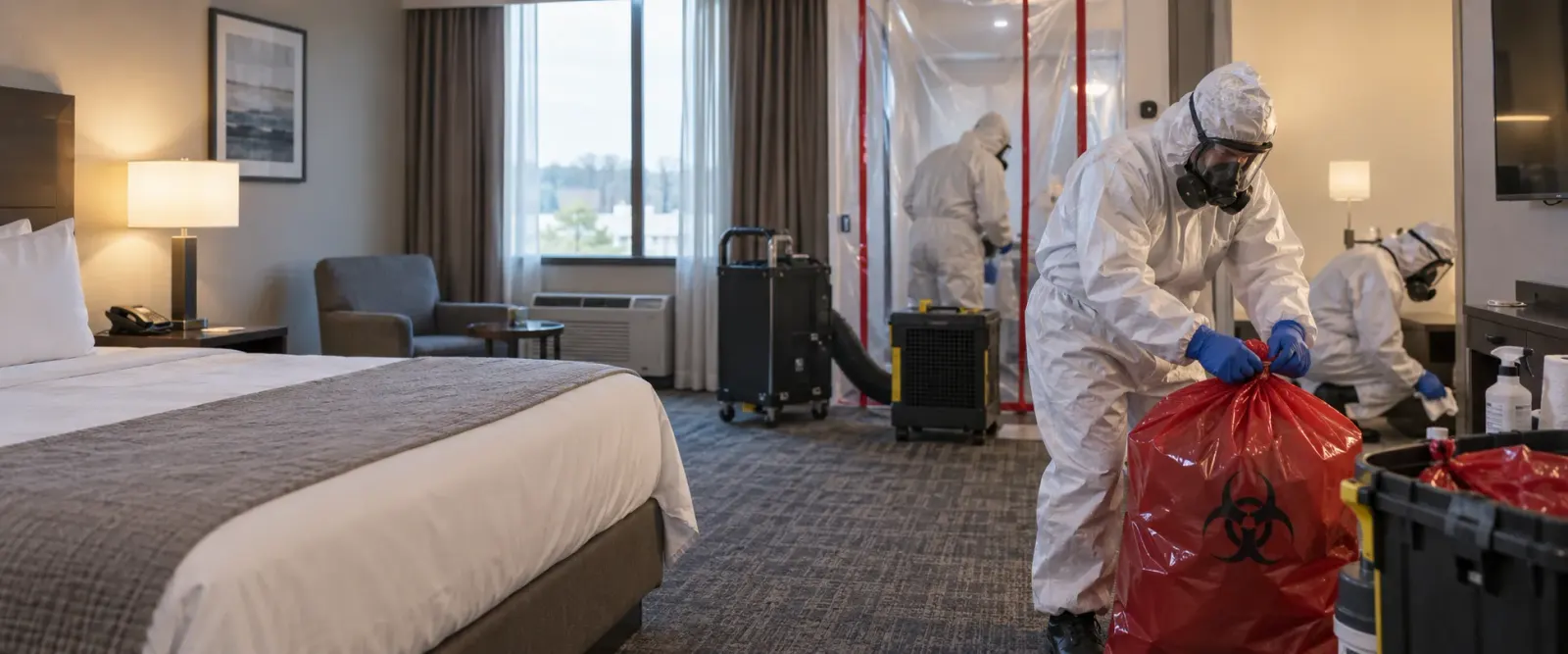
Why biohazard cleanup is needed in Escalon
A mobile home is a trauma scene location in California law, and Escalon has a senior park of more than a hundred spaces. Licensed for 106 spaces, Almond Grove in the southeast of town carries on as a 55-plus community under new owners, having begun as Paddack's Mobile Manor. The Health and Safety Code definitions in section 117776 extend a trauma scene to structures not fixed geographically, such as mobile homes, trailers or vehicles. Spaces in a park sit close, so the work area is kept tight and neighbours stay clear of it.
An old sewer trunk with cracks and blockages is one route by which sewage reaches buildings. The 14-inch trunk main under McHenry Avenue predates 1950, and when the City sent a camera through it, the old concrete showed cracking and erosion, with some lengths too blocked to see. The 2018-19 capital plan also called for upsizing the sewer lines in Vine Avenue and Main Street. Where sewage backs into a building, sanitising the human waste is biohazard work, and extraction and drying are water damage restoration.
Older Escalon houses that are hoarded or long neglected can meet the state's substandard-building conditions. Of 2,913 homes counted in 2021, 164 dated from 1939 or earlier and 190 from the 1950s, and one red-tagged house in northwest Escalon was recorded as needing demolition. HSC section 17920.3 lists rodent infestation, inadequate rubbish removal and accumulations of garbage and rodent harborages among substandard conditions. The crew's work is the sanitation: sharps, droppings, nests and soiled belongings, while junk removal in Escalon clears the volume.
In a food plant, an injury on the line reaches conveyors and equipment as well as the floor. Heavy industry is confined to the area south of Clough Avenue and along McHenry Avenue, where the food processors send wastewater down a separate industrial sewer, and the Liberty Business Park at Brennan Avenue and SR 120 is marketed for logistics and food processing. The IICRC S540 standard includes vehicle and other machinery remediation, so equipment and forklifts are part of the scope.
Businesses that serve travellers have public restrooms and lots, where needles and blood incidents need proper handling. The General Plan steers visitor-serving commercial for tourists and travellers to SR 120, a highway counted at about 15,600 daily vehicles where it meets Main and Kern streets. Cal/OSHA 5193 counts needles and broken glass as sharps, and broken glass is gathered with a brush and dust pan, tongs or forceps. Each sharp goes into a rigid, puncture-resistant container that is leakproof on its sides and bottom.
In 2021, 71.4 percent of Escalon's 2,866 occupied households owned their home, and the rest rented. When a rental is vacated after a death or a long occupancy, the unit is walked for sharps and soiled items before any cleanout crew goes in.
Biohazard cleanup, as delivered in Escalon
A 12-road-mile drive north from the Modesto base on McHenry Avenue crosses the Stanislaus River into Escalon. Each Escalon scene is written into the same log: release, containment, bagged and labelled waste, disinfection, confirmation of cleaning.
McHenry Avenue brings the crew into town past the treatment plant and the industrial area to the south; downtown and the SR 120 corridor lie beyond. December and January tule fog or harvest trucks push calls toward the two-hour end. Propertyvendr gives a time as soon as the request is acknowledged.
The crew starts only after law enforcement or the regulatory agency has released the scene, the condition IICRC S540 assumes. Inspection and preliminary determination come next: what is soiled, what is regulated waste, and whether an adjoining fourplex unit or mobile home needs to be kept clear.
The area is closed and handled under universal precautions. PPE keeps blood and body fluids away from skin, eyes and mouth, and respirator use follows a written 5144 program.
Soaked porous materials leave as regulated waste in closed bags marked BIOHAZARDOUS WASTE; sharps go into rigid containers.
Surfaces are decontaminated with an appropriate disinfectant from EPA List S and left wet for the full label contact time. In an older townsite house with rodent nests, droppings are soaked first and wiped up by the CDC method, never swept or vacuumed.
Once removal is complete, waste leaves Escalon for a permitted medical waste facility, or a freezer for 14 days at most.
The S540 confirmation of cleaning closes the job, and CDPH's cleaning information sheet helps the owner check it. Flooring and subfloor rebuild goes to reconstruction.
Where biohazard cleanup is needed in Escalon
Escalon's areas differ by age and use: the diagonal-street townsite, the SR 120 frontage, the industrial south along McHenry and newer western edges.
Downtown Main Street and the original townsite
The historic business district on Main Street, set on diagonal streets with square, oblong and triangular blocks. A scene in a room behind or above a shop is sealed off from the business while waste is removed.
Vine Avenue and Main Street (Reed Manor Subdivision)
The City's 2018-19 plan said this subdivision's storm drainage was never finished and proposed larger sewer lines in Vine Avenue and Main Street. If sewage reaches a house here, its sanitation is done before any drying.
Countrywood
Countrywood appears in City plans as the storm drain system a Vine Avenue line was to join. A request from Countrywood is scoped from the crew's first walk-through of the building.
Jordanolo Street
A six-inch steel water line was laid here in 1973, behind the sidewalks and across shared lot lines. In houses of that age, an unattended death is traced through the floor covering, pad and subfloor in turn.
SR 120 corridor
Escalon's only state highway, where the General Plan puts visitor-serving businesses. Restrooms and parking areas here get needle pickup and blood-incident cleanup, each logged by location for the owner.
McHenry Avenue south and the Southern Industrial Area
South of Clough Avenue, heavy industry and food processors line the road above the old trunk sewer. A line injury is cleaned from slab to machinery, and a sewage backup into a plant is sanitised first.
Wastewater treatment plant and the Stanislaus River edge
At the far south of the city, beside the river, sit the ponds that treat Escalon's domestic and industrial wastewater. Regulated waste from a scene never goes this way; HSC 118321.5 sends it to a permitted medical waste facility.
Liberty Business Park
Some 178 acres of flat sites near the rail line, which the City markets for logistics, manufacturing and food processing. Fleet vehicles and forklifts involved in an injury are cleaned under S540.
Brennan Avenue, Shadowood Park and Murphy Ranch
Murphy Ranch would annex 18 acres west of town as 72 house lots, and a 1957 house stands on the land. Any older house cleared before building starts is checked for rodent waste and sharps first.
Irwin Avenue and California Street, western Escalon
Proposed senior fourplexes at Irwin Village and further multifamily projects under City review. In a fourplex, the households sharing walls with an affected unit are kept away until the waste is gone.
Almond Grove Mobile Home Park, southeast Escalon
Senior residents, 55 and over, live in this park of 106 licensed spaces. Each home is a trauma scene location under HSC 117776, cleaned with neighbouring spaces kept clear.
Escalon Avenue north
Homes and businesses on the north side, where the City maps expansive soils and scheduled sidewalk repairs near Lillian Avenue. A needle found on a public sidewalk goes into a rigid sharps container, never a street bin.
Biohazard cleanup sub-services available in Escalon
Questions from Escalon property owners and managers
Yes. HSC 117776 defines a trauma scene as a place soiled by blood, body fluids or other residues from a serious injury, illness or death, and it includes mobile homes, trailers and vehicles. The same protective equipment, regulated waste handling and disinfection apply as in a house. With spaces close together in the park, the work area is kept small and the neighbouring homes are kept clear.
Inside the building, the work splits in two. Sanitising human waste from floors, drains and fixtures is biohazard cleanup, done in the splash-proof face shields, liquid-repellent coveralls, waterproof gloves and rubber boots CDC guidance names for workers handling human waste. Extraction and drying go to water damage restoration and its Sewage and Category 3 cleanup page. The City's line itself is the City's.
HSC 118321.5 sets it out: trauma scene waste is removed immediately on completion of the removal phase and transported to a permitted medical waste transfer station or treatment facility, or kept in a dedicated freezer for not more than 14 days. It never goes into household trash or the sewer. The Escalon scene log records when it left and where it was sent.
HSC 17920.3 lists conditions that make a building substandard, among them rodent infestation found by a health or code enforcement officer, inadequate garbage and rubbish removal, and accumulations of junk, garbage and rodent harborages that create a fire, health or safety hazard. Whether the house meets that test is the officer's finding; the response is the owner's decision. This is not legal advice.
No. HSC 118286 keeps home-generated sharps, including those from a multifamily residence, out of trash, recycling and green waste containers and out of any roll-off used for solid waste or construction and demolition debris. They go into a rigid sharps container and travel to a household hazardous waste facility, a consolidation point, a medical waste generator's facility or an approved mail-back.
Yes. The IICRC S540 standard for trauma and crime scene cleanup assumes every scene has been released by law enforcement or a regulatory agency before work starts. After release, the crew inspects, makes a preliminary determination and scopes the job. CDPH's trauma scene cleaning information sheet is written to help the client understand the work and judge whether it was done satisfactorily.
Biohazard cleanup near Escalon

