Why biohazard cleanup is needed in Ripon
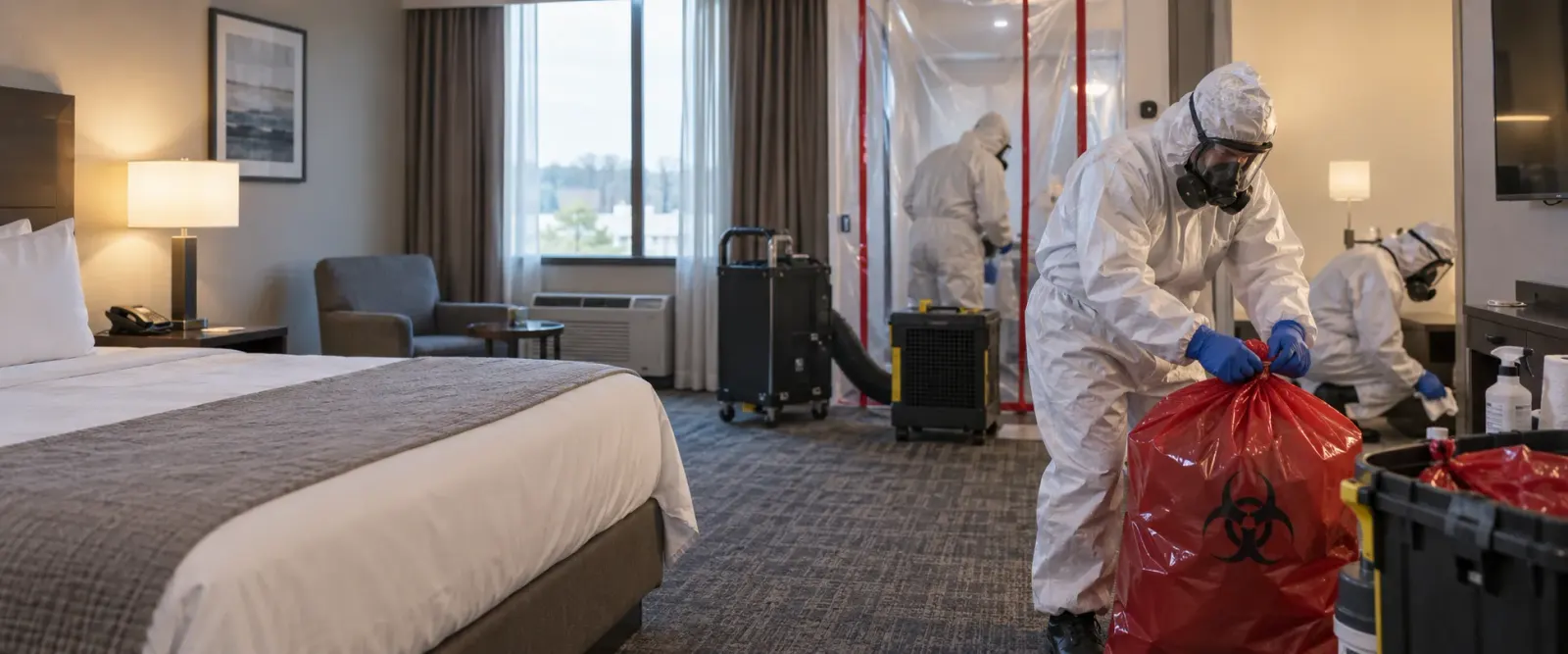
At a highway motel, guests stay in the rooms beside the one being cleaned. The General Plan records two major auto and truck travel plazas, fast-food restaurants and motels added at the Jack Tone Road interchange, which it describes as built to serve heavy truck traffic, and Highway 99 carries about 139,000 vehicles a day there. Soiled bedding is contaminated laundry. The room is sealed, and under HSC section 118321.5 the waste leaves immediately once the removal phase ends.
A truck cab or a car can be a trauma scene in its own right. The 2015 North Pointe plan notes two big truck service and parking operations by the Jack Tone Road interchange, with trucking yards inside the plan area too. The Health and Safety Code definitions in section 117776 name vehicles among the locations a trauma scene may occupy. IICRC S540 covers vehicle remediation, so seats, carpet and cab surfaces are removed or decontaminated like any room.
In an apartment building, one unit's cleanup is planned around the homes that share its walls. West Main Street holds Almond Blossom, 42 units from 1984, Almond Queen, 12 units from 1985, and the 94 senior units of Bethany Home, completed over 2006 and 2007. When a death goes unnoticed, fluids travel through carpet and pad into the subfloor, and Cal/OSHA 5193 makes that saturated material regulated waste. It is cut out and bagged while residents next door are kept out of the work area.
Where older buildings have deteriorated, a hoarded house can cross the state's substandard line. South of Main, the streets from Stockton to Acacia are lined with bungalows built between 1910 and 1920, and in 2009 a redevelopment survey covering a portion of the older areas counted signs of dilapidation or deterioration on 58 percent of 644 parcels. HSC section 17920.3 lists rodent infestation and accumulations of garbage and rodent harborages among substandard conditions. The crew handles the sanitation side, and junk removal in Ripon clears the volume.
In a processing plant, an injury reaches the equipment as well as the floor. Diamond Pet Foods has operated at 942 S. Stockton Avenue since 2013, in the district that holds most of Ripon's industry, and the North Pointe area mixed food-processing plants and the Goodwin Business Park with almond orchards in 2015. The IICRC S540 standard takes in structural, contents, and vehicle and other machinery remediation, so conveyors, guards and forklifts are decontaminated with the slab beneath them.
Ripon's 2016 Housing Element lists 94 senior apartments at Bethany Home, finished in 2006 and 2007, alongside 42 units at Almond Blossom from 1984 and 12 at Almond Queen from 1985, all on West Main Street. In buildings like these, containment is set around the neighbouring units first.
Biohazard cleanup, as delivered in Ripon
Highway 99 takes the crew 11 road miles north from the Modesto base and over the Stanislaus River, Ripon's only direct crossing to the south. Every Ripon scene is logged in the same order: release, containment, waste, disinfection, confirmation of cleaning.
The crew comes up Highway 99 across the Stanislaus, and the City warns that an emergency could shut that one crossing. Inside town, three overpasses at Main, Fulton and Jack Tone Road take it across the freeway. Winter tule fog or harvest-season trucks can stretch a call toward two hours; Propertyvendr gives the time on acknowledgement.
Nothing is touched until law enforcement or the regulatory agency has released the scene, the starting point IICRC S540 assumes. The crew then inspects and makes a preliminary determination: which surfaces and contents are affected, what is regulated waste, and which motel rooms or apartments must stay closed.
The room is sealed and worked under universal precautions. PPE blocks blood and body fluids from skin, eyes and clothes, and respirators are fit tested under a written 5144 program.
Mattresses, carpet and other soaked porous items leave as labelled regulated waste, and sharps go into rigid containers.
Hard surfaces are decontaminated with an appropriate EPA List S disinfectant, left wet for the full contact time on its label. In a hoarded bungalow south of Main, rodent droppings are soaked first and wiped up by the CDC method, never swept.
Waste leaves Ripon as soon as removal is finished, for a permitted facility or a dedicated freezer, 14 days at most (HSC 118321.5).
S540's confirmation of cleaning closes the scene, and CDPH's cleaning sheet helps the owner check the work. Flooring and subfloor rebuild moves to reconstruction.
Where biohazard cleanup is needed in Ripon
Ripon's areas differ by era and use: the brick downtown and bungalow blocks, the Highway 99 service corridor, the industrial south and 2000s tracts.
Downtown Main Street
Ripon's first brick buildings went up here: the Riddle Building in 1884, the Odd Fellows hall in 1886 and, in 1912, the Markham Hotel. A scene upstairs is sealed off from the ground-floor business until the waste has gone.
Stockton, Walnut, Locust, Elm, Orange, Palm and Acacia streets south of Main, and the depot area north of Main
Bungalow-era houses of 1910 to 1920 fill the blocks below Main, and a few Queen Anne and Italianate cottages survive near the old depot. In a house this old, fluids from an unattended death are followed through the floor to the framing.
South Stockton Avenue industrial district
Most of Ripon's industry, including the Diamond Pet Foods plant that opened in 2013 near the river. A workplace injury here is cleaned across floor, lines and equipment, and forklifts fall under S540.
Former paper mill by the Stanislaus River
A mill opened by Simpson Lee in 1965 and closed by Neenah in 2009 after 44 years. Any long-closed industrial building is checked for needles and rodent nesting before anyone works inside.
Stanislaus River corridor and the Vera district
The river edge holds the wastewater ponds and about 630 acres kept as Resource Reserve, and it is the one part of Ripon in a FEMA 100-year zone. Needles or broken glass found on this open ground are lifted with tongs or forceps, never by hand.
Jack Tone Road and the SR 99 highway service corridor
Travel plazas, truck parking, fast-food restaurants and motels at the interchange. Guest rooms, restrooms and truck cabs are each treated as a separate scene, with their own record for the operator.
North Pointe Specific Plan area
In 2015 this 310-acre plan area mixed almond orchards with food plants, truck yards and the light-industrial Goodwin Business Park, and 1,050 homes are planned. A yard injury involving a truck or trailer is cleaned under S540 vehicle remediation.
Ripona Planning District
Of this district's 146 acres, 42 are designated Urban Core, and the land below Milgeo Road is fully built. A shop or house vacated here is walked for sharps and rodent waste before its contents are cleared.
Wilma Avenue and the North Wilma district
Along Wilma Avenue sit City Hall and, in the North Wilma district, two school sites and community commercial land. Needles found near public buildings or in a commercial lot go into a rigid sharps container, never a trash can.
Doak Boulevard and the southern edge
A landscaped median through the homes from Mohler Road to Vera Avenue, then turn lanes into the industrial districts. Sharps found in median planting are picked up mechanically and logged by location.
West Main Street and South Jack Tone district
Below West Main, most of this district is set aside for low-density housing and commercial recreation, with the West Main apartments close by. In a senior building, neighbours are kept clear of the affected unit throughout.
2000s subdivisions
Almost a third of Ripon's homes, 1,577 of them, went up between 2000 and 2009 in tracts like Chesapeake Landing, Brookline Estates and Seven Oaks. In tract houses of that decade, fluids still reach the pad and underlayment.
Biohazard cleanup sub-services available in Ripon
Questions from Ripon property owners and managers
The affected room is contained so guests in nearby rooms are not exposed, and soiled bedding is handled as contaminated laundry under Cal/OSHA 5193. Regulated waste leaves the property immediately when the removal phase ends, as HSC 118321.5 requires. Whether other rooms stay let is the operator's call; the crew's part is to keep the work area closed and hand the room back disinfected and confirmed clean.
Yes. HSC 117776 includes vehicles among the places a trauma scene can be, and IICRC S540 lists vehicle and other machinery remediation as one of its components. Seats, carpet and other porous parts that are saturated or caked go out as regulated waste; hard surfaces are decontaminated with an EPA List S product at its label contact time. The vehicle is returned with a confirmation of cleaning.
Under HSC 118321.5, trauma scene waste is removed from the scene immediately on completion of the removal phase and transported to a permitted medical waste transfer station or treatment facility, or kept in a dedicated freezer for not more than 14 days. It never goes into a Ripon trash container. The scene log records when the waste left and where it went.
Civil Code 1710.2 says an owner or agent is not required to disclose an occupant's death, or how it occurred, where it happened more than three years before the offer to rent, and it treats a renter as a transferee. It gives no protection for an intentional misrepresentation in answer to a direct question. That is what the statute says, not legal advice; the owner or manager decides.
HSC 17920.3 lists conditions that make a building substandard, including rodent infestation found by a health or code enforcement officer, inadequate garbage and rubbish removal, and accumulations of junk, garbage and rodent harborages that create a fire, health or safety hazard. Whether a house meets that test is the officer's finding, and what follows is the owner's decision. This is not legal advice.
Both. Sanitising the human waste from floors and fixtures is biohazard work, done in the splash-proof face shields, liquid-repellent coveralls, waterproof gloves and rubber boots CDC guidance lists for handling human waste. Extraction and drying belong to water damage restoration and its Sewage and Category 3 cleanup page. One Ripon request can open both, each with its own scope.
Biohazard cleanup near Ripon

