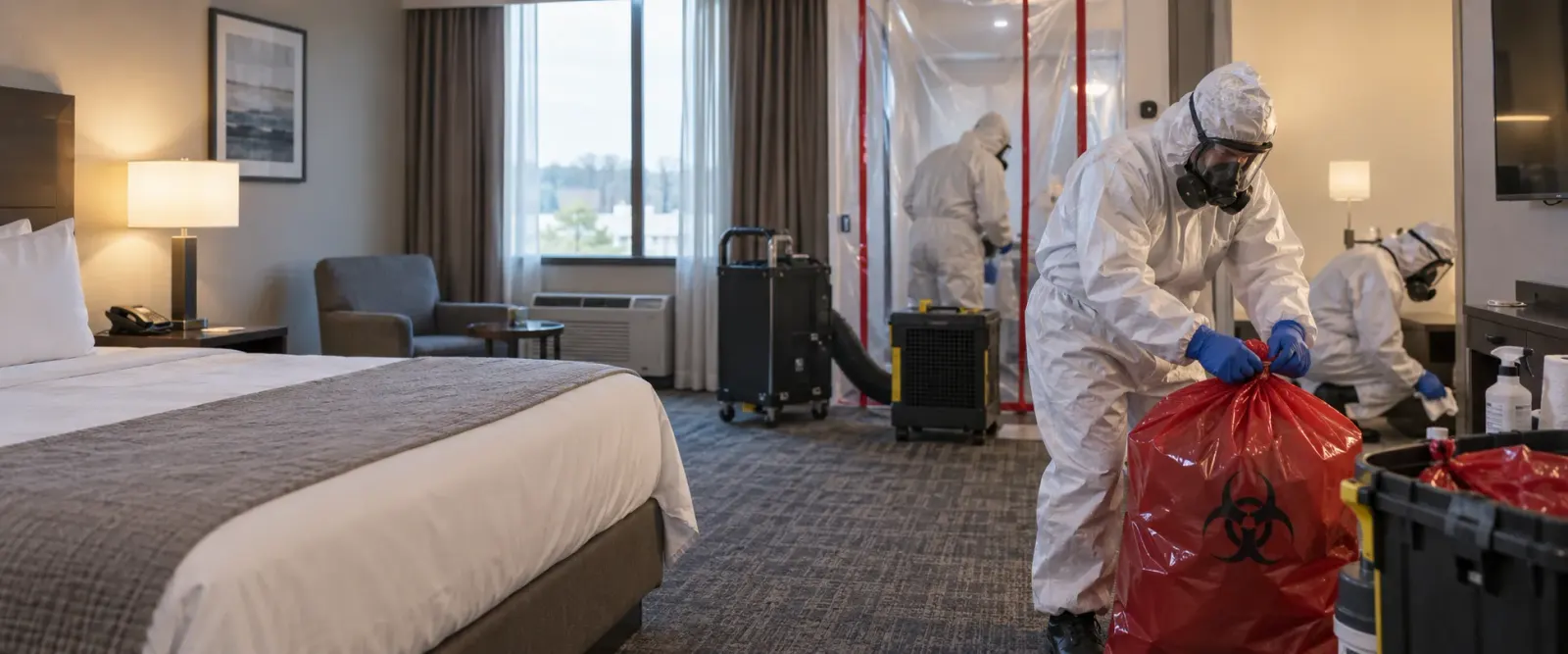
Why biohazard cleanup is needed in Waterford
About one Waterford home in six is in a building of two or more units, and a cleanup there is done with neighbours on every side. Of 2,786 homes counted in January 2023, the Department of Finance puts 364 in complexes of five units or more and another 111 in two- to four-unit buildings. The unit is sealed at shared walls, halls and vents, and the crew's protection has to keep blood and body fluid from skin, eyes and clothing, as Cal/OSHA 5193 requires.
Central Waterford's older, smaller homes are where the City has found the most housing in need of work. A door-to-door survey in 2002 judged 508 of the 2,163 homes in need of some rehabilitation, 16 of them dilapidated, with the biggest concentration east of Church Street and west of Tim Bell Road. HSC 17920.3 treats rodent infestation, failed rubbish removal and accumulated debris and rodent harborages as substandard conditions. Their sanitation begins with the rooms aired, and droppings are soaked rather than swept.
Waterford's sewer mains are vitrified clay in the older parts of town and PVC in the newer. All flow goes through about 200 manholes, four lift stations and 1.5 miles of force main to the one treatment plant, above the river off Riverside Drive, rated at 1 million gallons a day. If a line blocks and sewage comes back into a house or shop, its human-waste sanitation is done and logged before the water side of the loss is dried under a separate scope.
Downtown Waterford's shops and public buildings have to reopen clean after an incident. Downtown is built around E Street and Bentley Street, where the General Plan says its pre-1976 concrete-frame buildings, few in number, mostly hold commercial uses, and the Waterford Community Center took in evacuees during the January 1997 flood. A restroom or floor where blood was found is disinfected with an EPA List S product for its label contact time.
Waterford's industry sits along Highway 132 and the river frontage, and a workplace scene reaches the machinery. The General Plan places the present industrial base on the Highway 132 corridor and Tuolumne River frontage; a Caltrans highway, it carries through traffic past those sites. Under IICRC S540, vehicle and machinery remediation is part of the work, so a truck, a loader or a production line is decontaminated with the slab it stands on.
Every one of Waterford's 2,163 homes was visited in a July and August 2002 survey, and 508, or 23.5 percent, needed some rehabilitation; 16 were dilapidated. In a house already in that condition, the cleanup scope allows for flooring and subfloor that were worn before the scene.
Biohazard cleanup, as delivered in Waterford
Waterford is 14 road miles east of the Modesto base on Yosemite Boulevard, Highway 132, which runs through the middle of town. Every scene keeps one log, from the release and containment through bagged waste to the confirmation of cleaning.
Highway 132 is the route in, and the crew leaves it at Reinway Avenue, Hickman Road and F Street, or Tim Bell Street and Baker Street, whichever is nearest the address. Propertyvendr sets an arrival time inside the 90 to 120 minute window when the request is acknowledged and asks how the crew should get in.
Cleanup follows the release of the scene by law enforcement or the regulatory agency, which IICRC S540 takes as its starting point. The crew then inspects the apartment, house or shop, records what the fluids reached, and agrees the scope with the owner or manager.
Shared walls, halls and vents are closed off first. Every fluid is treated as infectious, protective equipment keeps it off skin and clothing, and respirators are fit-tested before first use and yearly.
Saturated porous items and flooring are bagged as labelled regulated waste; sharps go into rigid containers, glass by tongs or brush and pan.
Surfaces are disinfected with an EPA List S product left on for the time its label sets. Rooms with rodent droppings are aired for 30 minutes, then the droppings are soaked and wiped up, never vacuumed or swept.
Removal ends and Waterford waste goes to a permitted medical waste facility or a freezer, at most 14 days; the county hazardous waste site refuses it.
Cleaning is confirmed to S540 and the record handed over. Replacing floors or walls afterwards needs a City of Waterford building permit, since the department lists alterations beyond cosmetic change.
Where biohazard cleanup is needed in Waterford
Waterford's areas differ in age and who lives beside a scene: old central blocks, a highway corridor, river bluffs and new tracts to the north.
Downtown, E Street and Bentley Street
The downtown grew east of the old rail corridor, bounded by G Street, Main Street and D Street and reaching south across Highway 132. A shop restroom or sales floor is cleaned so the business can reopen, and the work is logged.
Central Waterford, Church Street to Tim Bell Road
Single-family homes, duplexes and apartments that the 2002 survey found most in need of repair, with fairly small units east and west of F Street. A cleanup in one unit is sealed from the next before any waste is moved.
Original Bakerville townsite, south of Highway 132
Surveyed in 1868 as twelve blocks, its street pattern still visible in the southeast of town. In homes on these old lots, fluids are followed through floor coverings into the boards below and removed only as far as they reached.
Skyline Boulevard and Lyn Way, east end
One of two smaller neighbourhoods the 2002 survey singled out for rehabilitation, at the far east end, where Highway 132 carries about 3,300 vehicles a day. Needles found in a yard or on a verge go straight into a rigid container.
West edge, Pecan Avenue to Yosemite Boulevard
Mostly older homes, with the Space in the Shade Mobile Home park on Yosemite Boulevard just outside city limits. A coach there counts as a trauma scene location under state law and is cleaned to the same standard as a house.
River Pointe, Highway 132 and Hickman
Filed in 2003 as 277 homes beside the Tuolumne, on its own two-well water system that remains separate from the City's. In a newer tract house, fluids are traced through carpet and pad to the subfloor and the rebuild scoped apart.
Lake Pointe, northeast Waterford
A 425-acre master plan adopted in 2007 for about 1,642 homes around a recreation lake, with a first map of 412 lots filed in 2025 and building expected from 2027. Once homes there are occupied, they come under the same cleanup standard as the older town.
Tim Bell Road north and Bonnie Brae
New subdivisions where two MID canals cross north Waterford, with sewer and water mains extended along Tim Bell Road in 2024. A backup into a new home is still sewage sanitation first and drying second.
Yosemite Boulevard (SR 132) corridor
A Caltrans highway that congests at peak commute hours and has only intermittent sidewalks, with the present industrial base along it. A vehicle or machine involved in a workplace scene is decontaminated under S540.
Tuolumne River bluff, Riverside Drive and the river parks
The wastewater plant stands on the bluff here, beside River Park and the S. Reinway Park and Trailhead. Sharps found in park restrooms or along a trail are picked up with tools and sealed in a sharps container.
West growth area, Reinway, Pasadena and Eucalyptus avenues
A gated 53-unit development of duplexes and houses approved in 2025 on Washington Road, and a 98-lot subdivision proposed with the Fahmy annexation. In duplexes, a cleanup on one side is sealed at the party wall.
Northern edge, Modesto Main Canal and Dry Creek
The MID Modesto Main Canal forms the city's northern boundary, with growth land beyond it toward Dry Creek. MID canals are typically dry in winter, and needles found in a dry canal bed are lifted with tongs, never by hand.
Biohazard cleanup sub-services available in Waterford
Questions from Waterford property owners and managers
The unit is sealed at its door, shared walls and any common vents before work begins, and the crew moves equipment and bagged waste by the shortest route out. Other tenants are not entered or disturbed, and waste leaves as soon as removal ends. The manager receives the record, and what to tell a future tenant is governed by Civil Code 1710.2 and decided by the owner.
HSC 118321.5 requires trauma scene waste to leave as soon as the removal phase ends, bound for a permitted medical waste transfer station or treatment facility, or a dedicated freezer for up to 14 days. Stanislaus County lists biomedical waste among what its household hazardous waste facility on Morgan Road does not accept, and none of it goes into a Waterford curbside cart.
Yes. The park sits on Yosemite Boulevard in unincorporated Stanislaus County, just past the city limits, and state law names mobile homes, trailers and vehicles as trauma scene locations. Saturated carpet, pad and floor panels are removed as regulated waste, the frame is decontaminated, and the homeowner and park manager receive one record.
Both, handled as two jobs. Sewage backup biohazard cleanup covers the human-waste sanitation on floors, fixtures and belongings, with the crew in splash-proof face shields, liquid-repellent coveralls, waterproof gloves and boots. Extraction and drying are the water trade's Sewage and Category 3 cleanup, done to IICRC S500. The older parts of Waterford sit on vitrified clay mains, and one request can start both.
It can be. HSC 17920.3 counts vermin or rodent infestation, inadequate garbage and rubbish removal, and accumulations of junk, debris, garbage and rodent harborages that make a fire, health or safety hazard as substandard conditions. How it is handled is for the owner and the authorities; the crew does the sanitation, and hauling the volume away is junk removal's hoarding cleanout. This is not legal advice.
No. HSC 118286 keeps home-generated sharps, including those from an apartment building, out of trash, recycling and green waste containers, commercial bins and any roll-off for solid waste or construction debris. The crew picks every needle out into a rigid sharps container before the unit's contents go into a bin.
Biohazard cleanup near Waterford

