Why storm damage happens in Empire
Empire's houses are old, and wind goes first for roof covering that has aged in place. Among 1,198 homes, the Census Bureau's 2019-2023 survey counts 109 from 1939 or earlier, 132 from the 1940s and 176 from the 1950s, and no home at all built since 2010. When a gust lifts that covering, rain follows the gap into the ceilings. The California Department of Insurance claims guide asks the owner to prevent further damage with temporary repairs, plastic sheeting or plywood, and warns that ensuing damage may not be covered where reasonable steps were not taken.
About one Empire home in seven is a mobile home, where a limb strike opens the living space in one blow. The same survey counts 163 mobile homes, and 495 of Empire's households rent. A single-story roof leaves nothing between a falling branch and the room below, so the opening is tarped or boarded on the first visit. Where the home is a rental, the owner and the household each need their own record, and the photos show which damage belongs to the structure and which to belongings.
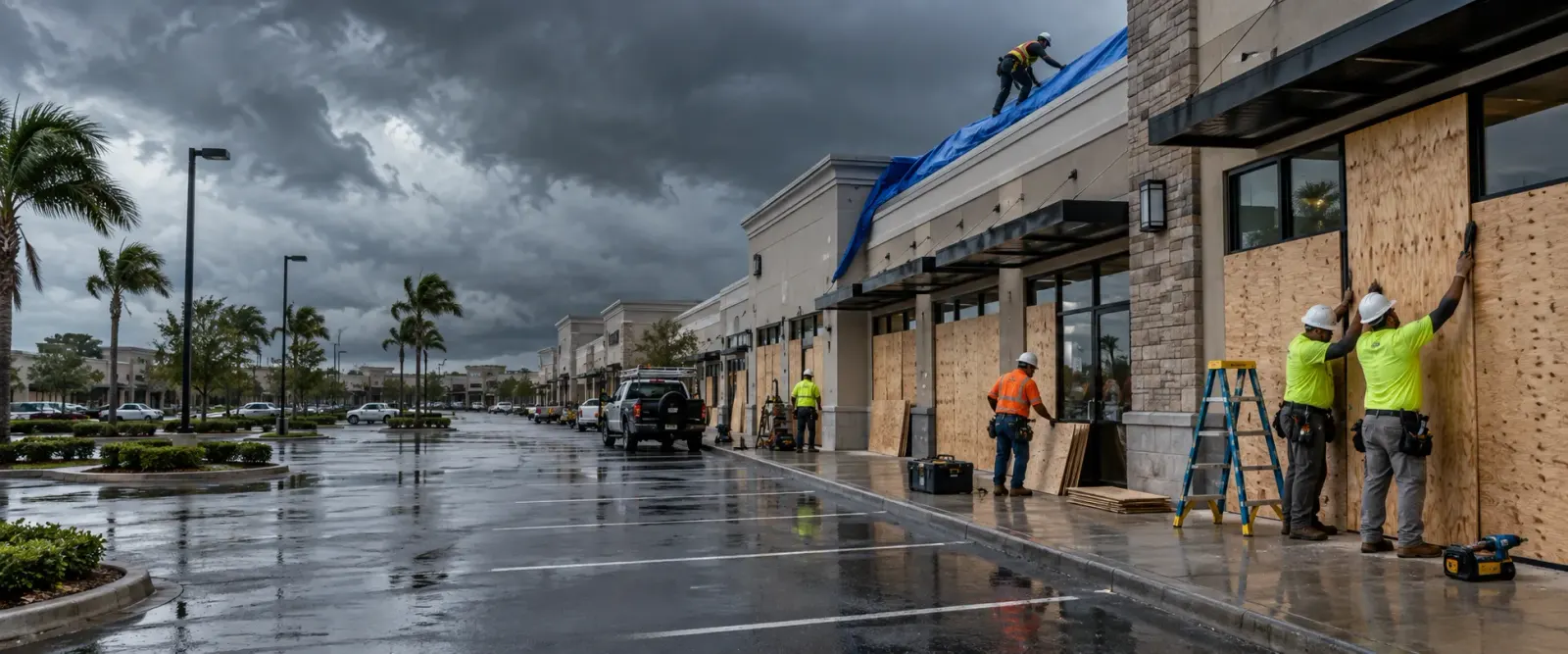
Empire's shops face a state highway, so a storefront broken by wind stays open to passing traffic until it is boarded. Empire's two commercial streets are Yosemite Boulevard and Santa Fe Avenue, and the Caltrans count at Santa Fe Drive and E Street is 14,900 vehicles a day. Buildings such as the 3,720 sq ft retail store at 4275 Yosemite Boulevard sit right on that frontage. Plywood over a broken pane is a security measure as much as a weather one, and it goes up before the crew leaves.
Empire's storm drainage is still being built, so a storm that opens a roof can also leave water close to the walls. The County's 2024-2028 capital plan carries a storm drain trunk line for the town to the river with its completion marked TBD, and County Public Works filed the project's exemption on 25 October 2024. Across the Stanislaus area, the NOAA river forecast center recorded 5 to 8 inches on the valley floor between late December 2022 and mid-January 2023, and FEMA declaration 4683-DR followed on 14 January 2023.
Several Empire buildings serve people who cannot simply leave when the roof opens. A 73-bed shelter runs on South Avenue, the school district keeps its office on McClure Road, and the County has built Empire a library of around 5,000 sq ft. In a building like these, the hazard zone around a fallen limb or loose roof section is set and held before any other work. Each opening is then boarded or tarped and logged for the agency that runs the building.
In 1908 a railroad station and a few buildings went up on the present site and took the name Empire, a Santa Fe shipping point. Its commercial buildings still line the rail and highway corridors, where wind reaches storefront glass and older roofs first.
Storm damage repair, as delivered in Empire
Empire sits 6 road miles east of the Modesto base on SR 132, Yosemite Boulevard. Whatever the job, the same log follows it from the hazard zone and utility call through the boards, tarps and photos.
The crew drives east on Yosemite Boulevard, SR 132, which carries 13,300 to 14,600 vehicles a day at Claus Road and 14,900 at Santa Fe Drive and E Street. The window is 60 to 90 minutes. When the request is acknowledged, Propertyvendr sets an arrival time and checks for wires down.
Before any work, people are moved out from beneath split or hanging limbs, which may still shift, and away from wires touching the tree, the roof or a fence. Nothing near a line is cut until the electric utility has been called, since a trunk under strain can react unexpectedly.
The structure and the belongings are photographed and filmed inside and out before anything is moved or discarded, and every call about the claim goes into a log.
A qualified tree worker directs removal under Title 8 section 3421, whether the tree stood on a lettered-street lot, by the canal or behind a shop.
Plywood goes over broken windows, doors and wall openings. Roof tarps follow Title 8 fall protection: section 1731 on a house above 6 feet, section 1730 on a roof over 20 feet. A tarp on a flat shop roof is fastened or weighted.
Water found inside, in ceilings, insulation or floors, moves to Empire water damage restoration that day.
Receipts and a permanent repair scope are assembled for the adjuster. Empire is unincorporated, so the Stanislaus County Building Permits Division issues the permit.
Where storm damage happens in Empire
Empire's storm exposure follows its two commercial streets, its older blocks and mobile homes, and the few public buildings where people stay or gather.
Yosemite Boulevard (SR 132) commercial strip
Shops along the state highway, with the post office at 5102 Yosemite Blvd. A pane broken by wind here faces 14,900 vehicles a day at Santa Fe Drive and E Street, so plywood goes up before the crew leaves.
Yosemite Boulevard between A and B Streets
A single retail store of 3,720 sq ft occupies 4275 Yosemite Boulevard, on General Commercial land with an 18-foot alley behind. A roof opened over its sales floor is tarped, and the lot and alley side are photographed for the claim.
Santa Fe Avenue and the rail line
Empire's second commercial street, near the BNSF and Modesto and Empire Traction railways. Its shops take the same wind as the highway strip, and broken glass and lifted roof edges are logged shop by shop.
Southeast lettered streets (E to I Streets, 3rd Street to Sunshine Court)
Houses between 3rd Street, Sunshine Court, E Street and I Street, in a town where about 42 percent of homes predate 1970. Wind lifts aged roof covering first, and a tarp holds the opening until the permanent repair.
Abbie Street rezone sites
Five parcels of vacant land proposed for about 55 homes at 25 units an acre, one of them County-owned. A tree or fence from an open lot that lands on a neighboring house is photographed before removal, so the adjuster sees where it came from.
I Street and the Empire Library
Empire's library address is 98 I St., and the County counts a new library building of around 5,000 sq ft among its finished projects. A roof opened over shelving is tarped first, and anything already wet goes to water damage restoration and contents handling.
South Avenue
At 6132 South Ave., the CHSS Empire Camp shelter keeps 73 beds. With guests on site, the hazard zone around a fallen limb or loose roof section is set first and held clear until the work is done.
Codoni Road at Highway 132
The corner where the sanitary district's pipe on Highway 132 was monitored in the 2003 capacity study. Buildings along this stretch of highway get the same make-safe sequence: hazard zone, photos, boards, tarps.
MID Lateral No. 1
The canal and an aqueduct shown on the County's rezone maps beside the Abbie Street sites. A tree that comes down along the canal is photographed where it lies before anything is cut.
McClure Road
Empire Union School District at 116 N. McClure Rd., on the SR 132 stretch named in a 2021 Caltrans ramp notice. Windows broken in a school office are boarded the same night and logged opening by opening for the district.
Claus Road and the Modesto sphere
Where the sanitary district meets Modesto at Claus Road and Yosemite Boulevard, all of it inside the City's sphere of influence. With no annexation planned by the City, building permits here come from the County.
Tuolumne River edge
The original Empire City stood across the river on the south bank, and the planned storm drain was to reach an MID outfall on the Tuolumne. A tree standing beside storm damage may be cracked too, so it is checked before anyone works under it.
Storm damage sub-services available in Empire
Questions from Empire property owners and managers
Stanislaus County does, through its Building Permits Division in Suite 3400 at 1010 10th Street, Modesto. The County lists Empire as unincorporated and requires a permit for all rebuilding and alterations of existing structures. Land use decisions inside the sanitary district rest with both the County and the City of Modesto, LAFCO notes, but Modesto has no annexation in view. In a Special Flood Hazard Area, the County also reviews the repair for substantial improvement.
The broken pane and any damage inside are photographed first, then plywood goes over the opening before the crew leaves. A shop on SR 132 faces about 14,900 vehicles a day at Santa Fe Drive and E Street, so an open front is a security problem as well as a weather one. Stock that got wet is noted in the log, and any water inside goes to water damage restoration.
Everyone stays clear of the limb and of any wire it touches, and the electric utility is called if a line is involved. Photos and video capture the limb and the hole before it moves. A qualified tree worker then directs the limb off the home, and the opening is tarped or boarded. If the home is rented out, the structure and the household's belongings are recorded separately for each party's claim.
At a site like the 73-bed CHSS Empire Camp shelter, the first step is a hazard zone around the damaged section, held clear of guests and staff until the danger is gone. The roof opening is then tarped, broken windows boarded and wet rooms passed to water damage restoration. Each opening is logged, so the operator and its adjuster have one record of what the storm did and what was made safe.
Pictures and video of every damaged area, made before anything is thrown out, as FEMA recommends, together with receipts for repair or replacement purchases. The state's Department of Insurance also wants a running record of calls and letters. The make-safe log, with its hazard zone, boards and tarps, sits in the same file.
No. In Empire, storm damage repair covers the make-safe: getting the tree off, closing openings with plywood, tarping the roof and recording the damage. Drying wet ceilings, insulation and floors is water damage restoration, the permanent reroof of a commercial building is a new commercial roof, and hauling storm debris away is the storm and fire debris service. Each of these can run from one request, under its own scope.
Storm damage repair near Empire

