Why storm damage happens in Keyes
In Keyes the heavy rain of winter 2022-23 came in four separate hits, days apart. The Turlock #2 station nearest the town recorded its four biggest days of that run on 27 December, 31 December, 9 January and 16 January, the wettest at 1.25 inches, in NOAA's daily record. The station's normal year is 12.39 inches. A roof that wind opened in the first of those storms would have taken rain from three more by mid-January unless it was covered, so the tarp goes on during the first visit.
Turlock Irrigation District supplies Keyes with power as well as irrigation water, so a line down on a tree or a roof is TID's to clear. The Keyes Community Services District's own 2025 study names TID for both. When a limb lies across a service drop, work at that spot stops until the utility has made it safe, and Cal/OSHA Title 8 section 3423 keeps tree trimming within 10 feet of high-voltage lines to line-clearance qualified workers. Boarding and tarping on the rest of the building go ahead meanwhile.
About one Keyes home in seven is a mobile home, and several parks sit on the edge of the services district. The Census survey counts 257 mobile homes, with wide margins, and LAFCO describes parks in and around the district sphere running their own sewer and water. One established park lies north of TID's Upper Lateral 2½, near an RV storage yard. When wind or a falling limb opens a roof there, each home touched is tarped or boarded and logged on its own line, because the park and each household may hold separate policies.
The largest roofs in Keyes stand along Golden State Boulevard, beside a freeway carrying 122,000 vehicles a day at Keyes Road. Between East Keyes and Barnhart roads, a truck center, a FreshPoint distribution site and a mega storage complex are built or rising. Where a building like these has a low-slope roof, wind under a loose edge peels the membrane back and lets rain onto the stock below. The Department of Insurance guide counts plastic sheeting over that opening as a reasonable temporary step.
Keyes mixes railroad-era houses with a large wave of 2010s tracts, and wind finds a different weak point in each. About 300 homes date from before 1950, 83 of them from before 1940, and 472 went up between 2010 and 2019, all with wide survey margins. On the older houses, wind lifts roof covering that has aged in place. In the newer tracts, strong wind on rain-softened soil can uproot young landscape trees, and fences, gutters and fascia are usually the first repairs logged.
In October 2019 the Keyes CSD filed to replace four TID wood-pole street lights on 10th Street, between Christine and Grace avenues, with ten metal poles and new curb, gutter and sidewalk. Wherever TID poles and lines stand, a limb across them waits for the utility.
Storm damage repair, as delivered in Keyes
Keyes is 8 road miles south of the Modesto base on Highway 99, with the Keyes Road interchange as the way in. On every visit the one make-safe log gains its hazard zone, utility call, boards, tarps and photos.
The crew leaves Highway 99 at Keyes Road, where Caltrans counts 110,000 vehicles a day just past the interchange, and turns toward the residential side or Golden State Boulevard. Keyes's window is 75 to 100 minutes. At acknowledgement Propertyvendr names an arrival time and asks if TID power lines are part of the damage.
People are kept away from split or hanging limbs, which can still drop, and from any wire touching a tree, roof or fence. Because a trunk under strain can move without warning once cut, no saw works near a line before the utility is called.
Photos and video record the building and its contents, inside and out, before a limb, a sheet of roofing or damaged stock is moved, and each call goes into the claim log.
Yard tree, park tree or orchard-edge tree, the removal runs under a qualified tree worker as Title 8 section 3421 requires.
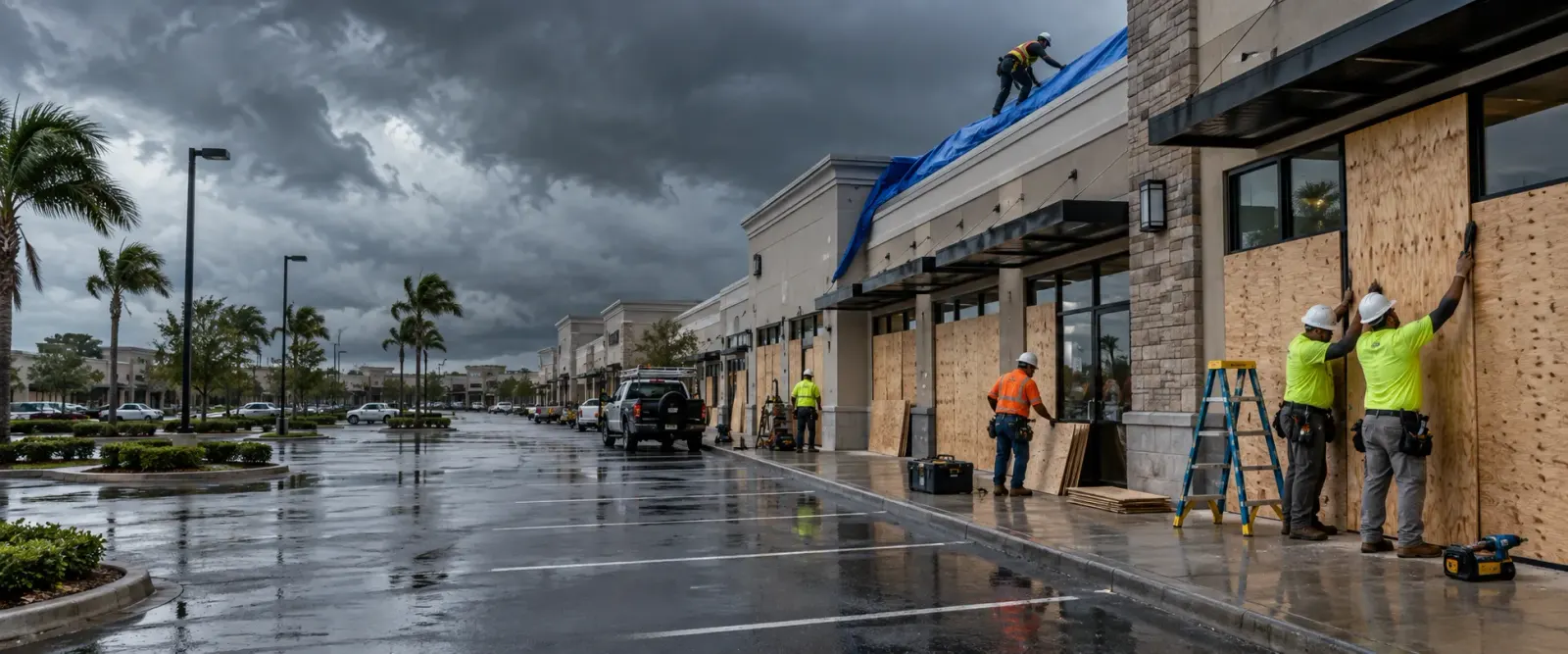
Openings are boarded with plywood. House roofs are tarped with fall protection above 6 feet under Title 8 section 1731, and roofs over 20 feet under section 1730, with tarps on low-slope commercial roofs fastened or weighted down.
Wet ceilings, insulation or floors are handed to Keyes water damage restoration.
For the adjuster, the crew's notes become a written scope of the permanent work, filed with the receipts. Unincorporated Keyes takes its permits, and any flood zone conditions, from the County.
Where storm damage happens in Keyes
Keyes's storm exposure divides at the freeway: older houses and parks on one side, rail-served industry, truck lots and orchards on the others.
7th Street community core
The pedestrian-oriented core of homes, shops and public buildings, with the District office at 5601 7th Street. Shop glass broken here is boarded that night, and a roof opened over a public building is tarped before it reopens.
Original townsite beside the Union Pacific line
Streets laid at right angles to the railroad, where Keyes Switch began in 1871. Houses from the town's early decades carry the oldest roofs in Keyes, and wind lifts aged covering first.
SR 99 and Keyes Road interchange, Highway Commercial
The gateway, zoned Highway Commercial for travelers, where the freeway carries 122,000 vehicles a day. Proposals here include Keyes Plaza and a fueling stop; built buildings on this frontage take wind on signs and roof edges.
Golden State Boulevard, Nunes Road to East Keyes Road
Planned Development 332, created in 2015 for highway commercial use, including a truck terminal approved in 2022 with a maintenance shop, offices and a truck dock. Wide roofs and dock openings are tarped and boarded where wind has opened them.
Golden State Boulevard, East Keyes Road to Barnhart Road
Six parcels, 65 acres, that the District has proposed adding to its sphere, holding truck, food distribution, fuel and storage businesses. A low-slope roof here is tarped under Title 8 section 1730 when over 20 feet.
Rohde Road gateway and TID Upper Lateral 2½
Thirteen mini-storage buildings, 39,393 sq ft in all, with a duplex, a four-plex and an office, beside a TID lateral in a 70-foot right-of-way. A roof opened over storage units is tarped and each renter's unit logged.
Industrial lands west of SR 99 and Foote Road
Industrial and Planned Industrial land, 124 acres, with heavy rail access, and the District lift station on Foote Road. Wind damage to rail-served buildings is photographed before repair, with the roof tarped first.
Norma Way, Nunes Road and Washington Road subdivisions
Keyes 19 North on Norma Way and Keyes 19 South at 5819 Washington Road, R-1 lots of at least 5,000 sq ft. In tracts this new, young landscape trees and fences give way first in strong wind on wet ground.
Anna Avenue, Grace Avenue and 10th Street
The County's named multifamily district along Anna Avenue, and the 10th Street blocks where the District planned to swap TID wood-pole street lights for metal. Rentals damaged by wind are logged unit by unit for owner and tenant.
Hatch Park, Maud Avenue and Lucinda Avenue civic blocks
Public buildings cluster here: the Maud Avenue library at number 4420, Hatch Park, and a Lucinda Avenue community center of 6,000 sq ft that the County applied in 2025 to renovate. Openings in public buildings are boarded the same night and logged for the County.
Mobile home parks on the district edge
Parks in and around the district sphere, one north of TID's Upper Lateral 2½, among some 257 mobile homes. A limb across one coach is dealt with home by home, with neighbors kept outside the hazard zone.
East Keyes Road farm edge and the Ceres Main Canal
Almond land along East Keyes Road and the Ceres Main Canal, where TID built its regulating reservoir in 2023. A tree down by the canal or across a farm road is photographed where it lies before cutting starts.
Storm damage sub-services available in Keyes
Questions from Keyes property owners and managers
The Turlock Irrigation District, which supplies Keyes with power. Keep everyone back from the limb and the wire. Nothing near the line is cut until TID has made it safe, since Title 8 section 3423 allows only line-clearance qualified workers to trim within 10 feet of high-voltage lines. Meanwhile the crew can set the hazard zone, photograph the damage and board or tarp the parts of the house away from the line.
The Stanislaus County Building Permits Division in Modesto, which requires a permit for rebuilding and alterations of existing structures. The Keyes Community Services District has no land use authority, and the County enforces flood zone requirements through the building permit process. About 110 acres of the Keyes fire district lie inside the City of Ceres sphere of influence, so for a parcel there the permit office is checked first.
The hazard zone comes first, keeping residents away from hanging limbs and any damaged line. Each coach is then tarped or boarded and photographed on its own line in the log, and park structures such as fences or common buildings get separate lines. That way the park operator and every household can hand their own adjuster a record showing what the storm did and what was made safe.
The opening and everything beneath it are photographed, then the roof is tarped under Title 8 fall protection, with the tarp fastened or weighted so the next gust cannot take it. Doors or walls that have opened are boarded. Stock or equipment that got wet is noted in the log, the wet part of the building passes to water damage restoration, and the permanent commercial roof repair is scoped separately for the adjuster.
The tree where it fell, the roof, walls and fences it struck, the rooms below and any damaged belongings, all before anything is moved. FEMA advises photos and video before items are discarded and receipts for anything bought to repair or replace property. Keep a log of phone calls and correspondence too, as the Department of Insurance guide recommends.
No. Storm damage repair is the make-safe: the tree off the structure, broken openings boarded, the roof tarped and every step recorded. Once the building is safe, taking the cut limbs and debris off the lot belongs to the storm and fire debris service, and wet interiors go to water damage restoration. One Keyes request can set all three moving, each with its own scope.
Storm damage repair near Keyes

