Why storm damage happens in Turlock
When a winter storm reaches Turlock, fallen trees lead the calls. They were the city's leading storm call in January 2023, when a mature Modesto ash was uprooted onto a vehicle in east Turlock. That winter's atmospheric rivers, from late December 2022 into mid-January 2023, left trees and power lines down across the region and 5 to 8 inches of rain on the valley floor, the CNRFC reports. Soil softened by that much rain lets a strong gust pull a tree out whole, roots and all.
The older the Turlock neighborhood, the bigger the trees over its roofs. Mid-century tracts along Fulkerth and Tuolumne stand under mature street trees, and the oldest houses in a town laid out in 1871 are near the railroad, downtown and in Crane Park. A limb landing on a roof there opens it to the same rain that loosened the tree. FEMA advises photos and video of the damage before anything is discarded, so the record starts before the first cut.
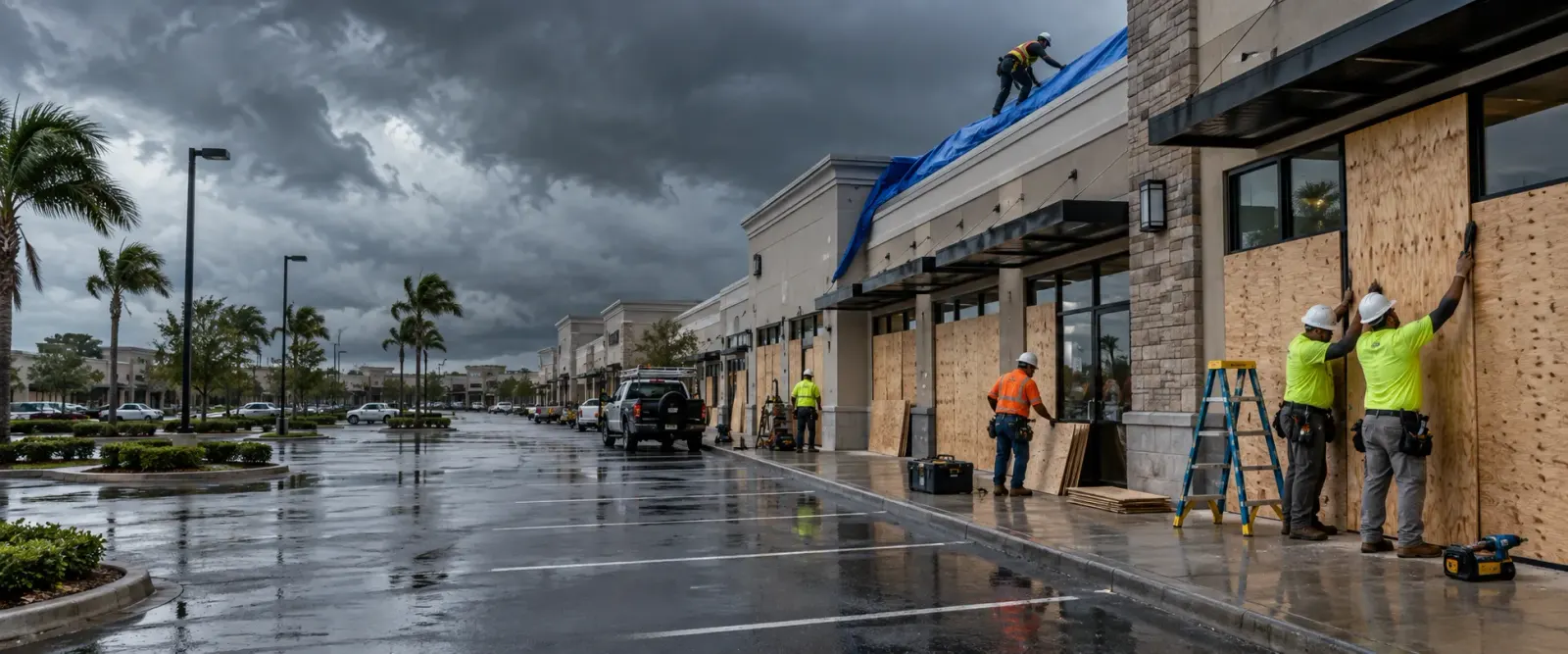
Monte Vista Crossings puts about 875,000 square feet of retail under low-slope roofs beside Highway 99. On roofs that flat, wind finds a loose perimeter edge or an open seam and rolls the membrane back, and rooftop units and signs can rip up the roofing they are fixed to. Rain then pours into the ceilings of national tenants. A tarp on a low-slope roof is weighted or fastened along its edges, since plastic that is only draped lifts again in the next gust.
West of 99, cold storage and distribution buildings pair long roof spans with big roll-up doors. The Westside Industrial Specific Plan area is given over to food processing, cold storage, distribution and truck yards. A door blown in or pulled off its track leaves a building open and unsecured overnight, so board-up there is a security job before it is a weather one. The Department of Insurance guide names plywood and plastic sheeting as the temporary repairs that prevent further damage.
On the dairies and ranchettes at the city edge, large-span farm roofs lift at the eave and the ridge. Open-sided barns and shops take wind from underneath, and a panel once loose tears more of the roof with each gust. Those properties are also the far end of Turlock's window, where fog and harvest traffic push arrival toward two hours, so the request is best made as soon as panels start to move. Outside city limits the rebuild is permitted through Stanislaus County.
In January 2023 fallen trees were Turlock's leading storm call, and a mature Modesto ash was uprooted onto a vehicle in east Turlock. A whole tree across a car, a carport or a roof has to be made safe before the claim can move.
Storm damage repair, as delivered in Turlock
Twelve road miles separate the Modesto base from Turlock, by Highway 99 or by Geer Road. The crew that sets the hazard zone also takes the photos and keeps the log, so the adjuster receives a single record.
The 90 to 120 minute window runs shortest to Monte Vista Crossings and Geer Road and longest to the Westside and the dairies. Tule fog or harvest traffic can stretch any Turlock call toward two hours, and Propertyvendr gives the arrival time when it acknowledges the request.
The crew marks off the ground under any hanging limb or loose panel and keeps people out of it, because broken limbs shift and trees under tension spring when cut. A power line on the tree or roof means nothing is cut until the utility clears it.
Before a limb moves or a ceiling tile is binned, the damage inside and out is filmed and photographed, and every insurer call goes in a log.
A qualified tree worker directs the site. Whose tree it is goes on record before the first cut.
Plywood closes broken glass and doors; tarps on low-slope retail roofs are weighted or fastened. Anyone on a roof works to Title 8 fall protection: section 1730 above 20 feet, section 1731 above 6 feet on residential-type roofing.
Wet ceilings or insulation go to water damage restoration in Turlock.
Permanent repairs are scoped for the adjuster, with receipts kept. The City of Turlock Building Division permits them; dairies and ranchettes outside the limits go through Stanislaus County.
Where storm damage happens in Turlock
Turlock's storm damage changes with the building: old trees over old roofs, low-slope retail, cold storage doors and farm roofs at the edge.
Downtown and the Main Street grid
Commercial blocks and homes from before the war sit between the tracks and Lander Avenue, many under flat roofs. Shop glass broken in a storm is boarded the same night, and a lifted roof edge is fastened before rain gets in.
Crane Park and the historic district
The city's oldest houses, a good number raised on crawl-space foundations. Older roofing and windows are covered with tarps and plywood, and the damage is photographed room by room before any repair is scoped.
Stanislaus State and university rentals
Apartments and converted houses of the 1960s to 1980s near Monte Vista and Geer, where tenants turn over often. Many openings mean many units to secure, and the board-up log records every unit touched.
Monte Vista Crossings and Highway 99 corridor
Big-box and in-line stores with national tenants on the freeway frontage. Low-slope roofs peel at the edges in wind, and each tenant's damage is photographed separately for its own insurer.
Geer Road retail
Older strip centers and restaurant suites on the central retail street, carrying some 21,000 vehicles daily near Monte Vista. A sign or rooftop unit shifted by wind can open the roof over several suites at once.
Westside Industrial Specific Plan area
Food plants, cold storage, distribution and truck yards on the far side of Highway 99. Roll-up doors pulled off their tracks leave buildings unsecured, so openings are boarded before anything else.
Northeast Turlock
Stucco HOA tracts of the 1990s to 2010s on what used to be orchard land. Fences, gutters and fascia go first in a gust, and HOA boards receive the common-area record.
East Turlock and Canal Drive basins
The east side around Donnelly Lake and Dianne Pond; in east Turlock a mature ash was uprooted in January 2023. Trees torn out of softened soil fall whole, and the crew checks for standing water before ladders go up.
South Turlock and Lander Avenue
Homes and light commercial along Lander, a stretch with recorded street flooding. When wind and a cloudburst arrive together, the roof is tarped while water may still stand in the street, and both are photographed.
West Turlock along Fulkerth and Tuolumne
Mid-century houses and newer commercial under mature street trees toward the freeway. A limb onto a carport or a roof is lifted off under a qualified tree worker and the opening covered.
Dairies and ranchettes at the city edge
Farm homes, barns and outbuildings on wells and septic, under wide agricultural roofs. Metal panels lift at eave and ridge, and county permits apply to the rebuild outside city limits.
Keyes, Denair and Hilmar
Keyes and Denair are each 5 road miles from Turlock and Hilmar 7. Every one has its own storm damage page, written from its own buildings and records.
Storm damage sub-services available in Turlock
Questions from Turlock property owners and managers
Request the make-safe first, at any hour, and keep everyone out of the room below. The crew sets a hazard zone, photographs the tree and the roof, and lifts the tree off under a qualified tree worker before tarping the opening, with the limbs then taken off site by storm and fire debris cleanup. If a power line is caught in the branches, nothing is cut until the utility has cleared it. Tell your insurer the same day, and note the call in your log.
Stanislaus County, for parcels beyond the city limits, while the City of Turlock Building Division handles those within. The temporary work comes first: tarps over lifted panels, plywood on open walls and a photo record of the roof and anything stored beneath it. The permanent repair is then scoped for the adjuster, and a roof that needs replacing is handled through commercial roofing.
On a low-slope roof, a draped tarp lifts in the next gust, so the cover is weighted or fastened along its edges. Anyone on the roof works under Cal/OSHA fall protection, section 1730 for roofs above 20 feet. Inside, wet ceiling tiles and stock are photographed before they are thrown out, as FEMA advises, and wet ceilings go to water damage restoration.
The opening is secured, since a building standing open overnight is exposed to theft as well as weather. Plywood or temporary framing closes the gap, the door and track are photographed where they lie, and anything wet inside is logged. Repairing or replacing the door itself is scoped afterward for the adjuster, with receipts kept for every purchase.
The California Department of Insurance guide asks policyholders to make temporary repairs to prevent further damage, naming plastic sheeting and plywood, and warns that a policy may not cover ensuing damage where reasonable steps were not taken. What your own policy pays depends on its wording, and the adjuster confirms it. FEMA advises keeping receipts for purchases and repairs, so the make-safe invoice goes in the file.
Everything, inside and out, before anything moves: the tree where it landed and the stump or roots it came from, the roof, gutters and walls it struck, the rooms beneath and any damaged belongings. FEMA advises photos and video before items are discarded. Note the date and time, and keep a log of every call to the insurer, as the Department of Insurance guide suggests.
Storm damage repair near Turlock

