Why storm damage happens in Livingston
In Livingston's older neighbourhoods the power runs overhead along the alleys, so a limb that falls there can bring a line down with it. The Housing Element describes older blocks with alleys and overhead utility lines, and dwellings near Downtown mostly dating from before the mid-1980s, while the newer tracts have underground utilities. Under Title 8 section 3423, tree trimming inside 10 feet of an energized high-voltage line is reserved for line-clearance qualified trimmers, which puts the utility first in line at any alley limb strike.
Livingston's recorded storms are spring ones, and three of them brought funnel clouds. Merced County's hazard plan lists funnel clouds over the city on 25 March 1998 and 3 May 2003, both logged jointly with Atwater and Merced, and again on 27 March 2019, with a heavy rain event on 28 March 2006 that recorded no damage. The NWS issues its wind advisories, watches and warnings on local criteria. A spring squall that lifts shingles leaves the roof open to the rain behind it.
Livingston built most of its houses in two recent decades, and those newer lots lose fencing, gutters and fascia before anything else. The Housing Element puts 870 units in the 2000s and 769 in the 1990s, together close to half the occupied stock, and the newest, largest houses sit on the western side of South Livingston. Young yard trees rooted in ground that a week of rain has loosened can tip over in a gale onto a garage or eave. The gap goes under a tarp before rain reaches the drywall.
Livingston's largest employer processes food on the industrial west side, and a storm-damaged plant roof is a make-safe job over a working floor. Foster Farms keeps its world headquarters in the city, and the assessor's 2020 data count 33 buildings on 19 industrial parcels and 235 on 82 commercial parcels. On a wide roof, a lifted edge or torn flashing lets rain spread over a large area. Staff are kept clear of the damaged section while it is covered, and the permanent roof repair is scoped on its own.
Merced County was in the federal declaration for the winter storms of 2022 and 2023, and Livingston's rain comes in the same few months. FEMA declared major disaster 4683 on 14 January 2023, and Cal OES lists Merced County for individual and public assistance. Rainfall here averaged roughly 10.9 inches a year over 1993 to 2016, by the WRCC figures in the City's water plan. The CDI claims guide treats plywood and plastic sheeting as the reasonable temporary repair.
The 2015-2019 American Community Survey counts 157 mobile homes in Livingston, 4.2% of its 3,699 units, and the Housing Element places one large park in South Livingston. A limb through a manufactured home's roof is lifted off and the opening covered before rain reaches the rooms.
Storm damage repair, as delivered in Livingston
The Modesto base is 24 road miles away, and the freeway and the Union Pacific run side by side on a diagonal through the city. Each visit writes the same make-safe log: hazard zone, utility call, boards, tarp and photos.
Winton Parkway and Hammatt Avenue are the two exits off Highway 99 into Livingston, and the crew arrives within 120 to 140 minutes at any hour. In the tule fog months, which the county plan runs into May in some years, and at harvest, arrival sits near 140. Propertyvendr gives a time with the acknowledgement.
A hazard zone goes up around any hanging limb, and nobody works near a line touching a tree, fence or roof. Limbs under tension can move when cut, so in an alley with overhead lines the utility is called before a saw is lifted.
Building and contents damage is filmed and photographed inside and out before any limb, pane or tile is moved, and each claim call is logged.
Where the limb lies across an alley line, the utility clears it before a qualified tree worker (Title 8 section 3421) cuts.
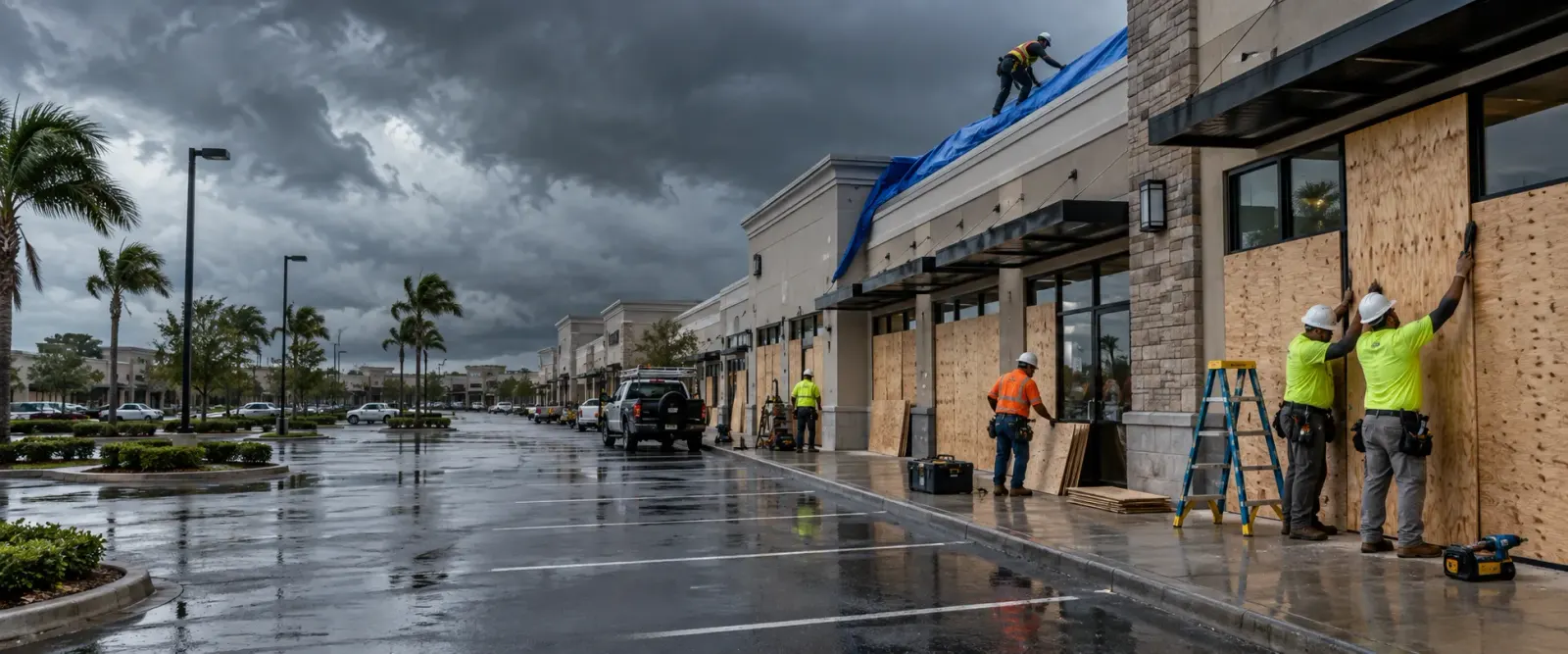
Roofs are tarped and fastened down against the next gust, with fall protection over 6 feet on a house roof (Title 8 section 1731) or over 20 feet on a plant or apartment roof (1730). Plywood covers each broken window and door.
Wet ceilings, insulation or flooring go to water damage restoration in Livingston.
The permanent repair is scoped for the adjuster and permitted by the City of Livingston Building Division, which plan-checks repairs over the counter. Receipts are filed.
Where storm damage happens in Livingston
Livingston's storm exposure changes across Highway 99: older alley blocks, newer tracts, apartment complexes, food plants and the river edge.
Downtown and Main Street
Older shops and homes south of the highway, served by alleys under overhead utility lines. A limb that drops through those lines onto a roof waits for the utility before any cut, and a broken shop window is boarded that night.
Central Livingston east of Lincoln Boulevard
Small lots, usually under 5,000 square feet, and the heaviest high-density zoning in Livingston, with substandard housing concentrated in the central east. With houses this close, a tree or loose panel from one lot often lands on the next.
B Street corridor
The medical clinic complex and affordable apartments run by Self-Help Enterprises and the Housing Authority, including Casitas Del Sol at 1001 B Street. Multi-unit buildings mean many openings to board and many residents to keep clear of the hazard zone.
Winton Parkway interchange
Highway 99 carries 60,000 to 62,000 vehicles a day here, and Self-Help Enterprises has applied to build 80 low-income units at Winton Parkway and B Street. A window broken by wind-blown debris near the interchange is boarded on the first visit.
Hammatt Avenue interchange and the Highway 99 frontage
Mainly commercial and medical land south of the highway, at a count of 60,000 to 61,000 vehicles a day. A storefront pane broken in a storm leaves the business open to the frontage road overnight, so plywood goes up on the first visit.
North Livingston
Mostly single-family homes north of the railroad, a third built before 1985 on alley blocks with overhead lines and the rest after 2000 with underground utilities. The older third is where a falling limb can take a service line down.
Industrial west side and Foster Farms
Very few homes west of North Main Street, mostly industrial, commercial and farm land around the Foster Farms plant. Wide processing roofs lose flashing and edges in wind, and a lifted section lets rain across a working floor.
Northern edge along the Merced River
The part of the city nearest the river, with a small Zone A area and a northwest corner where the one improved floodplain parcel is agricultural. A farm building's large roof lifts at the eave and ridge in strong wind.
South Livingston west of Prusso Street
Larger houses on lots of 7,000 square feet or more, most built in the last two decades. On lots this new, fences, gutters and fascia go first, and young landscape trees in wet soil can uproot.
South Livingston east side and The Villages at Main Street
Most of South Livingston's higher-density zoning, with The Orchards on Newcastle, 48 affordable units at 1972 Main Street, and the entitled 480-unit Villages at Main Street. Each unit touched by a storm gets its own line in the board-up record.
South Livingston mobile home park
One large park, which the Housing Element described as about half occupied with new mobile homes. A limb resting on a manufactured home is lifted off before the roof opening is covered and the unit recorded.
Arena and Livingston canals and the detention-basin watersheds
MID's Arena and Livingston canals take storm water from parts of the city through pump stations, and a 2021 hazard action would upgrade a storm lift station's pumps and panel. A roof opened in a storm is covered first, so rain stays outside.
Storm damage sub-services available in Livingston
Questions from Livingston property owners and managers
Everyone stays well back from the limb and the line, and the utility is called before anything is touched. Title 8 section 3423 keeps anyone except a line-clearance qualified tree trimmer from working a tree within 10 feet of a high-voltage line. Once the line is safe, the limb comes off the roof under a qualified tree worker, the opening is tarped, every step is photographed for the claim, and hauling the debris away afterwards is booked separately.
The City of Livingston Building Division, in the Community Development Department, which plan-checks, permits and inspects residential, commercial and industrial buildings through a contract with an outside consulting firm. Repairs and similar minor projects are plan-checked over the counter, and larger work takes five to ten business days. The counter keeps Monday to Thursday 8:00 am to 1:00 pm and Friday 8:00 am to 4:30 pm, with no building inspections on Fridays.
The National Weather Service issues three wind products on local criteria: a Wind Advisory, a High Wind Watch and a High Wind Warning. Merced County's hazard plan logs funnel clouds over Livingston in March 1998, May 2003 and March 2019. When a watch or warning is out, loose furniture, signs and branches over the roof are worth securing, and after the wind passes the roof and windows are checked before the next rain.
With people. Staff are moved clear of the damaged section and anything below it, and the utility is called if a line is involved. The opening is photographed inside and out, then covered and fastened against the next gust, with Title 8 fall protection on a roof over 20 feet. Rain that reached the floor goes to water damage restoration, and the permanent commercial roof repair is scoped separately.
The Department of Insurance guide asks policyholders to make temporary repairs to prevent further damage, with plastic sheeting or plywood, and says a policy may not cover ensuing damage when reasonable steps were not taken. The guide adds that an adjuster may visit before any forms are completed. What the policy pays is for the insurer to decide; the tarp, the photos and the call log give the adjuster the record.
Whichever opening lets the most weather or the most risk in. A roof hole over a bedroom is usually tarped first when rain is falling, while a broken ground-floor window on an alley or a street is boarded first at night for security. Both are done in one make-safe where possible, and each is photographed before and after for the claim.
Storm damage repair near Livingston

