Why storm damage happens in Oakdale
North of F Street, a winter storm meets Oakdale's oldest houses. Pre-1980 buildings make up 40 to 60 percent of the census tracts above East F Street, and the Craftsman houses gather most thickly on Laurel and California, with more on the numbered streets north of C Street. Wind-lifted roofing or a cracked window on a house that age lets rain straight into plaster and attic. Tarps and plywood close the opening before the next band arrives, and every photo is taken before anything is cut away.
Downtown Oakdale is a street of old storefront glass, and a pane broken at F Street and Yosemite leaves a business open overnight. The corner is anchored by the First National Bank Building of 1909, the only National Register listing in town, with the 1888 IOOF building beside it and the 1906 depot east of the tracks. Board-up there is security first. The break is photographed before plywood covers it, as FEMA advises for any storm damage.
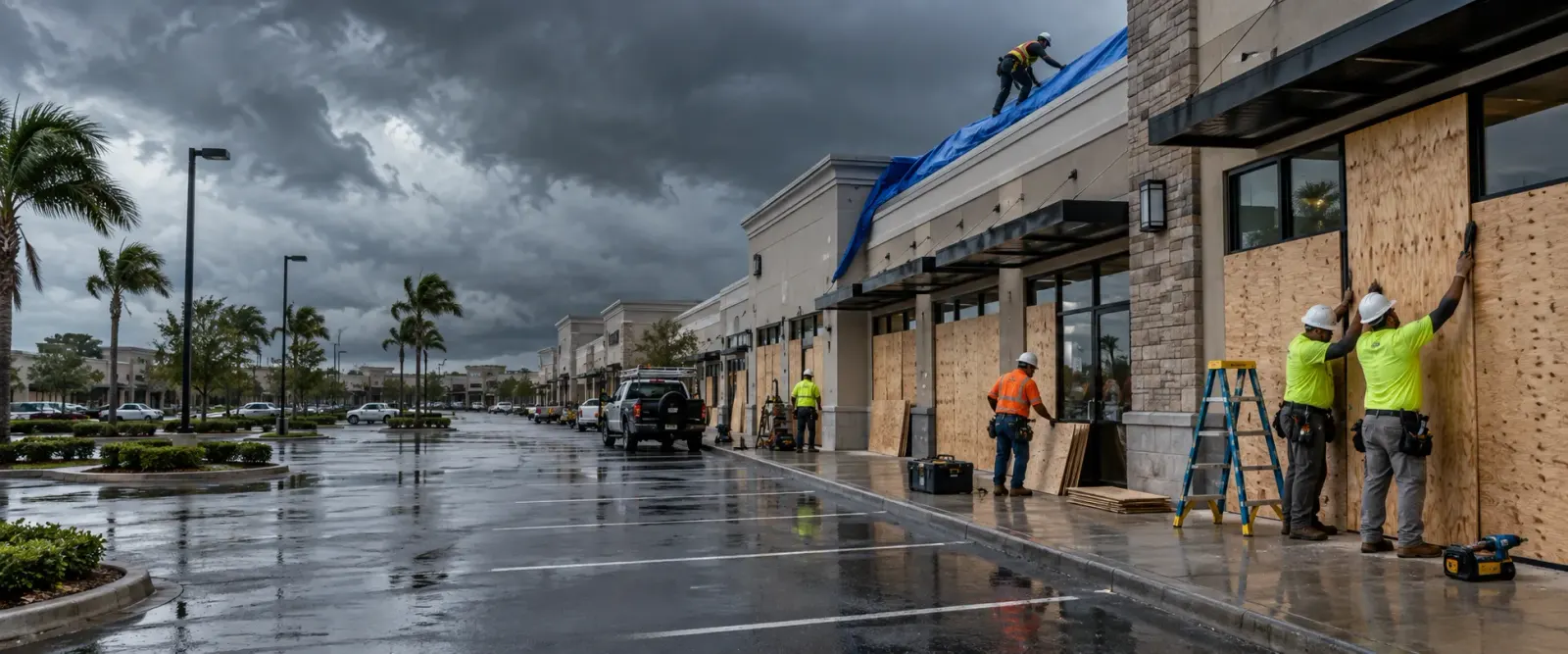
On East F Street, glass broken in a motel or a strip center is a security problem for guests and tenants at the same moment. The four-lane SR 108/120 corridor, carrying traffic to and from the Sierra, is lined with lodging, gas stations, auto sales and strip centers old and new. Large lobby and storefront panes left open overnight invite more than rain, so openings are boarded on the first visit and each tenant's damage is photographed on its own for its insurer.
South of the railroad, Oakdale's industry works under large-span roofs where wind gets under an edge. Industry takes up 546 acres of the city in the storm plan's land-use table, and ConAgra and Sconza appear in the General Plan among the big users on South Yosemite Avenue. A seam opened in wind lets rain across a wide floor, and a roll-up door blown off its track leaves a plant unsecured. Tarping a roof that size means fastening against the next gust, with fall protection under Title 8 section 1730.
Oakdale's wet months run from November to April, and the winter of 2022-23 showed what a long run of storms does. From late December 2022 to mid-January 2023, 5 to 8 inches reached the valley floor of the Stanislaus area, the CNRFC recorded, with trees and power lines down across the region. With 472 mobile homes in the city and 649 units in buildings of 50 or more, a storm of that kind leaves many openings to cover at once, and the board-up log records every unit.
Oakdale has recorded 257 buildings dating from 1870 to 1940, and 135 of the 214 homes in its 1986 survey belong to the Craftsman Bungalow group. A storm opening in a building that old is closed with care for what stands around it, and photographed before and after.
Storm damage repair, as delivered in Oakdale
The Modesto base is 15 road miles away, reaching town on State Route 108, which is F Street, or State Route 120 along Yosemite Avenue. Hazard zone, boards, tarps and photos all go on one file for the adjuster.
Tourist traffic crowds Yosemite Avenue below the Stanislaus River Bridge through summer, and winter brings the valley's December and January fog, so an Oakdale call can take the full 120 minutes. A time is given when the request is acknowledged.
Nobody stands under a hanging limb, a lifted sheet of roofing or a leaning sign: the zone is taped off first, because broken limbs move and trees under strain react when cut. A line in contact with the tree or building stops everything until the utility clears it.
Inside and out, the damage is photographed and filmed before a single item is moved or discarded, and each call to the insurer goes in the log.
A qualified tree worker runs the site, and whose tree it is, on the lot or beside it, is noted before any cut.
Plywood goes over broken glass and doors; tarps go over wind-opened roofs, fastened at the edges. On roofs the work follows Title 8 fall protection, 1730 for roofs over 20 feet and 1731 over 6 feet on residential-type roofing.
Any wet ceiling, insulation or floor goes to water damage restoration in Oakdale.
The permanent repair is scoped for the adjuster and permitted by the City's Building Division on South Fifth Avenue, which works a four-day week; inspections are phoned in for mornings.
Where storm damage happens in Oakdale
Oakdale's storm damage follows its eras: pre-1940 bungalows and storefronts, highway lodging, plants south of the tracks and senior homes on the fringe.
Downtown Corridor, F Street and Yosemite Avenue
Old storefronts set back behind wide sidewalks around the 1909 bank and the 1888 IOOF building, with warehouses along the tracks. Glass broken in a storm is boarded at once, and lifted roofing on the warehouses is fastened down.
Old town north of F Street and drainage sub-area C1
The oldest part of town, where Laurel and California avenues hold most of the bungalows. Old roofing and windows open in wind, and street water in the same storm makes quick cover more urgent.
F Street Historic Transition Corridor
The F Street stretch from Mann and Blankenship east to 1st Avenue, where old homes became offices beside shops and large churches. Older roofs on both are tarped under Title 8 fall protection and photographed first.
West F Street Corridor and Willow Glen
West along SR 108 toward Bridle Ridge, shops and services of every era sit near the hospital and the high school. Signs on the commercial lots catch the wind, and damage is photographed lot by lot.
East F Street Corridor and East F Street Specific Plan
The four-lane highway strip of motels, gas stations, car lots and shopping centers set behind parking. Broken lobby and storefront glass is boarded for security, and guests stay clear of the hazard zone.
North Yosemite Gateway Corridor
South of the river bridge, industry abuts the road on the east and a deep-set shopping center, apartments and older shops face it from the west. Apartment openings are boarded unit by unit and logged.
Yosemite Transition Corridor
Small industry, heavy commercial, homes and many empty lots and buildings from G Street to J Street. An empty building opened by a storm is secured quickly, since nobody inside will report the damage.
South Yosemite Industrial Corridor
Big plants named as ConAgra and Sconza beside business parks and scattered houses past the rail crossings. Wide roofs and roll-up doors are the storm openings, and fencing at the roadside goes down in gusts.
South Oakdale Industrial Specific Plan
Some 500 acres in 32 parcels below the rail lines, home to nearly all of Oakdale's industrial development. Wide roofs are tarped with fastened edges, and each building's damage is logged separately.
South Drainage Area and Bridle Ridge
The tracts and commercial land south of the tracks, Bridle Ridge among them since its 1999 annexation. Tract fences, gutters and fascia are the first to fail, photographed before they are cleared.
Stanislaus River bluff and river frontage
River parcels under ground that rises at 15 to 30 percent in places, with the Kerr Park floodplain left natural. On sloping ground near the bluff, a ladder is set only after its footing is checked.
Unincorporated fringe: Sunset Park, Country Club Heights, Belsera
Three fringe areas outside the city: Sunset Park, the acre lots of Country Club Heights and Belsera's 61 gated senior homes. Older residents are kept out of the hazard zone while openings are covered.
Storm damage sub-services available in Oakdale
Questions from Oakdale property owners and managers
Oakdale's Building Division, part of Community Development on South Fifth Avenue, issues it. The office keeps a Monday-to-Thursday week and stays shut on Fridays; applications are emailed, and processing takes two to four weeks on average. Inspections are requested by phone, weekday mornings Monday to Thursday until noon, and never for the same day. Tarps and plywood hold the building meanwhile, with any commercial roof replacement scoped for the adjuster.
Often, once the hazard is contained. The damaged rooms are closed off, guests are kept out from under anything hanging, broken glass is cleared and the openings boarded on the first visit. Rooms beside them can stay in use once they are dry and secure. Each room's damage is photographed on its own, and the log shows when each opening was closed.
The glass is photographed, shards are swept from the sidewalk and the opening is closed with plywood fixed to the frame, so the shop is secure until new glass goes in. Stock under the opening is photographed before anything is thrown out, as FEMA advises, and the permanent storefront repair is scoped for the adjuster, with any permit from the Building Division.
It can take longer to set up. Parcels along the river sit under ground that rises at 15 to 30 percent in places, and ladders and lifts need firm, level footing before anyone climbs. The hazard zone is set first, the damage is photographed from the ground, and the roof is tarped under Title 8 fall protection once safe access is in place.
The tree where it lies and where it stood, the roof, fascia and gutters it hit, and every room and belonging it damaged, all before anything is moved. FEMA asks for photos and video before items are discarded and for receipts from purchases and repairs. The Department of Insurance guide adds a log of every call and letter, which the make-safe file keeps for you.
They are two services. Storm damage repair makes the building safe and closed: hazard zone, tree off the structure, tarp and board-up, and the record for the claim. Hauling limbs and broken material away afterward is storm and fire debris removal, and drying a wet building is water damage restoration. One request in Oakdale can start all three.
Storm damage repair near Oakdale

