Why storm damage happens in Escalon
In an Escalon cloudburst, the danger on a flat roof is weight as well as wind. Two buildings in the city lost their roofs to accumulated water in the flash flood of May 1998. A roof that sags or ponds after heavy rain is treated as a hazard zone: nobody works on it or beneath it until the load is judged safe, and the photo record starts from the ground. Tarping follows once the deck will bear a person, with fall protection under Title 8 section 1730 on roofs over 20 feet.
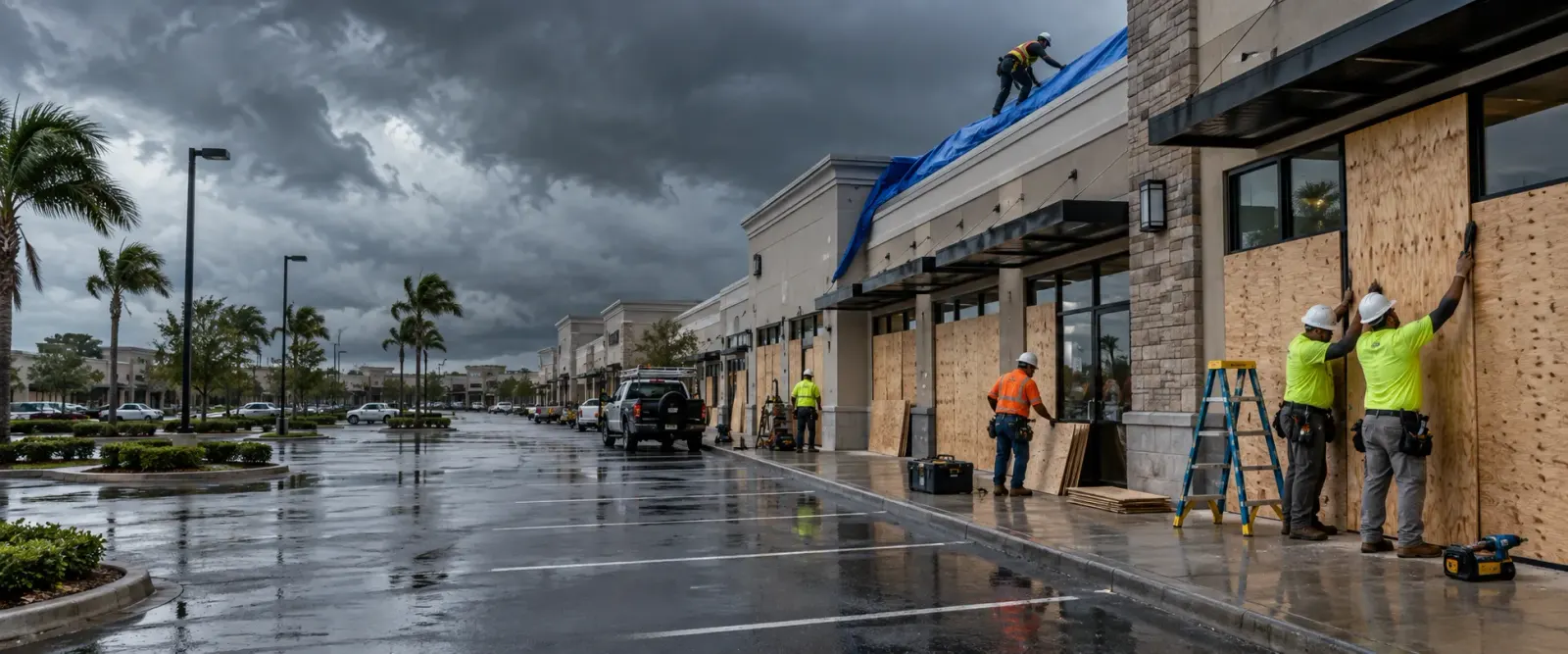
Main Street is where an Escalon storm finds old storefronts together. The General Plan treats Main Street from SR 120 to 5th Street as the city's center and its Central Business District as the historic services center, on a townsite whose streets run on the diagonal and whose blocks come square, oblong and in places triangular. The town is low-rise, one and two stories. Storefront glass broken in a storm there is boarded the same night, and each opening is photographed before plywood goes over it.
About seven in ten Escalon homes were built after 1980, and on houses that young, wind takes fences, gutters and fascia first. The 1980s were the busiest decade, with 729 of the city's 2,913 homes, and the Growth Management Ordinance of April 1978 has held building to the equivalent of 75 single-family homes a year. Where rain has soaked the ground, strong wind can uproot a yard tree onto a fence or a roof. Where damage crosses a lot line, each neighbor's record is kept apart.
Escalon's heavy industry, below Clough Avenue and on McHenry, sits under wide roofs beside utility poles. The General Plan places heavy industrial uses and warehousing there, and food processors use the City's separate industrial sewer; the Kraft Heinz permit alone allows 2.1 MGD in season. The McHenry corridor also carries PG&E poles close to the trunk sewer and gas lines. A limb or panel across a line stops all work until the utility clears it, under Cal/OSHA Title 8 section 3423.
West of town, Liberty Business Park and the SR 120 corridor are where Escalon plans its larger commercial and industrial roofs. Its specific plan covers roughly 178 acres where Brennan Avenue meets the highway, and the City pitches the flat sites to logistics firms, food processors and flex industrial users. In the storms of late December 2022 to mid-January 2023, the CNRFC recorded 5 to 8 inches on the valley floor of the Stanislaus and San Joaquin area, and San Joaquin County was named in both storm declarations.
NOAA's storm record for 5 May 1998 puts two hours of rain over Escalon at an estimated 3 to 5 inches. It flooded 19 homes, 32 businesses and 3 government buildings and brought down two roofs under standing water, without injury.
Storm damage repair, as delivered in Escalon
From the Modesto base the drive is 12 road miles; in town the crew works off SR 120 and McHenry Avenue, the two arterials. One make-safe log follows the job, with every photo and call recorded.
The window is 90 to 120 minutes, day or night, and December and January fog or harvest traffic pushes arrival toward the long end. Caltrans counts put some 15,600 daily vehicles on SR 120 where it crosses Main Street; the time is confirmed when the request is acknowledged.
Anything overhead that could still fall, a limb, a sagging deck or a loose sign, gets a taped zone and nobody under it, since broken limbs move and trees under tension react when cut. A line touching the tree or building stops work until the utility clears it.
Before anything is moved or thrown away, each room, roof face and damaged item is photographed and filmed, and the insurer calls are logged.
A qualified tree worker directs removal. Whose tree it is, and whether a pole or line is involved, go in the file first.
Broken openings take plywood and torn roofs take tarps, fastened so they hold in the next gust. Roof crews follow Title 8 fall protection: 1730 above 20 feet, 1731 above 6 feet on residential-type roofing.
Wet ceilings, insulation or floors go to water damage restoration in Escalon.
The repair is scoped for the adjuster. The City's Development & Community Services office on McHenry Avenue permits it, with a separate re-roof form, and calls when the permit is ready.
Where storm damage happens in Escalon
Escalon's storm exposure changes across a small town: old Main Street fronts, 1980s tracts, industrial roofs on McHenry and new sites on SR 120.
Downtown Main Street and the townsite
The historic center on Main Street from SR 120 to 5th Street, on a grid of square, oblong and triangular blocks. Older storefront glass broken in a storm is boarded before the crew leaves.
Vine Avenue and Main Street (Reed Manor Subdivision)
Homes whose storm drainage the City listed as never completed, on undersized temporary pumps. When wind and heavy rain come together, yards may hold water while roofs need tarps, so ladder footing is checked first.
Countrywood
A neighborhood the City names for its storm drain system, the line the Vine Avenue fix was to join. Storm damage here follows the same order as anywhere in town: hazard zone, photos, then tarp or plywood.
Jordanolo Street
A street whose 1973 steel water line runs behind the sidewalk and along shared lot lines. Fences on shared lines that wind brings down are photographed from both yards before anything is moved.
SR 120 corridor
The state highway through town, the frontage where the General Plan wants traveler and visitor businesses. Signs and storefront glass along it are boarded and photographed.
McHenry Avenue south and the Southern Industrial Area
Heavy industry and warehousing south of Clough Avenue, with PG&E poles along the trunk sewer. Roll-up doors and wide roofs are secured first, and any line down stops the work.
Wastewater treatment plant and the Stanislaus River edge
The domestic and industrial ponds at the southern tip of the city, off McHenry by the Stanislaus. Wind damage to plant buildings is secured and photographed like any industrial site.
Liberty Business Park
Flat specific-plan land at the highway and Brennan Avenue, next to the BNSF line, offered for logistics and food processing. Where buildings stand on it, wide roofs are tarped with edges fastened against the next gust.
Brennan Avenue, Shadowood Park and Murphy Ranch
The proposed 72-lot Murphy Ranch at SR 120 and Brennan, beside the Shadowood Park storm basin, with one house on the site from 1957. Around the basin, fences go first in wind and are photographed before clearing.
Irwin Avenue and California Street, western Escalon
West of downtown by the rail line, where a senior fourplex project was proposed at Irwin Village and further multi-family plans are under City review. In multi-unit buildings, every boarded opening is logged by unit.
Almond Grove Mobile Home Park, southeast Escalon
A 55+ park licensed for 106 spaces. Residents are kept out of the hazard zone while sheeting or plywood goes on, and each home's damage is photographed for its owner.
Escalon Avenue north
Newer commercial frontage on Escalon Avenue and homes on the expansive soils mapped in the north of the city. Cracked walls after a storm are photographed so wind damage can be told apart from ground movement.
Storm damage sub-services available in Escalon
Questions from Escalon property owners and managers
Keep everyone out of the space below and off the roof, then request the make-safe. In the flash flood of 5 May 1998, with an estimated 3 to 5 inches in a two-hour burst, two roofs in the city came down under accumulated water. The crew treats a sagging roof as a hazard zone, photographs it from below and outside, and works on or under it only once the load is judged safe.
Escalon's building permits come from its Development & Community Services Department on McHenry Avenue, and a re-roof, or commercial roofing, has an application form of its own. The City accepts applications in person or by post, fax and e-mail, and does not issue permits at the counter; it calls once a permit can be picked up. Tarps and plywood hold the building while that runs.
Nothing is cut until the utility has cleared the line. PG&E poles run along the McHenry corridor, and Cal/OSHA Title 8 section 3423 bars tree trimming within 10 feet of high-voltage lines except by qualified line-clearance trimmers. The hazard zone is set wide around the line, the damage is photographed from a distance, and the tree comes off and the opening is covered once the utility is done, with the cut limbs hauled off afterward as storm debris cleanup.
Usually, where the damage is limited and the home is secure. In a 55+ park, residents are kept out of the hazard zone while sheeting or plywood goes on, and anyone in a home with an open roof moves to a dry room until it is covered. Each home's damage is photographed and logged separately for its owner and for the park.
Your policy wording decides that, and the adjuster confirms it. The Department of Insurance guide does expect temporary repairs to prevent further damage, naming plywood and plastic sheeting, and cautions that ensuing damage may not be covered where reasonable steps were skipped. Keep the make-safe invoice and every receipt, as FEMA advises, and a log of each call and letter.
The opening that lets in the most weather, or leaves the building least secure, is closed first. With rain still falling, a torn roof over lived-in rooms usually gets its tarp before anything else; after dark, a broken shop window or door on Main Street usually gets plywood first. Each cover is photographed and its time logged.
Storm damage repair near Escalon

