Why storm damage happens in Salida
Salida's wind and rain come mostly between December and March, and the winter of 2022-23 showed how hard they can arrive. Modesto airport normals give December 2.21 inches, January 2.57 and February 2.22, and July none. Over the storm run of late December 2022 to mid-January 2023, the NOAA California Nevada River Forecast Center gave valley totals of 5 to 8 inches for the Stanislaus and San Joaquin area and reported trees and power lines down across the region. The Stanislaus River at Ripon, across from Salida, crested at 50.43 feet, below its 55-foot action stage.
Half of Salida's houses come from a single decade, so whole streets share roofs, fences and trees of the same age. Of 4,337 homes in the latest Census survey, 2,174 went up in the 1990s and 4,110 are detached, with 1993 as the median year. In tract housing like this, strong wind on rain-softened soil can uproot landscape trees, and fences, gutters and fascia fail first. Most of these homes are owner-occupied, and the California Department of Insurance guide expects the owner to prevent further damage with temporary plastic sheeting or plywood.
On Broadway Avenue, Salida's downtown, the trees grow in the middle of the street. The County treats the Broadway corridor as the commercial core, and at Curtis Street the avenue has a tree-lined landscaped median to the west and a concrete median with parallel parking to the east. A limb from the median can come down across parked cars or a shopfront. If a limb lands on a line, Title 8 section 3423 leaves trimming within 10 feet of high-voltage lines to line-clearance qualified workers.
Salida's largest buildings are schools and industrial plants, and a storm opening in one of them shuts a lot of floor space. Joseph Gregori High School stands on Stoddard Road, Vella Middle School and Flory Industries on Toomes Road, and BMC West Lumber Company on Murphy Road. Where a building of that size has a low-slope roof, wind that finds a loose edge or seam peels the membrane back and rain drops into the rooms below. Tarps there are fastened or weighted until commercial roof repair, and every opening is logged for the district or the owner.
Salida is unincorporated, so the permanent repair after a storm goes through Stanislaus County. The County lists Salida as an unincorporated area, and its Building Permits Division issues permits for rebuilding, alterations and additions, only to the property owner and never to a tenant or lessee. Inside a Special Flood Hazard Area, the County checks whether a repair is a substantial improvement, costing more than half the value of the original structure, and a Flood Development Permit normally goes in with the building permit application.
After 1.34 inches of rain at the Modesto airport on 24 October 2021 and 0.97 the next day, Salida's sewer plant logged 1.88 million gallons on 25 October, its biggest day in recent records. A storm that heavy in October tests roof edges and gutters before the wettest months begin.
Storm damage repair, as delivered in Salida
Salida lies 7 road miles north of the Modesto base up Highway 99, entered at the Kiernan Avenue or Hammett Road interchange. From the first visit on, one make-safe log records the hazard zone, utility call, boards, tarps and photos.
Highway 99 carries about 137,000 vehicles a day at the Kiernan Avenue junction and 134,000 at Hammett Road, the two ways into Salida. The window is 60 to 90 minutes. Propertyvendr gives an arrival time when the request is acknowledged, and asks whether a limb or wire is down on the property.
A hazard zone is marked before any work: nobody stands beneath a split or hanging limb, which may still move, or near a wire in contact with the tree or roof. A trunk held under tension can jump when cut, so cutting near a line waits for the utility.
Structural damage and damaged belongings are photographed and filmed inside and out before anything is cleared, and the claim log starts with the first call.
A qualified tree worker runs the removal under Title 8 section 3421, whether the tree stood in the Broadway median or a 1990s back yard.
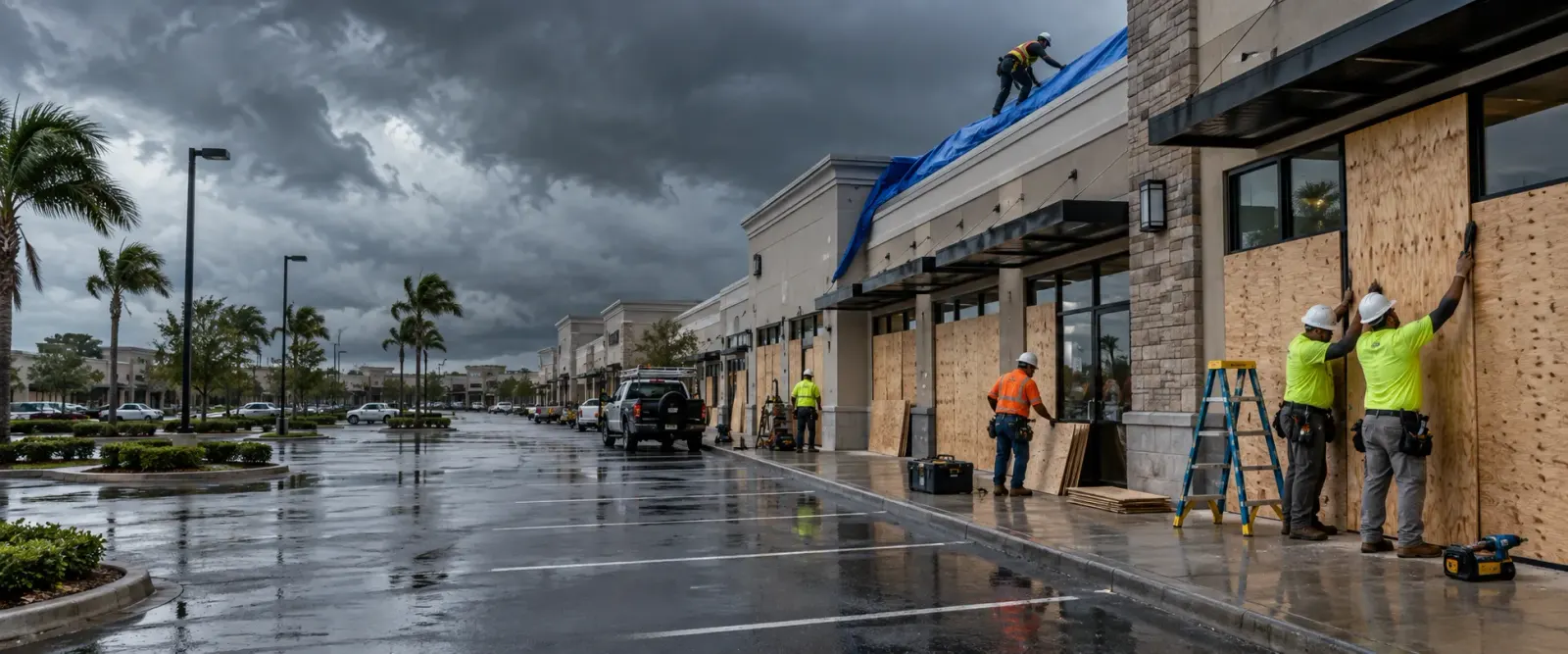
Broken windows, doors and wall openings take plywood. A house roof is tarped with fall protection above 6 feet under Title 8 section 1731, and a roof above 20 feet under section 1730, with low-slope tarps fastened or weighted.
Any water already inside, in ceilings, insulation or floors, is handed to Salida water damage restoration that day.
The adjuster receives the permanent repair scope with receipts, and the permit comes from the Stanislaus County Building Permits Division, 1010 10th Street, Suite 3400, Modesto.
Where storm damage happens in Salida
Salida's storm exposure runs from a tree-lined downtown median and 1990s tracts to schools, industrial yards, farmland planned for industry and river land.
Downtown Salida and Broadway Avenue
The County's downtown commercial core, with a tree-lined median west of Curtis Street and an alley behind the lots. A limb from the median can reach a storefront or parked cars, and broken shop glass is boarded that night.
Salida Boulevard
Home to the fire district's one staffed station, at 4820 Salida Boulevard, which it shares with the Sheriff's Office. Wind damage to shops and houses along the boulevard starts with the hazard zone, keeping people and traffic clear of any fallen limb.
Kiernan Avenue (SR 219) interchange
Highway 99 carries about 137,000 vehicles a day here, Kiernan Avenue 27,500 east of the freeway, and the 2015 rebuild plan included a storm drain pump station. It is the main way in, so a closure here moves the crew to Hammett Road.
Hammett Road interchange and the northwest Amendment Area
The Community Plan sets regional and highway commercial and two Business Park areas beside this interchange, with Hammett Road north of Ciccarelli Road planned at six lanes. The freeway here, at 134,000 vehicles a day, is the second way in.
Pirrone Road and the wastewater plant on the Stanislaus River
Ponds surround the sewer plant at 6200 Pirrone Road, with the river on one side and an MID canal on the other. Its 64 acres may keep operating and expand as a Special Treatment Area, and storm damage there is logged for the District as owner.
Stanislaus River Park lands
About 244 acres along the river planned for a regional park, inside habitat and flood easements held by the U.S. Army Corps of Engineers, and not expected within twenty years. A tree down near a home at its edge is photographed where it fell.
Stoddard Road and Sisk Road
Joseph Gregori High School at 5518 Stoddard Road and the Salida Union School District office at 4801 Sisk Road. Windows broken in a school or office are boarded the same night, and each opening is logged for the district's adjuster.
Toomes Road and Murphy Road
Flory Industries at 4737 Toomes Road, Vella Middle School at 5041 Toomes Road and BMC West Lumber Company at 4237 Murphy Road. Section 1730 of Title 8 sets fall protection for the tarp crew on any of these roofs over 20 feet.
North Gateway planned industrial lands
Most of the Amendment Area's 1,259 Planned Industrial acres, east of Sisk Road under the 2003 North Gateway plan. Much of the plan area is still in farm use, and on open ground farm buildings take wind at the eave and ridge.
Ciccarelli Road and Ladd Road fire stations
The Ciccarelli Road station, rated in excellent condition, stands unstaffed, and the Ladd Road station, rated poor, is used by a private business. In a building nobody occupies, a storm opening can go unseen, so photos date the damage.
Existing Plan Area and the Sanitary District
The Sanitary District serves about 1,485 acres, and the Community Plan found most of the community planned before 2007 already built out. Fences, gutters and fascia on 1990s houses are the usual wind repairs, logged house by house.
South of Kiernan Avenue, within Modesto's sphere of influence
Parts of the fire district inside Modesto's sphere of influence, including two areas annexed to the City while staying in the fire district. For a parcel here, the office that permits the permanent repair is checked first.
Storm damage sub-services available in Salida
Questions from Salida property owners and managers
Stanislaus County issues it, from the Building Permits Division office in Suite 3400 at 1010 10th Street, Modesto. The County lists Salida as unincorporated, and its permit page names rebuilding, alterations and remodeling among the work that needs a permit; some project types can be filed online through its Accela Citizen Access portal. The application goes in from the property owner, never a tenant or lessee. For the two areas south of Kiernan Avenue annexed to Modesto, the permit office is checked first.
It can change the permanent repair. For a Salida building inside a Special Flood Hazard Area, County officials check whether the repair is a substantial improvement, meaning it costs more than half the value of the original structure, and the Flood Development Permit normally travels with the building permit application. The tarp and plywood go on regardless, and the zone is checked before the permanent scope is written.
The area under and around the limb is closed off, because a broken limb may keep moving, and the crew checks whether it touches any line. The damage is photographed and filmed where it lies before anything is cut. Once the site is safe, a qualified tree worker directs the removal, the broken glass is boarded and any opening in the roof is tarped, each step logged for the owner and adjuster, and the limbs then cleared by storm debris removal.
The drains belong to County service areas that Stanislaus County Public Works runs, one of them, CSA 4, for storm drains alone, and a 2020 Board decision sought to widen it to about 4,400 parcels. A blocked or flooded street goes to Public Works. Damage to the building itself, a fallen limb, a lifted roof edge or a broken window, is the make-safe request, photographed and logged for the owner.
Neither starts before the hazard zone is set and any line is dealt with. After that, the opening letting in the most weather, or leaving the building open to entry, is closed first. A broken shopfront on Broadway is a security gap as well as a weather one, and a holed roof over a bedroom lets the next storm straight in.
Not for temporary repairs. The Department of Insurance guide says to make temporary repairs to prevent further damage, and notes that an adjuster may visit before any forms are completed. FEMA advises photos and video of the damage before anything is discarded, receipts for repairs, and a word with the adjuster or insurer before signing any cleaning, remediation or maintenance agreement.
Storm damage repair near Salida

