What stucco repair covers, and when a property manager needs it
Stucco, siding and painting is work on the outside layer of a wall: the plaster, the boards or panels, the coatings, the sealants and the flashing that keep water out of what sits behind them. The California Building Code treats an exterior wall as a drained assembly, with a water-resistive barrier behind the cladding and a way for water that gets past the cladding to drain back out. Timing matters because a crack that was cosmetic in September is a wet wall cavity by January.
A property manager needs it when cracks open at window corners on a stucco tract and the first storms stain the inside face, when soil, bark or new paving has been built up over the weep screed so the bottom of the wall never drains, when hardboard or wood siding on an older rental splits and the paint lets go, when a strip center's parapet and sign penetrations start leaking behind the storefront, when a tilt-up's panel joints and sealants have gone chalky and open, and when an association's buildings reach their repaint year together. All of it is scoped across the 32 cities served.
The work is performed by the assigned contractor, whose licence and insurance details reach the customer at assignment. Every job leaves the same record: the elevation-by-elevation scope, photographs before, during and after, the written estimate, and the product and color schedule.
Stucco repair sub-services available across the Central Valley
Why stucco repair is needed in Central Valley buildings
A wall is built to let water back out, and most failures block that route. Behind stucco or siding sits a water-resistive barrier, and the bottom of a stud wall carries a weep screed that drains whatever gets in. Soil, bark and new paving built up over that screed close the drain, and the base of the wall holds water against the lath and the framing.
On stucco tract and association buildings the water arrives from the irrigation as often as the sky. Overspray and planters wet the base of the wall through the dry half, and cracks at window corners draw rain into the cavity through the wet half. Who pays follows the declaration: Civil Code 4775 makes the association responsible for repairing, replacing and maintaining the common area unless its own documents say otherwise.
Anything built before 1978 changes how the paint comes off, not whether it can. On housing of that age the components are tested, or the job runs as a lead renovation under the EPA renovation, repair and painting rule: the pamphlet and unit notices go out beforehand, doors and windows within 20 feet are closed, the ground is covered 10 feet out, and burning and torching are prohibited.
A concrete or masonry wall keeps water out at its joints, not behind a barrier. Tilt-up warehouses and downtown brick have no drained cavity to fall back on, so the panel joints, the sealants between dissimilar materials, the wall caps and the coating are the defense. Products are chosen inside the limits the San Joaquin Valley air district sets for architectural coatings, are not thinned past them, and stay in closed containers between coats.
The envelope is repaired in one half of the year and tested in the other. The 1991 to 2020 normals at the Modesto airport put April to October at an inch of rain a month or less, with no nights near freezing from May to September, so plaster goes on and cures without cold-weather protection. November to March is when a failed crack or open flashing shows as a stain indoors.
How stucco repair is delivered
A site visit is arranged with the contractor assigned to the request. Site visit scheduled at a time that suits you. Start date set in the written estimate. The owner or board brings the year built, the reserve study page, any pest report and paint records.
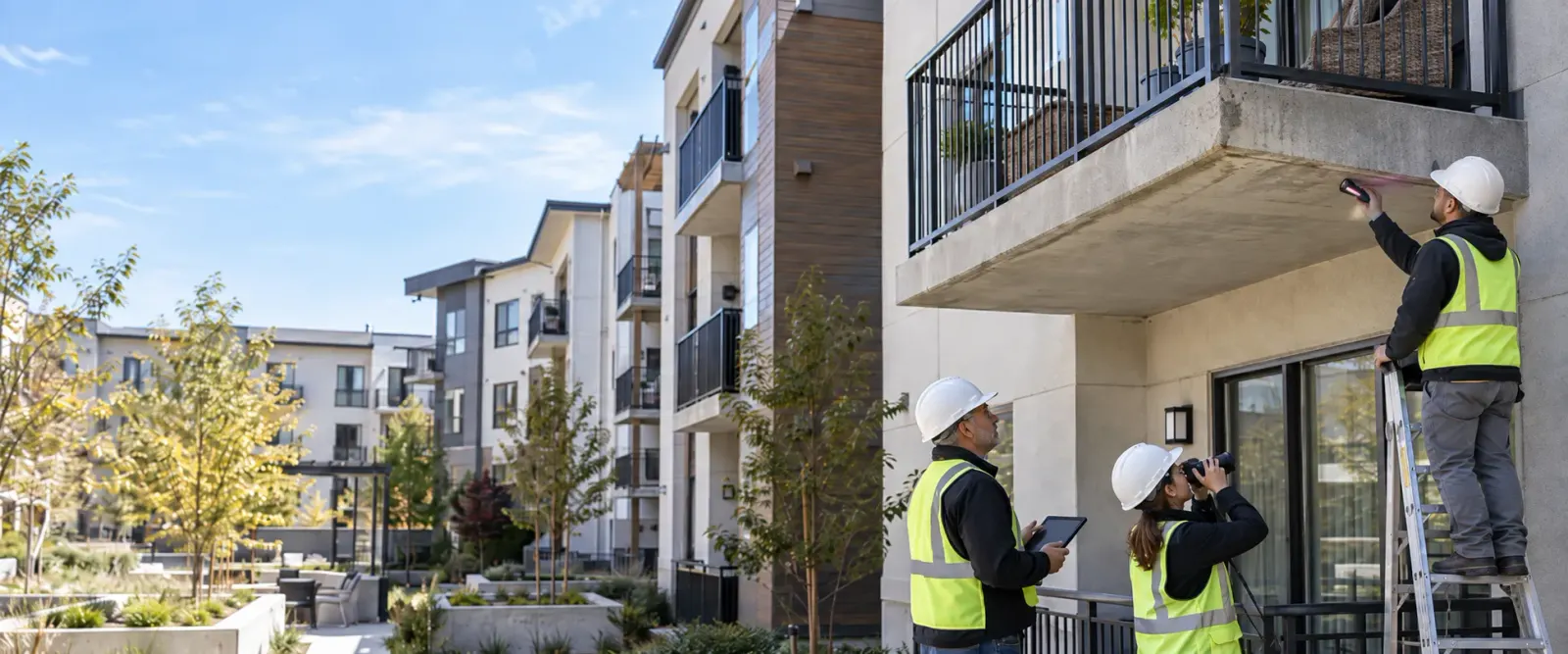
Cracks are mapped elevation by elevation, the weep screed is checked for clearance to soil and paving, and window, door and penetration flashing is opened where the stain says the water got in. On a building from before 1978 the paint is tested before anything is disturbed.
Re-stucco and siding replacement follow the building department's own rules, and the permit route is checked with it before the estimate is written. An association also approves under its governing documents.
Line items per elevation: crack and patch areas, recoat or repaint by surface, siding by length, flashing and sealant work, with opened-wall unknowns priced as allowances.
Notices go to the affected units, doors and windows within 20 feet are closed, and the ground is covered 10 feet out. Scaffold goes up under a qualified person, fall protection above 7 1/2 feet, and shade once it passes 80 degrees.
Stucco goes back as barrier lapped over the weep screed flange, corrosion-resistant lath and three coats, each cure run before the next; siding returns with its flashing; debris leaves for a permitted facility.
After a lead renovation the work area, the sills and the ground below are checked clean before containment comes down. The permit final is recorded where one was pulled, photographs are filed by elevation, and the product list and color schedule go to the owner or association.
What you receive on every elevation
Every elevation is recorded so an owner, a board or a manager can see what was opened, what was found behind it and what went back.
Stucco repair by city
Each city page covers the walls that fail in that city, the subdivisions they stand on, the building department that decides the permit and the sub-services most asked for. Modesto is the hub, with its own section for each area.
Stucco repair questions from Central Valley property owners
A coating can bridge minor cracks, and one of the coating categories is made for exactly that, applied thick in a single pass. It cannot tell you whether water has already passed the crack and reached the barrier and lath behind it. Where a stain, a soft patch or a rust line says it has, the section is opened and put back before anything is coated.
The weep screed is the metal edge at the bottom of a stud wall. The barrier laps over its flange, so water that gets behind the plaster runs down and out through it. It is set at least 4 inches above soil and 2 inches above paving, and soil, bark, raised planters and new paving take those clearances away. Once the screed is buried the base of the wall has no exit.
Three coats over lath, with a cure between each. The scratch coat is kept moist for 48 hours and the brown coat follows; the brown coat is cured the same way, and the finish coat goes on seven days after it. Plaster is placed above 40 degrees or kept above it for 48 hours afterwards. Paint is a separate schedule, and the product maker's instructions govern it.
The surface preparation changes. Paint on a building of that age is tested first, or the job is run as a lead renovation: the pamphlet and written notices go to the units beforehand, doors and windows within 20 feet are shut, the ground is covered 10 feet out. Disturbing more than 20 square feet outside without containment is itself treated as a hazard.
The declaration decides, and the Civil Code fills the gap. Unless the governing documents say otherwise, the association repairs, replaces and maintains the common area; an owner maintains exclusive use common area while the association repairs and replaces it. Boards usually scope this work against the reserve study, which looks at the major components on a three-year cycle and flags those with less than 30 years of useful life left.
Anything outside the wood is this service: the barrier, the lath and plaster, siding boards and panels, trim paint, coatings, sealants and wall flashing. Wood that has decayed or been damaged by pests is dry rot repair. When a wall is opened and the sheathing, studs or sills are wet or soft, that wood is scoped there and the wall is closed again here.
Yes, with notice and containment. Work is phased by building and elevation so that a unit's doors and windows are shut only while the crew is within 20 feet of them, and the ground below is covered while that section is prepared. Access to entrances, stairs and parking is agreed with the manager before the first day.
Related work around the building envelope
Guides for boards and owners
Service area from the Modesto base
Typical time from the Modesto base to a property in each city, by road, when a site visit is booked. Fog in December and January and harvest truck traffic on Highway 99 and Highway 132 can add 15 to 30 minutes.
Windows are planning figures from the fulfilling contractor's dispatch records and are confirmed with a time when the request is acknowledged. [CLIENT to confirm]

