Why storm damage happens in Gustine
Gustine has a recorded 80 mph wind. Merced County's hazard plan logs a thunderstorm wind of that speed at Los Banos and Gustine on 1 April 1996, and funnel clouds at Gustine on 8 April 2005 and at Gustine and El Nido on 18 January 2006. The plan rates heavy rain for the city as a High-significance hazard. The National Weather Service puts out its wind advisories and warnings on local criteria, and a gust of that force can lift roofing and break glass on many buildings in one afternoon.
Downtown Gustine's older buildings and wood shake roofs are the ones a storm reaches first. Gustine's General Plan singles out aging downtown buildings and the town's many wood shake roofs as fire hazards, and the City is working on the district's shop facades and architecture without losing its first character. A shake roof that loses a section in wind is tarped at once, since the opening lets rain straight into the space below, and the permanent repair is scoped to keep the building's character.
When a storm cuts the power, Gustine's pumped drainage can stop with it. Runoff goes by pipe and ditch to CCID and on toward Los Banos Creek, and the drainage plan amended in 2008 states plainly that the pumps have failed and lost power before. Clay ground and shallow groundwater slow whatever is left. Rain let in through a broken roof or window stays inside, so the opening is closed first and drying follows.
Gustine's tenants outnumber its owner-occupiers, so a storm reaches landlords and renters together. Renters live in 51.3% of occupied homes, and 1,111 of those 2,169 homes have passed 40 years. There are 199 units in buildings of three or four and 89 mobile homes. In a fourplex, each unit a limb or gust reached is boarded, tarped and recorded on its own line, so the owner and each tenant can show the adjuster what happened in their space.
Food and dairy processing still anchors Gustine, and a storm that opens a plant roof stops a working floor. The Housing Element names Saputo's dairy manufacturing and Hillview Packing's fruit packing as top employers and Pusateri Nut as a major one, with the industrial uses set along the eastern border, apart from the houses. On a large plant roof, a lifted edge or torn flashing lets rain spread across a working floor. The CDI claims guide names plywood and plastic sheeting as reasonable temporary repairs.
The City's Storm Drain Master Plan takes the Newman gauge, 10.3 inches a year, as its baseline, and the county plan puts most of Gustine's rain between late October and early April. A roof opened in the first autumn storm faces five more months of rain.
Storm damage repair, as delivered in Gustine
Gustine is 30 road miles from the Modesto base, at the crossing of State Routes 33 and 140 near Interstate 5. Every visit adds timed entries to a single make-safe record the adjuster can read line by line.
Gustine lies 30 road miles from the Modesto base where Routes 33 and 140 meet, and the crew arrives within 120 to 140 minutes at any hour. Fog is one of the town's High-significance hazards in the county plan, so on fog nights or at harvest, arrival runs toward 140. Propertyvendr gives the time.
Everyone is kept away from hanging limbs and any line touching a tree, fence or roof. A limb under tension can move when cut, so the utility is called first where a line is involved, above all when the storm has cut the power.
Photos and video of the building, its roof and damaged belongings are taken inside and out before anything is moved, and each call about the claim is logged.
A tree comes off a Gustine roof under a qualified tree worker (Title 8 section 3421), clear of live lines.
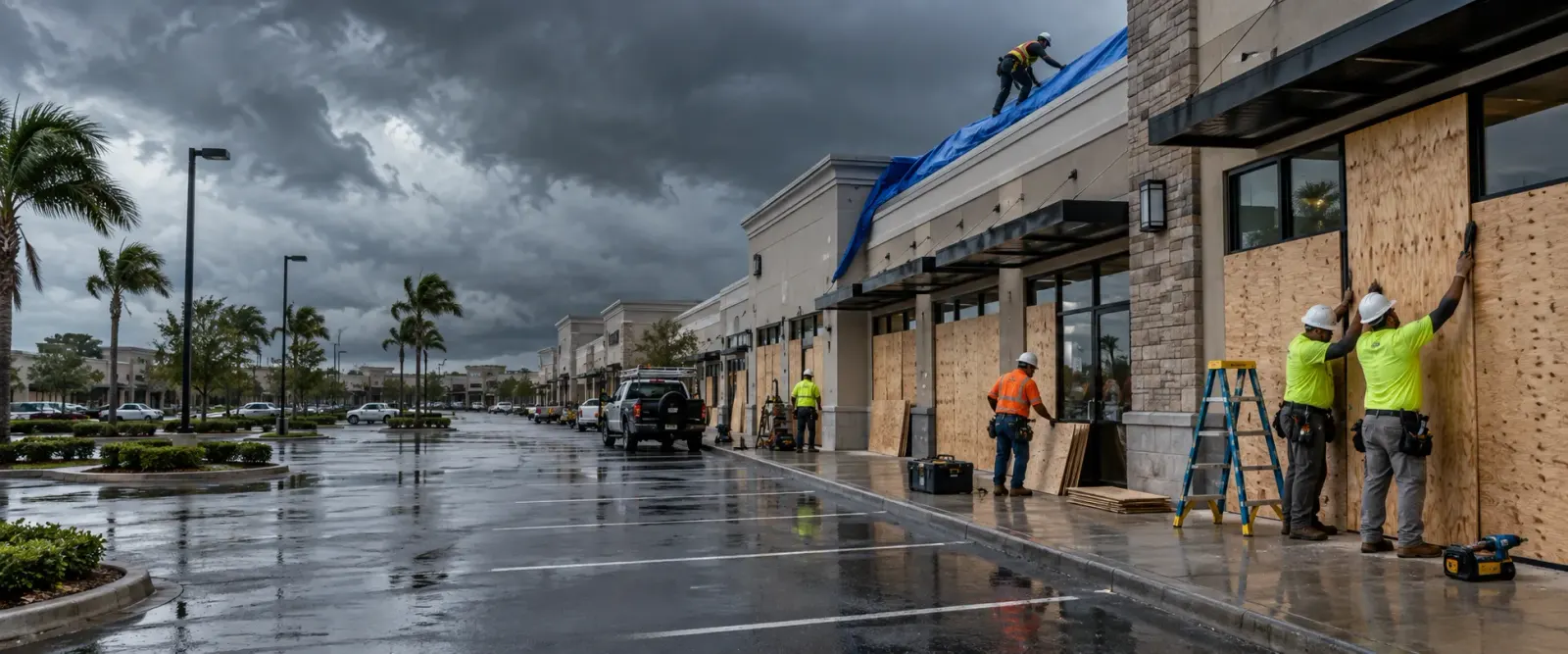
Shake and composition roofs are tarped and fastened against the next gust, with fall protection over 6 feet on houses (Title 8 section 1731) and over 20 feet on plant roofs (section 1730). Broken windows and doors are covered with plywood.
Wet ceilings, insulation or floors pass to water damage restoration in Gustine that day.
The permanent repair is scoped for the adjuster and permitted by the Gustine Building Division, 352 Fifth Street; demolition needs a CalGreen waste plan, and receipts are kept.
Where storm damage happens in Gustine
Storm exposure in Gustine differs by quarter: an older downtown with shake roofs, rented blocks, newer north-west houses and plants to the east.
Downtown Gustine
The older commercial core in Northeast Gustine, where the General Plan flags building condition and shake shingle roofs. A shake roof or storefront damaged by wind is covered the same night to keep rain and intruders out.
Northeast Gustine and the 5th and 6th Avenue sites
Mostly commercial and industrial zoning, with the city's largest higher-density housing areas and vacant sites on 5th and 6th avenues set for rezoning. Where shops and homes mix, one fallen limb can reach both.
Northwest Gustine
Mostly single-family houses, with the newest and largest at the north and west tip, and the CCID canal along the western edge. On newer lots, fences, gutters and fascia go first in strong wind.
Southeast Gustine and Gustine Garden Apartments
Single-family and public-institution zoning and Gustine Garden Apartments, 33 units financed through Section 515 loans. In an apartment building, residents are kept clear of the hazard zone and every unit touched is logged.
Southwest Gustine and the Highway 33 frontage
Mostly single-family and public-institution zoning, with a 2.20-acre site on Highway 33 set for rezoning to 44 units. Buildings on the highway frontage are boarded the night a storm breaks their glass.
North Avenue and the community ditch
The area north of North Avenue, where the General Plan found no adequate municipal drainage and a community ditch carries irrigation water in summer and runoff in winter. Rain let in by a wind-opened roof here has nowhere quick to go.
Borrelli Ranch and the High School Ditch
The Borrelli Ranch subdivision on the north side, draining through the High School Ditch system. Houses on subdivision lots lose fences and gutters first, and a landscape tree in wet clay soil can uproot.
Highway 33/140 corridor
Route 140 carries 5,000 to 7,200 vehicles a day between Linden and Fourth avenues, with a roundabout and median projects listed as in design. Signs and storefronts along it are the exposed parts in a wind event.
Second Street cheese plant blocks
The General Plan placed the Land O Lakes (Beatrice) cheese plant south of SR 33 between Second and Third Streets, with homes south and east of it. The plant roof and the houses beside it take the same gust.
Meredith Avenue, Railroad Avenue and Carnation Road
A 42-inch storm drain along Meredith Avenue, a CCID pipeline beside it and a farm site at Meredith and Railroad set for 139 units. Existing buildings beside open farm ground meet wind with little in front of them.
Southeast Gustine Annexation (Sullivan and Hunt Roads)
About 219.2 acres at Sullivan and Hunt Roads proposed for annexation, near the CCID Main Canal, with vesting tentative maps approved for three developments. A storm-damaged building there is made safe and recorded like any in town.
Gustine Municipal Airport and the wastewater plant, Highway 140 east
The City airport 1.5 miles east of town, with 14 City-owned and 4 private hangars on about 45 acres. Hangar doors and roofs are what wind works loose, and an open hangar is closed first.
Storm damage sub-services available in Gustine
Questions from Gustine property owners and managers
The roof is tarped and any broken window boarded first, so rain stops coming in from above. The 2008 Revised Storm Drain Master Plan says pumped discharge cannot be counted on because of past pump failures and power disruptions, and the General Plan describes flat ground and clay soils, so standing water outside can take time to leave. Water already inside is photographed and passed to water damage restoration.
The City of Gustine Building Division, 352 Fifth Street, handles permits, plan check and inspection inside city limits. The Housing Element gives two to six weeks for a building permit after planning approval, and 1 to 24 working days for a first plan review by contract staff. The City uses the 2022 California Building Code without local amendments, and demolition needs a CalGreen waste management plan. The tarp and plywood hold the building meanwhile.
People are kept clear of any loose shakes or hanging debris, the roof and the rooms below are photographed, and the open section is tarped and fastened so the next gust cannot lift it, and the loose shakes it brought down are taken away in the debris haul. The General Plan lists the older downtown buildings and shake shingle roofs among its concerns, and the City is keeping downtown's original character, so the permanent repair is scoped separately for the adjuster and the Building Division.
With the staff. Everyone is moved clear of the damaged section and the floor under it, and the utility is called if a line is down. The opening is photographed inside and out, then tarped and fastened with Title 8 fall protection on roofs over 20 feet. Rain on the floor goes to water damage restoration, and the permanent roof repair is scoped as commercial roofing.
Carefully, and by entry path. FEMA advises photos and video of all damage inside and out, before anything is thrown away, and receipts for anything bought to protect or repair the building. Recording where rain came through the roof or a broken window, room by room, shows the adjuster how each part of the damage happened. The Department of Insurance guide also asks for a log of every call and letter.
The California Department of Insurance guide asks policyholders to make temporary repairs to prevent further damage, naming plastic sheeting and plywood, and warns that a policy may not cover ensuing damage when reasonable steps were not taken. What a policy pays is for the insurer and the owner to settle. The make-safe log shows each temporary step, with the time it was taken and the photos before and after.
Storm damage repair near Gustine

