Why storm damage happens in Stockton
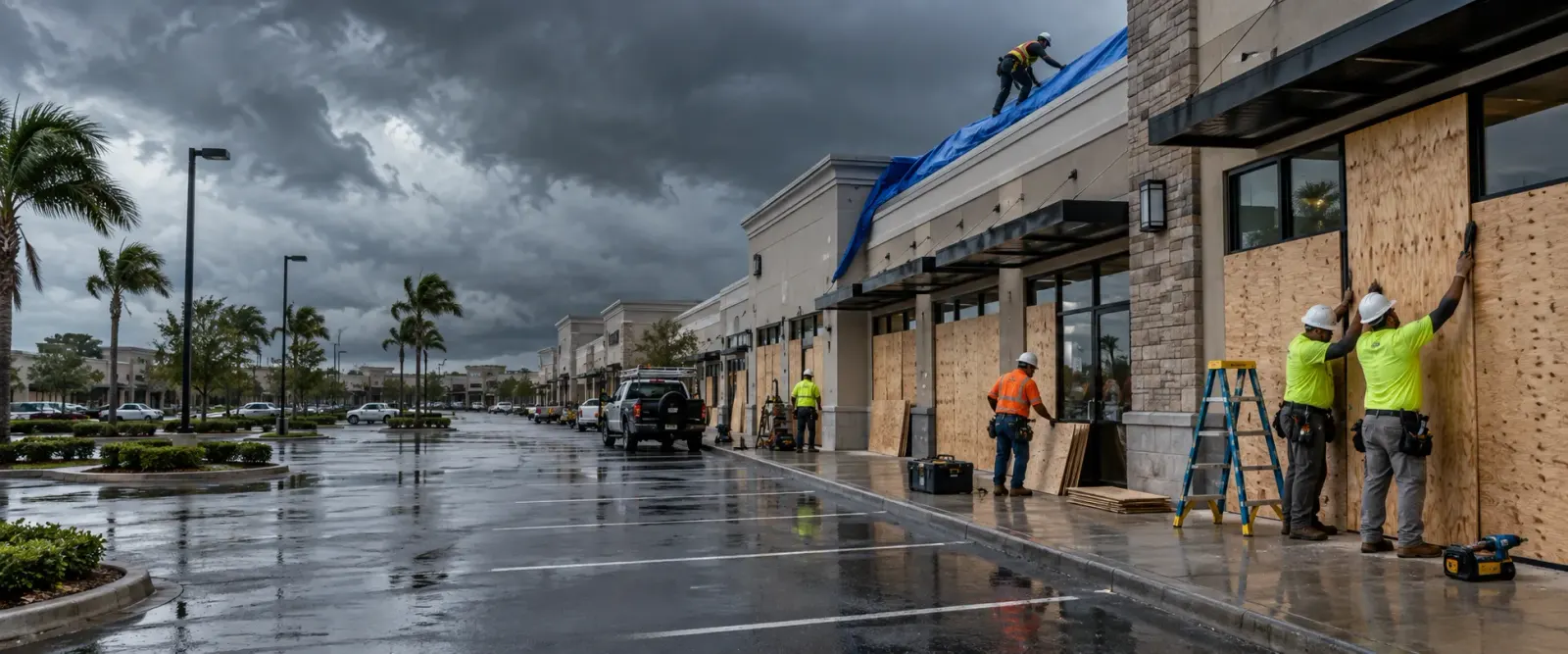
Wind that gets under a loose edge on a flat or low-slope retail roof peels the membrane back, and Stockton has a great deal of retail roof. Weberstown Mall opened in 1966 with 800,000 square feet, Sherwood Mall followed in 1979 with 511,242, and strip malls and big-box centers run along Hammer Lane. A rooftop unit or sign that shifts in a gust tears the roof it is fixed to, and rain then goes straight into the tenant ceilings below. On a roof that flat, a tarp is fastened or weighted against the next gust, because a draped sheet lifts.
The storms that closed 2022 brought emergency declarations for Stockton at every level of government. On 31 December the City and County declared local emergencies. The California Nevada River Forecast Center counted ten atmospheric rivers and a bomb cyclone between late December and mid-January, with trees and power lines brought down across the region. FEMA approved major disaster declaration 4683 on 14 January 2023, for an incident period starting 27 December 2022, and Cal OES lists San Joaquin County in both the emergency and the major disaster declarations.
At the Port and around Arch Road, a single door forced off its track leaves a whole warehouse open. Covered warehouse space at the Port passes 7.7 million square feet, with forty-seven buildings of 120,000 square feet each in the West Complex alone, and the Industrial Annex groups large buildings near Arch Airport Road and Stockton Metropolitan Airport. Stock behind a broken roll-up door is exposed to rain and to anyone passing, so the opening is closed the same night. Where the roof is more than 20 feet up, tarping follows Cal/OSHA Title 8 section 1730 fall protection.
Stockton's apartment stock is old and closely built, so one storm leaves many openings and many residents near the hazard. Of the city's complexes with five or more units, 23.3% went up before 1960 and 38.3% between 1960 and 1979, and much of the 1970s boom was duplex and condominium complexes in Lincoln West, west of I-5. A limb strike or a burst of wind can break windows across several buildings at once. Residents are kept out of the hazard zone, and the board gets a record of every unit that was boarded or tarped.
Stockton's storm season is short, and its gutters and street trees meet it first. The 1991-2020 NOAA normals for Stockton Metro Airport place about 10.9 of the year's 13.45 inches between November and March and almost none from June to September. Before winter the City asks residents to clear leaves and debris from storm drains and gutters; a gutter left full spills over the fascia and down the wall. Trees that fall in the right-of-way are reported to the City's Municipal Service Center.
December 2022 was Stockton's wettest December on record, 8.50 inches against the 8.05 set in December 1955, and 2.38 inches fell on 31 December alone. A roof opened that week still had storms ahead of it into mid-January, so temporary cover went first.
Storm damage repair, as delivered in Stockton
From the Modesto base, Highway 99 runs 33 road miles north to Stockton. On every visit the make-safe log records when the hazard zone was set, which openings were boarded and where each tarp was fastened, with photos of each.
From Highway 99 the crew reaches Downtown and the Port by Highway 4, which borders Downtown and carries 122,000 vehicles a day at Wilson Way. Street flooding like the 31 December 2022 closures on Robinhood Drive and the Hammer Lane underpass moves arrival toward the 120-minute end, and so do winter tule fog and harvest trucks.
Nobody stands under a hanging limb or near a line that touches the tree or the building, since limbs can keep moving and a trunk under tension can react when cut. Within 10 feet of a high-voltage line, the utility clears it before any cutting.
Inside and out, the damage is photographed and filmed before anything is moved or thrown out, as FEMA advises, and every call and message goes into a log.
Right-of-way trees go to the City's Municipal Service Center; a tree on the roof comes off under a qualified tree worker.
Tarps on mall and warehouse roofs are fastened or weighted, with Title 8 fall protection; broken storefront glass and forced doors get plywood the same night. The CDI claims guide asks policyholders to make temporary repairs that prevent further damage, and this is that step.
Wet ceilings, insulation or floors pass to water damage restoration in Stockton.
Receipts are kept and the permanent repair is scoped for the adjuster; the Permit Center at 345 N. El Dorado Street permits it, or the County for Lincoln Village parcels.
Where storm damage happens in Stockton
Storm damage in Stockton follows the roof and the tree: mall and warehouse spans, dense apartment blocks, mid-century streets and newer cul-de-sacs by the sloughs.
Downtown
Grand historic buildings on Weber Avenue, warehouses on Fremont Street and the old Miner Avenue auto row, with Stockton Arena facing McLeod Lake. A broken ground-floor pane leaves a building open overnight, so board-up here is also security.
Midtown and the Miracle Mile
One-story bungalows and two-story houses near University of the Pacific, and more than 150 businesses on Pacific Avenue between Alpine and Harding Way. A broken shopfront pane leaves a business open overnight, and a lifted house roof lets rain into the ceilings.
Country Club and Smith Canal
Mid-century single-story and ranch-style homes around a large public parcel off I-5, with the Stockton Golf and Country Club at the edge. On houses of that era, fences, gutters and fascia give way first.
Brookside
Begun around a golf course in the late 1980s, Brookside adds gated satellite developments, cul-de-sacs ringed by private lakes and shopping centers by the freeway at Benjamin Holt, March Lane and Country Club Boulevard. HOA boards get one record per unit touched.
Pacific Avenue, Lincoln Village, Weberstown and Sherwood
The 1966 Weberstown Mall and the 1979 Sherwood Mall put more than 1.3 million square feet of retail beside Lincoln Village's small mid-century houses. Lincoln Village is an unincorporated island, so its rebuild permits come from the County.
Upper Hammer Lane and Thornton Road
Hammer Lane is lined with strip malls and big-box centers; behind them, toward White Slough, sit vintage and mid-century homes, and Thornton Road has county pockets with no sidewalks. Signs and rooftop units on the centers move in a gust and tear the roof.
Morada and Holman
Very low-density housing, older east of Highway 99 and newer master-planned tracts to the west, with an auto mall west of Holman Road and a big-box center to the east. Signage and wide commercial roofs take the wind here.
Spanos Park, Trinity and Eight Mile/Bear Creek
The A.G. Spanos Business Park takes about 200 acres at I-5 and Eight Mile Road, and large recent houses fill the cul-de-sacs off Thornton Road, Davis Road and Whistle Way along Bear Creek. Landscape trees in newer tracts drop onto fences and gutters.
Weston Ranch and Van Buskirk
French Camp and Walker sloughs divide these two newer communities, set between Highway 4, I-5 and the San Joaquin River. Weston Ranch has one main access road, Carolyn Weston Boulevard, so a tree across it holds up every visit.
South Stockton and Boggs Tract
Around Airport Way, Charter Way and the County Fairgrounds the grid mixes eras and most units are past 50 years old; Boggs Tract, mostly unincorporated, sits among port industry and rail. Old roofs here are tarped before the next rain.
East Stockton and Mormon Slough
Along Wilson Way, once Highway 50, small single-story mid-century houses stand next to auto-oriented commercial and industrial lots, most of it outside city limits. Shop doors and yard fencing are what wind usually opens here.
Port, Airport Way and Arch Road industrial areas
Two thousand acres of Port real estate with more than 7.7 million square feet of covered warehouses, and a 1,015,791-square-foot cross-dock center that was being developed off Arch Road in 2023. Roll-up doors and long roof spans are the weak points.
Storm damage sub-services available in Stockton
Questions from Stockton property owners and managers
The City asks residents to report fallen trees in the right-of-way to its Municipal Service Center, so that call goes in first. On the building side, the crew sets a hazard zone, keeps everyone away from any line the tree touches and photographs the damage before the tree is moved. Once a qualified tree worker has the tree off the roof, the opening is tarped. The photos and the call log go to your adjuster with the rest of the file.
Lincoln Village, most of East Stockton, most of Boggs Tract and French Camp are unincorporated islands, and county properties are permitted by the San Joaquin County Building Division at 1810 E. Hazelton Avenue. Inside city limits, plan review, permits and inspections run through the Permit Center at 345 N. El Dorado Street. Board-up and tarping are temporary make-safe work; the permit question arises when the permanent repair is scoped, and the parcel decides which office handles it.
The area around the door is closed off so nobody works under a hanging panel. The damage and the exposed stock are photographed and filmed before anything is moved. Then the opening is closed with plywood, and any damage to the roof above is tarped. If rain has already wetted stock or insulation, water damage restoration takes that part, and the door repair is scoped for the adjuster.
Yes. The Governor proclaimed a statewide state of emergency on 4 January 2023, and FEMA approved major disaster declaration 4683 on 14 January 2023, covering severe winter storms, flooding, landslides and mudslides from 27 December 2022. Cal OES lists San Joaquin County in both the emergency and the major disaster declarations. Stockton's City and County had already declared local emergencies on 31 December 2022. Which assistance applies to a property is set by those programs, not by the repair.
What a policy pays is between you and your insurer. In its residential claims guide the California Department of Insurance says to make temporary repairs to prevent further damage, with plastic sheeting or plywood; left undone, it warns, a policy may not cover ensuing damage. That is why board-up and tarping come first, and why each board, tarp and receipt is photographed and logged for the adjuster.
No. Storm damage repair makes the building safe and closed: the hazard zone, the tree off the roof, the tarps and boards and the record for the claim. Hauling the storm debris away afterwards is its own service, storm and fire debris removal. Drying a wet building is water damage restoration, and permanent roof work belongs to commercial roofing, each arranged as a separate stage of the same file.
Storm damage repair near Stockton

